
Protect your family with pure water for drinking, bathing, and appliances.


The filter that improves drinking water isn’t automatically the system that protects your pipes. A water softener for protecting plumbing in Brisbane addresses hardness minerals such as calcium and magnesium, which can contribute to scale in pipes and appliances. Filters target other water concerns, so the right setup depends on what you want to treat.
If you’re dealing with residue on taps, scale around appliances or simply trying to make sense of Brisbane’s water, it helps to know what each system actually does. A softener and a filter aren’t interchangeable, and some households may need one, the other or a combination.
This guide explains hard water, its potential effects on household plumbing and how softeners differ from drinking-water filters. It also covers what to consider when choosing a setup, including when whole-house treatment makes sense and when point-of-use filtration may better suit your needs.
Key Takeaways
- Learn how hardness minerals can contribute to scale in plumbing and appliances, and what signs may prompt you to investigate your household water.
- Understand how whole-home softening works and why it addresses a different concern from drinking-water filtration.
- Match a system to your priorities, such as reducing scale throughout the home or filtering water at the tap.
- See why there isn’t a single hardness threshold in this guide that applies to every plumbing system and appliance.
- Explore how Great Water Filters’ whole-house softener and filtration options may suit different household water needs.
What is Hard Water, and Why Does Brisbane Have It?
Hard water contains dissolved minerals, especially calcium and magnesium, which can leave scale inside pipes and appliances. Brisbane households may experience different levels of hardness depending on their water source and local conditions.
For a practical look at how a softener connects to household plumbing, watch this installation video:
Scale build-up in pipes and appliances
When hard water is heated or evaporates, calcium and magnesium can form deposits on surfaces. You might notice a chalky ring around a tap, marks on a shower screen or scale around a kettle’s heating element. These signs suggest mineral residue, but they don’t show how much scale is inside concealed pipes.
Scale can build up in pipework and appliances that heat water, narrowing passages or coating working surfaces over time. There’s no single hardness level that establishes a risk of damage for every Brisbane home. Not every household needs a softener to protect its plumbing. Assess water hardness and look for recurring scale on fixtures and appliances to decide whether treatment is worth considering.
Plumbing and appliance protection
A softener can reduce hardness by passing water through resin media that captures calcium and magnesium. In a salt-based ion-exchange system, the process replaces those minerals with sodium ions. With fewer hardness minerals in treated water, less new mineral scale can form on taps, pipe surfaces and appliance components.
Softened water may help limit mineral deposits on showerheads, hot-water equipment and washing machines. It doesn’t remove existing scale from pipes, repair damaged plumbing or filter every substance in water. A water softener for protecting plumbing in Brisbane is relevant when hardness is the concern; filtration serves different purposes.
Softening also changes water’s mineral composition. Salt-based systems regenerate resin with concentrated brine, then rinse it to remove remaining brine and impurities. This creates a salty wastewater stream, so discharge and household septic arrangements matter when considering a system. For drinking water, consider whether the change from calcium and magnesium to sodium suits your preferences and needs. Softening isn’t automatically the right choice for every tap or use.
Whole-home softening and drinking-water filtration
A whole-home system treats water where it enters the house, before it reaches taps, showers and appliances. The key question is whether you need to reduce hardness, filter particular substances or address both concerns with separate treatment stages.
Softening and filtration work differently. A softener uses resin media to capture calcium and magnesium, the minerals linked with hardness. In a salt-based ion-exchange system, those minerals are exchanged for sodium ions. The treated water then travels through the home’s plumbing rather than being treated only at one kitchen tap.
Resin eventually needs regeneration. A softener flushes the resin tank with concentrated saltwater brine, then rinses away remaining brine and impurities. Depending on the system, regeneration uses salt or potassium. This is part of the operating cycle, not the same as replacing a filter cartridge. A dual-tank softener can continue supplying treated water while one tank regenerates.
Activated carbon filtration targets different water-quality concerns. Carbon media can absorb and trap chlorine, volatile organic compounds (VOCs) and sediment. This may improve water taste and odour, which can matter at a kitchen drinking-water tap. Carbon filters may be less effective against some minerals, salts and heavy metals, so they shouldn’t be treated as a substitute for softening when hardness is the issue.
A point-of-entry filter treats incoming water for multiple household outlets. This can suit a household seeking filtration across showers, laundry and kitchen taps. A point-of-use filter treats water at a selected outlet, such as the kitchen sink. It can focus treatment on drinking and cooking water without treating every outlet in the home.
For example, a household concerned about mineral scale throughout its plumbing might consider whole-home softening. If the main concern is chlorine taste at the kitchen tap, activated carbon filtration may be more relevant. Where both needs matter, separate treatment stages can target each one. Choose based on the water concern, the outlets that need treatment and the system’s maintenance requirements.
Include ongoing maintenance in your decision. Filter media and cartridges need maintenance to keep a system working as intended, while a softener also needs regeneration. Compare what each system treats, where it treats water and how its media is maintained. This helps you choose based on household water quality rather than assuming one device solves every concern.
Choosing a system based on household needs
Start by identifying the problem you want the system to solve. Chalky deposits around taps point towards hardness, while an unwanted chlorine taste may call for filtration. If you’re concerned about both scale and drinking-water taste, you may need separate treatment stages rather than one all-purpose device.
Next, identify where treatment is needed. If scale affects several bathrooms, the laundry and a hot-water appliance, consider whether whole-house treatment suits your household. A point-of-use filter can be more targeted when the main concern is water for drinking or cooking at one kitchen tap. The location of the problem helps determine the system type.
Water hardness is only one part of the decision. Think about which outlets need treated water, how many appliances rely on the supply, and what maintenance the household can manage. Filter replacement is a practical consideration for whole-home filtration, with routine maintenance such as replacements typically required every 6 to 12 months. The precise schedule depends on the system and its use.
A reverse osmosis system uses a semi-permeable membrane to remove a range of contaminants, including bacteria, viruses, minerals and chemicals. This can suit a household seeking treatment at a drinking-water outlet. However, reverse osmosis can filter water slowly and waste some water during filtration. Consider how much drinking and cooking water your household uses and whether a slower flow fits your routine.
Whole-house filtration serves a different purpose: treating water where it enters the home, so it can supply multiple outlets. It may suit a household seeking filtration across bathrooms, laundry and kitchen taps. However, it isn’t automatically a water softener. Check whether the chosen treatment addresses hardness, because a filter designed for taste or sediment may not reduce calcium and magnesium.
Existing plumbing and appliance issues matter, too. If a kettle has scale but the showerheads and taps remain clear, a drinking-water treatment point may address the priority. If deposits appear across several fixtures, whole-house treatment may be more relevant. Neither setup repairs an already damaged pipe or appliance, so treat recurring leaks, reduced flow or appliance faults as separate repair concerns.
Use this simple sequence to narrow the options:
- List the affected outlets and appliances, such as the kitchen tap, showerheads or hot-water system.
- Identify whether the priority is hardness, taste, sediment or a combination.
- Compare the treatment location, maintenance needs and water use of each system.
This comparison keeps the decision tied to your household’s actual needs. A system chosen for one drinking-water tap may not address scale throughout the plumbing, while whole-house treatment may be unnecessary for a concern limited to one outlet.
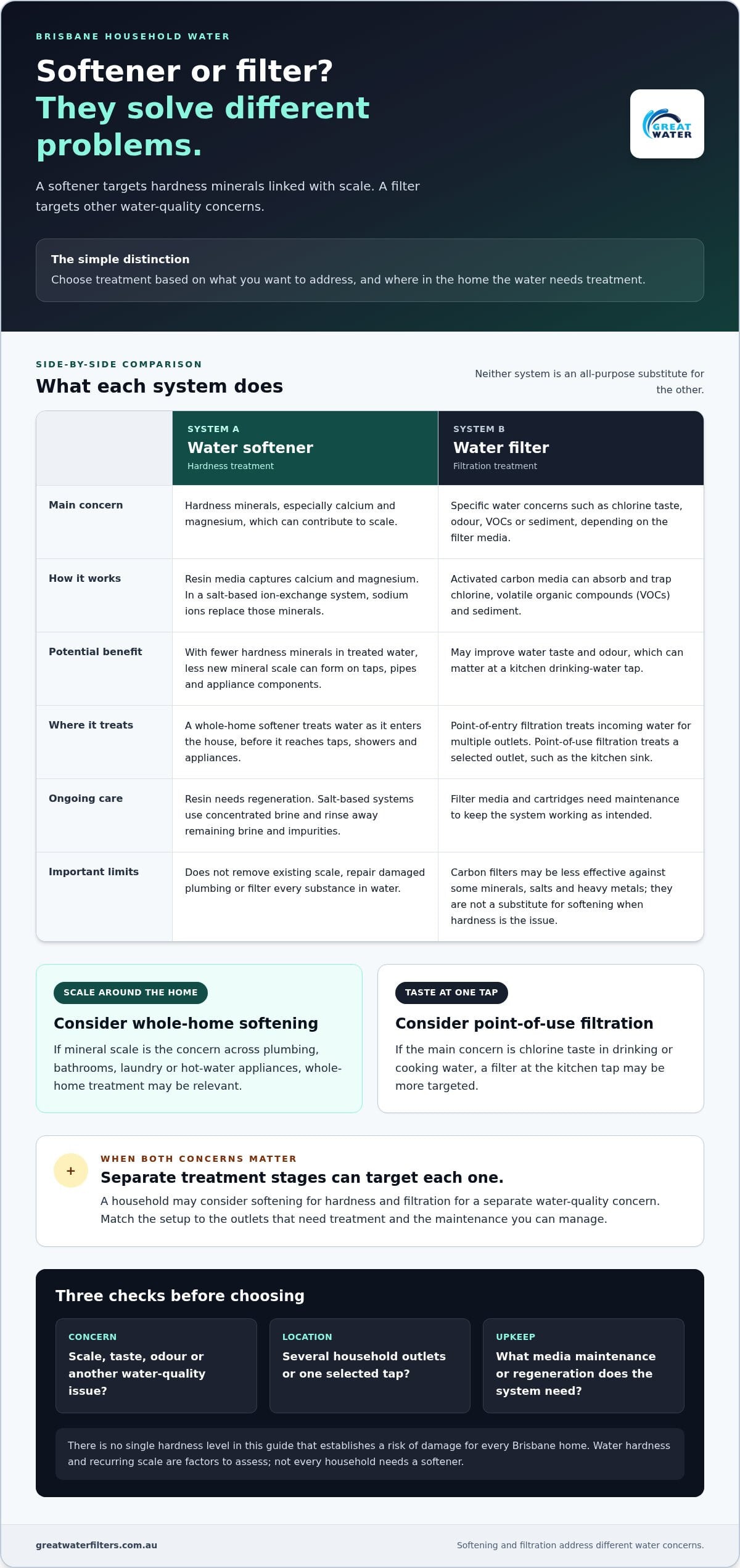
Water softeners compared with filters
For Brisbane plumbing, a softener reduces hardness minerals, while a descaler changes how minerals behave and a point-of-use filter treats water at one outlet. If scale protection is the priority, compare how each option addresses minerals and which parts of the home it treats.
A salt-based softener uses ion exchange to capture calcium and magnesium, replacing them with sodium ions. Because treatment occurs across the incoming supply, softened water can reach multiple taps and appliances. This suits households focused on hardness throughout their plumbing. It also changes water’s mineral composition and requires resin regeneration using salt or potassium.
Magnetic and electronic descalers use electromagnetic pulses to affect how minerals behave in water. Salt-free conditioners use template-assisted crystallisation for a similar scale-management aim. These approaches don’t remove hardness minerals. They differ from ion-exchange softeners, which capture calcium and magnesium. The key comparison is mineral removal versus managing scale formation.
Point-of-use filters treat water at a selected tap, often for drinking and cooking. An activated carbon filter can trap chlorine, volatile organic compounds and sediment, and may improve taste and odour. It won’t necessarily reduce hardness throughout the plumbing. For example, a kitchen filter doesn’t treat shower water or the supply feeding a washing machine.
Match the system to the concern. If scale appears on several fixtures and appliances, consider treatment where water enters the home. If the issue is limited to drinking-water taste at the kitchen tap, a point-of-use filter may be more relevant. If you want to alter scale behaviour without removing minerals, compare a conditioner or descaler with a softener’s ion-exchange process.
Before choosing, note where deposits appear and which outcome matters most. A kettle with mineral residue points to a different treatment area than scale across showerheads and taps. Also consider ongoing operation: softeners need regeneration, while filters need media or cartridge replacement. These different maintenance tasks belong in your household decision.
- Choose a softener when reducing calcium and magnesium throughout the home is the priority.
- Consider a descaler or conditioner when the goal is managing scale behaviour without removing minerals.
- Choose a point-of-use filter when the concern centres on water from a specific tap, such as taste or sediment.
Don’t assume a drinking-water filter or descaler will soften all household water. Match the treatment method and coverage to the scale concern.
What water hardness level can damage plumbing, hot-water systems and appliances?
There isn’t one hardness reading that predicts damage for every Brisbane home. Scale formation depends on more than mineral content: heating, water use, pipe condition and appliance design also matter. A hot-water system can show deposits differently from a cold-water tap, even within the same household.
Calcium and magnesium can form scale as water is heated or evaporates. In a kettle, deposits may be visible around the heating element; inside pipework, buildup can remain hidden. A visible mark shows mineral residue, but it doesn’t measure hardness or prove that plumbing needs treatment.
Look for patterns rather than relying on one fixture. Recurring deposits on showerheads, tap aerators and the kettle suggest minerals are affecting several parts of the home. If only one appliance shows residue, its location, age or use may also help explain the issue. These observations can guide your next step, but they don’t establish a universal damage threshold.
Hardness tests can help clarify whether calcium and magnesium are present at levels that warrant attention. Test water from the household supply, then compare the result with scale around hot-water outlets and appliances. Periodic testing can also show whether a softener continues to reduce hardness after installation.
Consider the system’s operating conditions, too. Frequent heating can make the effects of mineral deposits more apparent on hot-water components and kettle elements. A household with recurring scale across multiple outlets shows a different pattern from one with an isolated mark. Neither pattern alone measures internal damage or identifies the cause of a plumbing fault.
- Check several locations: inspect tap aerators, showerheads, kettle elements and hot-water outlets for recurring deposits.
- Test the water: use a hardness test to assess minerals, rather than judging only by taste or appearance.
- Track changes: record where residue returns and whether it appears after heating or regular appliance use.
A water softener may be worth considering when testing and repeated scale suggest hardness is a whole-house concern. It reduces calcium and magnesium through ion exchange, but won’t repair an existing blockage or faulty hot-water system. Persistent low flow, leaks or poor heating need attention as plumbing or appliance problems, not simply a water-treatment adjustment.
Use test results alongside the household’s scale patterns and appliance symptoms. This provides a more useful basis for choosing treatment than applying a supposed cut-off to every Brisbane home. It also helps distinguish mineral deposits from problems that need a separate diagnosis.
Great Water Filters: ES5Q Hi Flow Wellness Whole House Water Filter System
The ES5Q Hi Flow Wellness Whole House Water Filter System from Great Water Filters is an option for households considering whole-home filtration. If reducing hardness minerals is the priority, the Whole House Water Filter Softener is the more directly relevant option to explore. Great Water Filters offers Smarter & Healthier water filter systems, with Free Installation Australia wide and Transparent upfront Pricing.
For drinking water at a dedicated tap, the Elite Series 3 Reverse Osmosis Water Filter System offers another point-of-use option. The best fit depends on where treatment is needed and which water concern matters most. Great Water Filters can help you compare its whole-house filtration, softening and drinking-water options.
For guidance on a suitable setup, contact Great Water Filters.
Take the next step towards a better-fit system
Choosing a water treatment setup is easier when you start with your household’s priorities, not a device name. Note the water concerns you want to address, the outlets that matter most, and any test results or recurring symptoms. This gives you a clear basis for discussing what may suit your home.
If you’re considering a water softener for protecting plumbing in Brisbane, focus the discussion on the scale concern and where treatment needs to reach. Great Water Filters offers a 100% No Risk approach: No Upfront Payment Required, and you Only Pay when Fully Installed & Happy.
Take your time and make the next decision with confidence. A clear starting point can make the process feel more manageable.
Frequently Asked Questions
Why Consider Water Softening?
Consider softening if hardness is contributing to recurring scale around several household fixtures or appliances. The practical benefit is less new mineral buildup on treated surfaces, which may reduce the effort needed to clean affected areas. Softening is most relevant when a water test supports hardness as the cause. It won’t remove existing deposits or fix a leaking tap, blocked pipe or faulty hot-water system.
How hard is Brisbane tap water, and does hardness vary by suburb or water supplier?
Brisbane tap water doesn’t have one hardness level that applies to every household. Water characteristics can differ with supply source and local conditions, so a suburb name alone can’t establish the reading at your tap. If scale is a concern, test water from your household supply and note the result alongside visible deposits. This gives you a more useful basis for deciding whether softening is relevant.
What types of water softeners are suitable for Brisbane homes: salt-based, salt-free or whole-house filters?
Choose according to whether you want to remove hardness minerals, manage scale behaviour or filter another water concern. Salt-based ion exchange captures calcium and magnesium and exchanges them for sodium ions. Salt-free conditioners alter how minerals behave but don’t remove them. A whole-house filter treats water for its designed filtration purpose, but isn’t automatically a softener. Match the treatment to the issue and the outlets you want covered.
Are water softeners permitted under Queensland plumbing rules, and what backflow or drainage requirements apply?
Don’t assume every softener installation has identical Queensland plumbing requirements. Connections, backflow protection and the route for regeneration discharge depend on the system and installation design. Before installation, have the proposed connections and discharge arrangements assessed against applicable Queensland requirements. This is especially important for salt-based units, which regenerate with brine and produce wastewater. Avoid choosing a unit based only on its size or advertised treatment method.
How do I choose and size a water softener for a Brisbane home's water use and pipework?
Base sizing on the home’s measured hardness, expected water use and plumbing layout, not just the number of bathrooms. Consider how many people use water at peak times, which outlets need softening and where the pipework connects. Ask how the unit’s capacity relates to household demand and regeneration frequency. A household with several simultaneous showers has different flow needs from one treating a single outlet.
What ongoing costs do Brisbane water softeners have, including salt, water and maintenance?
Salt-based softeners require salt or potassium for regeneration. This uses concentrated brine and produces salty wastewater. Ongoing care can include checking the brine tank, cleaning it annually and periodically testing that the softener is working correctly.
What are the risks of softened water for plumbing, drinking water, septic systems and the environment?
Salt-based softening replaces calcium and magnesium with sodium, so consider whether that change suits your household’s drinking-water preferences and needs. Regeneration produces salty wastewater, making discharge and septic arrangements important. Softened water can reduce new scale, but won’t remove existing scale or repair damaged plumbing.
COMMENTS