
Protect your family with pure water for drinking, bathing, and appliances.
What if the answer to “is Sydney tap water safe to drink 2026” is reassuring, but the water at your tap still tastes or smells different from what you expect? Sydney Water’s public report covering April to June 2026 says the drinking water supply met the Australian Drinking Water Guidelines and was safe to drink.
It’s understandable to have questions when you hear conflicting claims, especially if you’re unsure about your suburb or live in a building with its own plumbing. Safety and taste aren’t the same thing. An unusual taste or odour doesn’t automatically mean water is unsafe.
This guide explains how Sydney water is treated and monitored, where to find current quality reports and local alerts, and what may affect water between the supply network and your tap. You’ll also learn when filtration might suit a household preference or treatment goal, and why it isn’t automatically necessary to make Sydney tap water safe.
Key Takeaways
- Get a grounded answer to “is Sydney tap water safe to drink 2026” and find out where to check current local alerts and water-quality reports.
- Understand why the public water supply and the water flowing from an individual home’s tap can be affected by different factors.
- Separate taste or odour preferences from specific safety concerns before deciding whether extra treatment suits your household.
- Use a simple process to check official notices, pinpoint the location and describe what you’ve noticed.
- Explore filtration as an optional, goal-led choice, with system selection based on your needs and verified specifications.
Is Sydney tap water safe to drink in 2026? Start with the local answer
For most residents connected to Sydney Water’s public supply, the current answer is yes: the utility’s report for April to June 2026 says drinking water met the Australian Drinking Water Guidelines and was safe to drink. Before relying on that general position, check Sydney Water’s current notices. An active local advisory may give different instructions for an affected area.
That finding describes the public supply, not a guarantee that every tap in every suburb or building has identical conditions. Water travels through the network and then through a property’s plumbing, so an issue inside a building can differ from a supply-wide concern. In short: Sydney Water reported that its drinking water met Australian guidelines in April to June 2026, but residents should check current local alerts and consider their property’s plumbing.
A short video offers another perspective on local water testing before we look at what official guidance can and can’t tell you.
What does “safe to drink” mean for Sydney tap water?
Here, “safe” means the water supply meets relevant Australian drinking-water guidance, based on the monitoring and reporting available. The Australian Drinking Water Guidelines provide a national framework for assessing drinking-water quality. They help interpret results, but they aren’t a live suburb-by-suburb alert service. Current local information from Sydney Water matters too, particularly if an incident or advisory has been issued.
This distinction helps put health claims in perspective. A guideline result is evidence about the reported supply; it doesn’t assess a property’s plumbing or explain every change in taste, smell or appearance at an individual tap. If you have a health concern or receive an official notice, follow the relevant authority’s advice rather than drawing conclusions from general online claims.
Which official sources should Sydney residents check?
Start with Sydney Water’s drinking-water quality information and local alerts. Its reports describe the public supply, while alerts provide time-sensitive advice. For background on the utility and its role in the region, the Sydney Water Corporation overview may be useful, but use Sydney Water’s own notices for current safety information.
NSW Health is the appropriate source for relevant public-health notices and response guidance. Check the date on any report or notice, confirm it applies to your location, and note when you reviewed it. This guide’s local supply summary is based on Sydney Water’s report covering April to June 2026, and the information was checked in October 2026. If circumstances change, follow the latest official notice.
How Sydney’s drinking water is treated, tested and reported
To understand is Sydney tap water safe to drink 2026, look beyond a single result. Sydney Water’s treatment and monitoring information explains how the public supply is managed. Its reports show results over a stated period, while alerts communicate advice about a particular event or location. Each has a different purpose.
From catchment and treatment plant to household tap
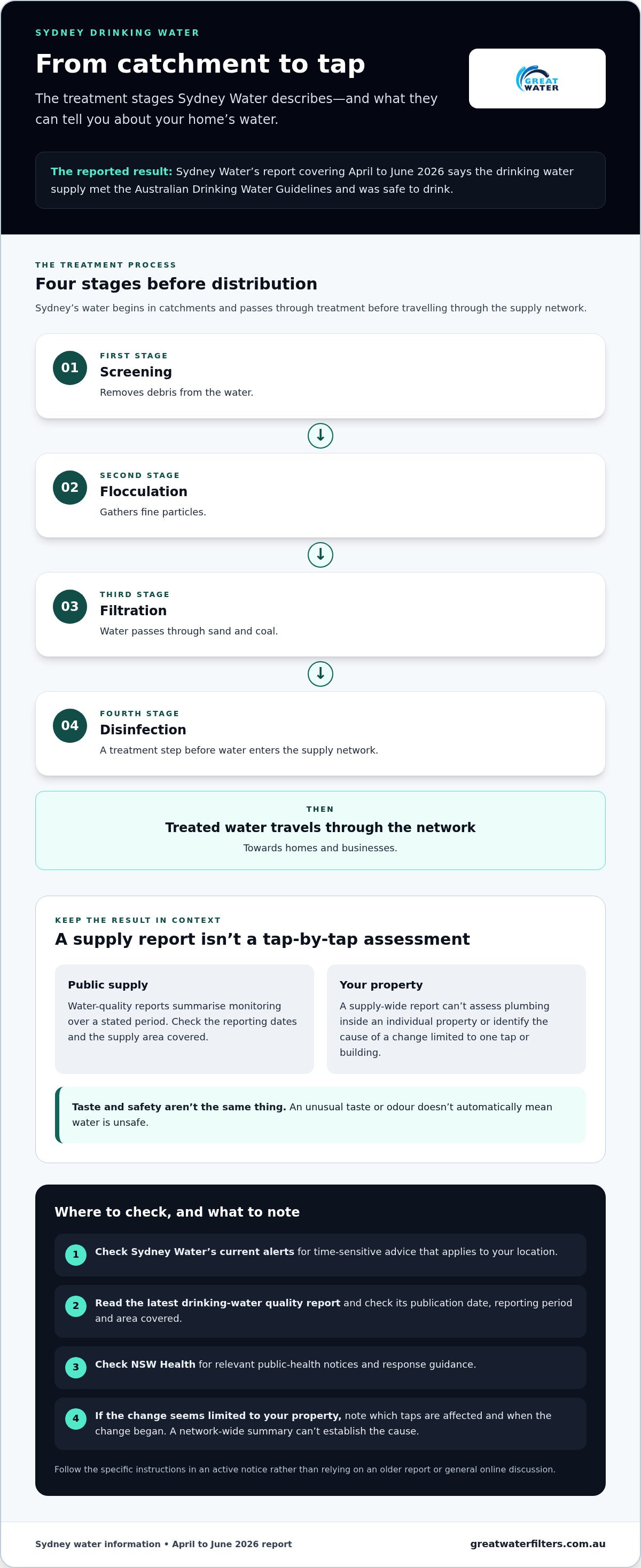
Sydney’s water begins in catchments and passes through treatment before distribution. Sydney Water describes treatment steps that include screening to remove debris, flocculation to gather fine particles, filtration through sand and coal, and disinfection. The treated water then travels through the supply network towards homes and businesses.
This is a broad picture, not an assessment of the pipework inside an individual property. A utility-wide report can describe the water it monitors, but it can’t identify a problem at a particular tap or explain a change limited to one building.
Testing provides evidence about water quality at monitored points and times. Sydney Water’s published water-quality reports help residents understand results for the supply, while its PFAS monitoring information focuses on that issue. Water-quality monitoring checks the public supply over time and gives residents evidence to assess it, rather than diagnosing every household tap.
What water-quality reports and alerts tell residents
Use Sydney Water’s current drinking-water quality reports for routine information and its alerts for time-sensitive local advice. NSW Health is another relevant official source for public-health notices and response guidance. Check the publication date, the area covered and whether the information is a routine report or an instruction issued during an incident.
These sources answer different questions:
- Routine reports summarise water-quality monitoring over a stated period. Read the reporting dates and any notes about the supply area before applying the findings to your home.
- Alerts and incident advice tell residents in an affected location what to do. Follow the specific instructions and check for updates rather than relying on an older report or general online discussion.
- Property-specific concerns may need a separate investigation. If the water changes only at your home, note which taps are affected and when the change began. A network-wide summary can’t establish the cause.
For a practical check, search Sydney Water’s site for its latest drinking-water quality information and local alerts. Check NSW Health as well if a public-health notice is relevant. Record the date you reviewed each source and the location it covers. This makes it easier to distinguish a current instruction from routine results if you revisit the information or discuss a concern. Don’t treat a report as a substitute for following an active notice.
Does safe Sydney tap water still need a filter? Safety, taste and household context
Safe public-supply water and water that suits your taste are two different things. A household might choose filtration because it prefers a different flavour or has a defined treatment goal. That choice doesn’t mean the Sydney supply is unsafe, and installing a filter isn’t a universal requirement. If you’re asking, is Sydney tap water safe to drink 2026? Keep the safety question separate from what you’d like to change about your water.
When taste, smell or appearance changes
A change in taste, smell or appearance can be unsettling, but your senses can’t identify a contaminant or confirm whether water is safe. Treatment, including disinfectants used in the supply, can influence taste or odour, but a sensory change alone doesn’t reveal its cause. Don’t assume it’s harmless or dangerous without checking current official advice.
Look for a Sydney Water notice that applies to your location. If the change coincides with an advisory, follow the authority’s instructions. Don’t rely on general online advice or use a filter as a substitute. If no notice appears, record what you’ve noticed and whether it affects one tap or several. That context can help distinguish a household plumbing issue from a wider supply concern.
When a household may choose additional filtration
Start with the goal, not the product. Is your priority a taste preference, treatment at selected drinking-water taps, or a household-wide treatment objective? The answer helps narrow the type of system to consider. Then compare that goal with the system’s verified specifications and documentation. Expect a filter to address only what it is designed and documented to treat.
A whole-house water filtration system may suit a household-wide treatment goal, but the label alone doesn’t show that it addresses every possible water concern. Its treatment capability must match your concern. For a specific issue, use current local water information to understand what you’re trying to address, then assess whether the system’s documented capabilities align with it.
Keep these questions separate as you decide:
- Supply safety: What do current official reports or local notices say?
- Personal preference: Is the main aim to change the taste or another quality you notice?
- Targeted treatment: What specific concern do you want to address, and do the system specifications support that purpose?
If the concern is taste, say so plainly. If it’s a specific treatment goal, identify it precisely. Clear goals make it easier to compare suitable options without treating filtration as proof that something is wrong with the public supply. The right choice is one that fits your household’s stated need and the system’s verified capabilities, not a broad promise that one filter solves every issue.
What Sydney households can do if they are concerned about tap water
If you’re asking, is Sydney tap water safe to drink 2026, make your next step specific to your address and what you’ve noticed. A concern affecting several homes in an area may call for a different response from a change limited to one tap or building. Check official information first, then record the details. This helps you follow relevant advice without guessing at the cause.
A simple check-the-source and check-the-location sequence
Check Sydney Water updates for your suburb or supply area, review NSW Health advice if a notice raises a health concern, then note the notice date and instructions. Confirm the update applies to your location. Follow its stated actions until the authority updates or withdraws the advice. Don’t substitute general online claims for an active official notice.
- Check current updates. Look at Sydney Water’s alerts and drinking-water information. If there’s a public-health notice, check NSW Health guidance as well.
- Match the location. Compare the suburb, supply area or affected streets named in the notice with your own address. Don’t assume an alert applies everywhere in Sydney, or that it doesn’t apply because a nearby area isn’t mentioned.
- Record the details. Save the notice date and the actions it specifies. Check for updates before changing what you do.
- Describe what you’ve noticed. Note when the change began, which taps are affected and whether other people in the property have noticed it too.
This sequence helps separate a temporary supply issue from a concern that may be limited to your property. If an official notice is in force, follow it first. A filter or online discussion isn’t a substitute for the authority’s instructions.
When the concern may be inside the property
If only one tap or one building is affected, the issue may be specific to the property rather than the wider supply. That observation doesn’t identify the cause. Water’s appearance, taste or smell, and a building’s age alone can’t confirm pipe materials or prove contamination. Avoid diagnosing the problem from these clues. Seek an appropriate assessment if it remains a concern.
A qualified plumbing professional can assess property plumbing concerns. If you’re unsure whether the issue is local or area-wide, check Sydney Water’s updates and describe what’s affected, when it started and whether it occurs at more than one tap. Keep any official notice or update date handy. Clear observations help direct the concern to the right next step.
Save or share this checklist:
- Checked Sydney Water updates for my location.
- Reviewed NSW Health advice if a health notice applies.
- Recorded the notice date and followed its instructions.
- Noted which taps are affected and when the change began.
- Considered a qualified property assessment if the concern persists.
Choosing extra water filtration in Sydney: a considered next step
Extra filtration is an option, not a requirement for making Sydney’s public water safe to drink. Once you’ve checked current local information and clarified what you want to change, consider whether a system suits that goal. A taste preference, a drinking-water treatment objective and a household-wide treatment goal are different needs, so choose a system according to its purpose.
Match the system to the water goal
Start by describing the goal in plain terms. If you’re considering a household-wide option, the whole-house water filtration category may be relevant. Great Water Filters offers the ES5Q Hi Flow Wellness Whole House Water Filter System. It is a whole-house system, but suitability for a particular concern depends on its verified specifications and your installation context.
For a drinking-water treatment goal, the Elite Series 3 Reverse Osmosis Water Filter System is another option. Before choosing any system, compare its documentation with the treatment goal you’ve identified. Don’t assume a filter addresses a particular substance or concern unless its verified specifications say so. If you’re mainly seeking a different taste, keep that preference distinct from a health or safety concern.
A useful starting point is to ask yourself:
- Do I want treatment across the household or at a drinking-water point?
- What specific quality or concern am I trying to address?
- Do the system’s verified specifications match that goal and the property’s installation context?
A whole-house label doesn’t mean a system resolves every possible water issue. Nor does choosing a filter prove that the public supply is unsafe. Clear goals help keep the decision practical and proportionate.
What a Great Water Filters installation offers
Great Water Filters supplies and professionally installs residential water-treatment systems in Sydney. The focus is on Smarter & Healthier water filter systems matched to your stated water goals and relevant product specifications, rather than a one-size-fits-all recommendation.
For a straightforward experience, the service includes Free Installation Australia wide and Transparent upfront Pricing. There’s No Upfront Payment Required, and you Only Pay when Fully Installed & Happy. The service also includes 100% No Risk. These terms don’t change the need to select a system based on your actual goal and its documented capabilities.
Great Water Filters also supplies and installs residential water-treatment systems in Melbourne, Perth, Brisbane, the Gold Coast, Adelaide, Alice Springs, Hobart and Launceston. There’s no need to rush into a decision. Take the time to understand local water information, define what you want from additional treatment and consider the system details in that context. If filtration suits your household, Great Water Filters looks after the installation, so you can sit back and relax.
Make your next water decision with confidence
If you’re asking is Sydney tap water safe to drink 2026, use current local information to guide the safety question, then decide whether you have a separate household goal. You don’t need to add filtration simply because you’ve heard conflicting claims. A useful next step is to write down what you want to improve, whether that’s a taste preference or a specific treatment objective, and use that goal to assess suitable options.
There’s no need to rush. A clear purpose makes it easier to choose a system based on your home’s needs and its verified specifications, rather than broad promises. Great Water Filters makes installation straightforward, with the details presented clearly before you decide.
Take the time you need, and choose what feels right for your household.
Frequently Asked Questions
Is Sydney tap water safe to drink straight from the kitchen tap?
Generally, yes, if your home is connected to Sydney Water’s public supply and there’s no current notice affecting your area or property. For the question “is Sydney tap water safe to drink 2026”, check the latest local advice before relying on a general answer. If you’re in a rental or apartment, ask building management whether they’ve received a notice or reported a plumbing issue affecting the property.
Can Sydney tap water taste or smell different and still be safe to drink?
Yes, a change in taste or smell doesn’t automatically mean water is unsafe. You might notice a different taste after returning from a trip, or at one tap but not another. These clues can’t identify the cause or confirm safety. Check current Sydney Water advice, note where and when you noticed the change, and follow any instructions that apply to your location.
Is Sydney tap water safe for babies and making infant formula?
When preparing infant formula, follow current instructions from NSW Health and the formula manufacturer, as preparation advice can depend on a baby’s age and circumstances. Don’t assume a household water filter changes the preparation steps or makes water suitable for formula. If you’re unsure, ask your child and family health nurse, GP or paediatrician for advice tailored to your baby.
What should I do if there is a boil-water notice in my Sydney area?
Follow the notice exactly, including which water uses it covers and how long the advice applies. Check that it names your suburb or supply area, then revisit the issuing authority’s updates for changes. Don’t rely on an old screenshot, a neighbour’s summary or a filter as a substitute for official instructions. If you’re caring for others, share the current notice and its actions with everyone in the household.
Can old household plumbing affect the water coming from my tap?
Yes, plumbing inside a home or apartment building can affect water after it leaves the public supply. If a change appears at one tap but not others, note the location and when it occurs, then raise it with the property owner or building manager. Age or appearance alone can’t identify pipe materials or confirm a water-quality issue. Arrange an appropriate qualified assessment if the concern continues.
Do I need a water filter if Sydney tap water is considered safe?
No, a filter isn’t automatically needed for safety. You might choose one to suit a taste preference or a specific treatment goal, but first identify what you want it to address. Check the system’s verified specifications against that purpose; don’t assume every filter treats every concern. If you’re satisfied with your tap water and there’s no relevant official advice, choosing extra filtration remains a household preference.
COMMENTS