
Protect your family with pure water for drinking, bathing, and appliances.

Adelaide’s tap water is generally moderately hard, not soft. Metropolitan supplies have hardness of around 93-96 mg/L as calcium carbonate, below the 200 mg/L threshold used to classify water as hard. So, the practical answer to whether Adelaide tap water is hard or soft is that it sits in the middle range, although hardness can vary between local supplies.
If you’ve noticed marks on taps or mineral deposits in the kettle, water hardness may help explain them. Hardness measures minerals such as calcium and magnesium; it does not determine whether drinking water is safe.
This guide explains what Adelaide’s hardness levels mean at home, how mineral deposits can affect fixtures and appliances, and why water quality and supply may vary by location and season. You’ll also learn what hardness does, and doesn’t, tell you about your tap water.
Key Takeaways
- Compare hardness readings with calcium-carbonate categories to understand what the mineral level means for your household.
- Mineral deposits can build up on fixtures and inside appliances; recognising the signs helps you decide what needs attention.
- Hardness and drinking-water quality are different considerations, so visible scale alone doesn’t indicate whether water is safe to drink.
- Water sources and seasonal conditions can affect the minerals reaching homes, and local supply can make a difference.
- If reducing hardness throughout your home is a priority, a whole-house water filter softener is one option to consider.
How Hard Is Adelaide’s Water?
Metropolitan Adelaide tap water generally falls in the moderately hard range, with hardness around 93-96 mg/L as calcium carbonate. The answer to whether Adelaide tap water is hard or soft depends partly on suburb, because local supplies can have different mineral levels.
Water Hardness Categories and Thresholds
Water hardness measures dissolved minerals, mainly calcium and magnesium, and is expressed as calcium carbonate equivalent. This common unit lets you compare a sample with standard hardness categories.
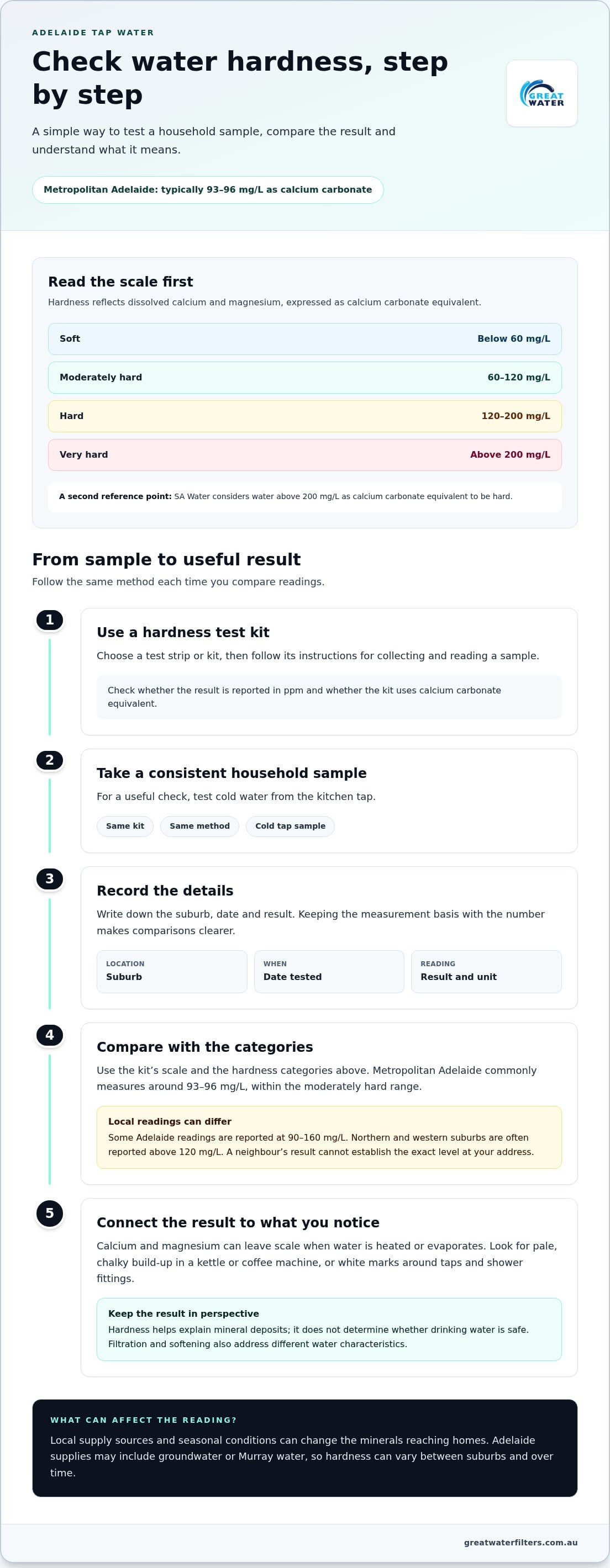
A general scale classifies water below 60 mg/L as soft, 60-120 mg/L as moderately hard, 120-200 mg/L as hard, and above 200 mg/L as very hard. SA Water considers water above 200 mg/L as calcium carbonate equivalent to be hard. These categories help explain mineral scale, but hardness is not itself a measure of drinking-water safety.
At around 93-96 mg/L, metropolitan Adelaide’s typical level sits within the moderate range. Some Adelaide water readings are described as 90-160 mg/L, so a single city-wide figure won’t describe every household. The category gives useful context for what may happen in a kitchen kettle or around a bathroom tap.
Hardness Differences Between Adelaide Suburbs
Differences between suburbs reflect the source water supplying each home and the minerals it contains. Some Adelaide areas receive groundwater from underground aquifers, where calcium and magnesium occur naturally.
Hardness in northern and western Adelaide suburbs is often reported above 120 mg/L, which falls into the hard range on the category scale. That contrasts with metropolitan readings around 93-96 mg/L. The difference matters because households on harder supplies may notice mineral deposits sooner on taps, shower fittings or appliances.
Adelaide’s supply can also include water from the Murray, where mineral content increases as water travels towards the city. The blend reaching a suburb can therefore affect its measured hardness. A neighbour’s reading can be a useful comparison, but it cannot establish the exact level at your address.
Measuring and Checking Water Hardness
To check your tap water, use a hardness test strip or kit and follow its instructions for collecting and reading a sample. The result may be reported in parts per million (ppm); compare it with the kit’s scale and note whether it uses calcium carbonate equivalent.
Hardness is not the same as total dissolved material: it specifically reflects calcium and magnesium ions in the water. Calcium carbonate equivalent expresses their combined hardness as though measured in that form. This provides a consistent basis for comparing results, even though the water contains dissolved calcium and magnesium.
Test results can be compared with the categories above: below 60 mg/L is soft, while 60-120 mg/L is moderately hard. A result over 120 mg/L enters the hard category on this scale, while SA Water’s hard-water threshold is above 200 mg/L. Keep the unit in view, since a number without its measurement basis can be misleading.
For a useful household check, test a cold-water sample from the kitchen tap and record the suburb, date and result. If you compare another sample, use the same kit and method. This makes it easier to see whether readings differ between locations or over time.
Hard-water effects on household fixtures and appliances
Yes. Dissolved calcium and magnesium can leave mineral scale in Adelaide homes, especially where water is heated or allowed to evaporate. The amount depends on the local supply’s hardness and how water is used.
Scale Build-up in Appliances
Scale is a mineral deposit left behind as hard water heats or evaporates. In a kettle, for example, repeated boiling can leave a pale, chalky layer on the base and around the element.
Coffee machines can also collect deposits inside water-heating components and narrow passages. SA Water recommends Adelaide residents descale kettles and coffee machines regularly to protect them from mineral build-up. Follow the appliance maker’s cleaning instructions, as unsuitable products or methods can damage internal parts.
Look for scale that returns after cleaning or residue inside a kettle or coffee machine. A filtered-water system doesn’t automatically soften water: filtration and softening address different characteristics. The right approach depends on whether your main concern is mineral deposits, taste or another household need.
Limescale in Pipes and Fixtures
Limescale can form where mineral-bearing water repeatedly contacts plumbing surfaces. Around a South Australian home, early signs may include white marks on tap outlets, shower fittings or sink surfaces after water dries.
Deposits can also collect inside pipework and plumbing components over time. A narrowing outlet or reduced flow can have several causes, so don’t assume scale explains every change. Compare affected taps and fixtures, and note whether deposits appear where water regularly evaporates.
Hardness is only one factor in household wear. Water temperature, how often an appliance runs and how readily surfaces dry all affect where deposits become noticeable. For example, a frequently used kettle heats water repeatedly, while an unused tap may show residue only after splashes evaporate.
Groundwater can naturally contain calcium and magnesium, so local supply conditions matter across Adelaide. A home receiving harder water may need more frequent attention to scale-prone appliances than one with a lower-hardness supply. This is a maintenance consideration, not proof that Australian drinking water is unsafe.
For practical upkeep, inspect kettle interiors, coffee-machine instructions and tap outlets during routine cleaning. Descale appliances according to their manufacturer’s directions, and clean visible residue from suitable surfaces before it builds up. If deposits return quickly, consider whether local water hardness may contribute, rather than relying on appearance alone.
Adelaide drinking water quality
Water hardness describes dissolved minerals such as calcium and magnesium; on its own, it doesn’t determine whether drinking water is safe. Adelaide tap water is described as safe to drink and meeting the Australian Drinking Water Guidelines. Hardness and overall water quality are separate considerations.
SA Water tests drinking water across South Australia, and its summary reports results from the past 12 months. The organisation says it conducts over 100,000 water tests annually and tests for 92 different chemicals or substances. That monitoring covers more than mineral content alone, including water-quality characteristics that affect taste and treatment.
For example, the Australian aesthetic drinking-water guideline for pH is 6.5 to 8.5. pH measures how acidic or alkaline water is, while hardness reflects dissolved calcium and magnesium. A pH reading and a hardness reading therefore describe different properties. One can’t be used as a substitute for the other when considering household water.
Chlorine is used in water treatment, and its taste or smell can be noticeable to some people. Adelaide tap water is identified as noticeable when chlorine concentrations exceed 0.6 mg/L. If the taste is strongest first thing in the morning, the recommended household measure is to run the tap for 30 seconds. This can reduce overnight chlorine build-up in the tap water.
Minerals in hard water aren’t automatically a health concern. Calcium and magnesium can contribute to a person’s daily mineral intake, and hardness alone doesn’t mean water needs treatment for drinking. Filtration and softening have different purposes: filtration addresses substances a system is designed to reduce, while softening targets hardness minerals.
That distinction matters if you’re considering a home water treatment system. A household focused on kettle scale may prioritise hardness, while a concern about taste may call for a different treatment objective. A sodium-based softener can slightly increase the water’s salt content. SA Water’s 2022/23 results found every sodium sample collected in South Australia exceeded 20 mg/L, while the Australian aesthetic guideline for sodium is 180 mg/L.
Water quality can also differ by supply area, so a general city description won’t explain every taste or household concern. SA Water’s testing results describe the broader supply, while hardness tests address mineral levels at a particular tap. Keeping these questions separate helps clarify what a result does, and doesn’t, tell you.
Signs of hard water at home
Mineral residue can leave visible clues around an Adelaide home, but appearance alone doesn’t measure water hardness. Look for repeated deposits where tap water dries, and distinguish them from ordinary dirt, soap or cleaning residue.
Start with glassware and smooth surfaces. After washing, glasses may show pale spots or a cloudy film as water droplets evaporate. Similar marks can appear around a sink, on a shower screen or near a tap outlet. If the residue returns after cleaning and normal use, dissolved minerals may be contributing.
Soap can offer another household clue. Hard water may make soap harder to lather, leaving more residue on a basin or shower surface. Notice whether the same product behaves differently across bathrooms or after a change in water supply. A single patch of soap scum isn’t a reliable hardness reading, as product choice and cleaning habits also affect residue.
- Glassware: Check for recurring spots after washing and air-drying.
- Bathroom fittings: Look for pale deposits around tap openings and shower heads.
- Surfaces: Notice chalky marks on sinks or shower screens where splashes dry.
- Soap use: Observe whether lathering and rinsing leave more residue than expected.
Patterns matter. Deposits at several water-contact points, such as a shower screen and kitchen sink, are more useful clues than one isolated mark. Compare the same type of surface after cleaning. If residue repeatedly forms where droplets dry, mineral content is one possible explanation; a hardness test gives a more direct measure.
Keep the distinction between a household clue and a drinking-water assessment clear. Hardness relates to dissolved minerals, while the Australian Drinking Water Guidelines address drinking-water quality. Visible marks on a glass don’t establish whether tap water is safe to drink, just as clear-looking water doesn’t reveal its mineral level.
Adelaide’s metropolitan water is commonly moderately hard, so signs may be subtle rather than dramatic. A few spots on glassware or a light film around a tap may be more noticeable than heavy scale. The pattern also depends on where water dries and how regularly surfaces are cleaned.
For a practical check, note where deposits appear, clean the affected surfaces, then observe whether the same marks return during normal use. Record whether they occur around hot-water fixtures, cold taps or both. Pairing these observations with a hardness test helps distinguish mineral residue from other household build-up, without treating every white mark as proof of a water-quality problem.
Water sources and seasonal variation
Adelaide’s tap-water hardness reflects its source, the minerals in that water and how supplies are blended. Seasonal conditions can change which sources contribute, so household water may not have identical characteristics throughout the year.
The Murray River is a major source for Adelaide, with water travelling hundreds of kilometres towards the city. Its mineral content increases along the way. Calcium and magnesium dissolved in source water contribute to hardness, so their levels affect the character of the supply reaching homes.
Groundwater is another factor in parts of the region. Some Adelaide suburbs receive water from underground aquifers, which can naturally contain calcium and magnesium. This helps explain why hardness can differ between suburbs, even when homes are connected to the metropolitan supply. A suburb’s source and the blend reaching it matter more than the city name alone.
Understand seasonal variation through source conditions rather than assuming a fixed pattern. Changes in rainfall, river flows and available supply can influence how water sources are managed and blended. The mineral level at a tap depends on the sources contributing at that time, including whether groundwater is part of the local mix. These factors can affect hardness without making every seasonal change obvious at home.
For residents, a practical sign may be how quickly limescale returns on a kettle or tap. A change in mineral content could alter how often deposits appear, but household use matters too. A kettle used daily heats water repeatedly; one used rarely may show less scale, even in the same suburb.
Homes outside metropolitan Adelaide can have different source arrangements. Rural properties using tank or bore water may have harder water, depending on its mineral content. Tank water and bore water aren’t interchangeable: a bore draws groundwater, while a rainwater tank collects rainfall. The source helps explain why hardness results can vary between nearby households.
To understand a seasonal change, compare hardness readings from the same tap using the same test method, and record when each sample was taken. Pair the results with household observations, such as limescale appearing more often in kettles. A test measures hardness directly; visible deposits show only how minerals behave on particular appliances or surfaces.
For an Adelaide household, source, suburb and seasonal supply conditions together provide a clearer picture than one general city-wide description. These factors explain why two homes may notice different mineral effects, even when both use tap water.
Great Water Filters: ES5Q Hi Flow Wellness Whole House Water Filter System
The ES5Q Hi Flow Wellness Whole House Water Filter System from Great Water Filters is a whole-home option for households considering Smarter & Healthier water filter systems. It includes Free Installation Australia wide. If reducing hardness is your priority, the Whole House Water Filter Softener is another option; filtration and softening address different concerns.
For drinking water at a dedicated tap, the Elite Series 3 Reverse Osmosis Water Filter System may suit a different household need. Great Water Filters provides Transparent upfront Pricing, with No Upfront Payment Required and payment only after installation is complete. The pay-on-completion approach is described as 100% No Risk, with “Only Pay when Fully Installed & Happy.”
Contact Great Water Filters to discuss the options for your home.
Choose the next step that suits your home
If you’re weighing whether Adelaide tap water is hard or soft, let your household’s main concern guide your next step. Being clear about what you want to address makes it easier to discuss a suitable water-treatment option.
Great Water Filters offers a pay-on-completion approach: No Upfront Payment Required, and you Only Pay when Fully Installed & Happy. You can explore the options at your own pace and decide what suits your home.
A considered choice starts with the issue that matters most to you. Take the next step when you’re ready.
Frequently Asked Questions
What Is Water Hardness?
Water hardness describes the concentration of dissolved calcium and magnesium in a sample. It’s commonly expressed as milligrams per litre of calcium carbonate equivalent, even though calcium carbonate isn’t the only mineral present. For example, a hardness result helps explain why one household may see more residue in a kettle than another. It doesn’t measure chlorine, pH or overall drinking-water safety.
Is Adelaide tap water hard or soft?
Adelaide’s metropolitan tap water is generally moderately hard. The typical metropolitan range sits below the threshold used to classify water as hard, although some local supplies have higher levels. If you’re seeing scale at home, that alone can’t identify your exact supply or its hardness. A test result from your tap gives a more useful household-specific reading than a broad city-wide description.
What is the water hardness of Adelaide tap water in mg/L as calcium carbonate?
Metropolitan Adelaide tap water is typically around 93-96 mg/L as calcium carbonate equivalent. That places the usual reading in the moderately hard category. The figure is a general metropolitan range, not a guaranteed result for every address. For example, a household supplied partly by groundwater may have a different reading. Use a hardness test kit or strip to get a result for your own tap.
What is Adelaide tap water hardness in grains per gallon?
Using the metropolitan range of 93-96 mg/L as calcium carbonate, Adelaide water is approximately 5.4-5.6 grains per gallon. Grains per gallon is another way to express the same hardness measurement, so the unit changes but the mineral content does not. If you’re comparing a test result with a product or appliance guide, make sure both values use the same unit before drawing conclusions.
How does water hardness vary across Adelaide suburbs?
Hardness can differ by suburb because local supplies may use different sources or blends. Northern and western Adelaide suburbs are often described as exceeding 120 mg/L, while metropolitan levels are commonly lower. A neighbouring home may not have an identical result if its supply mix differs. If scale appears more quickly in one property, compare a tap-water test from that address rather than relying on a suburb-wide estimate.
Does Adelaide tap water hardness change seasonally or by water source?
Hardness can vary with the sources contributing to a local supply. Adelaide draws on River Murray water and, in some areas, groundwater. Seasonal conditions can affect source availability and blending, which may alter the mineral content reaching a household. To compare changes, test the same tap with the same method at different times and record each result. This gives a clearer picture than judging seasonal variation from limescale alone.
What minerals cause hardness in Adelaide tap water?
Dissolved calcium and magnesium are the main minerals responsible for hardness. They enter water naturally as it moves through geological materials or underground aquifers. Their concentration influences a hardness reading and can contribute to deposits on household surfaces. A hardness test measures the combined effect of these minerals, rather than telling you the precise amount of each separately.
Is Adelaide tap water safe to drink despite its hardness?
Yes. Adelaide tap water is described as safe to drink and meeting the Australian Drinking Water Guidelines; hardness alone doesn’t make it unsafe. Calcium and magnesium are minerals that can contribute to dietary intake. If you notice an unusual change in taste, appearance or smell, treat it as a separate water-quality concern rather than assuming hardness explains it. Mineral deposits on a kettle don’t determine drinking-water safety.
COMMENTS