
Protect your family with pure water for drinking, bathing, and appliances.

Could one tap simplify your kitchen without becoming a poor fit for your household? When reading 3 in 1 boiling water tap reviews in Australia, look beyond convenience: the right choice depends on how you’ll use the tap, the water it can deliver and how its temperature controls work.
It’s reasonable to want quick access to hot water, while also weighing safety, running costs and whether the system suits your daily routine. Reviews can help, but they’re most useful when you compare the details that matter to your home rather than relying on broad ratings.
This guide explains how to assess output and temperature, what to look for in review feedback, and how energy features may affect everyday use. You’ll also learn which households may benefit from a boiling water tap, and when a different kitchen water system could be a better match.
Key Takeaways
- Decide whether a boiling water tap suits your routine by considering how often you use hot water and what you expect from the system.
- Learn which output and temperature details can help you judge whether a tap will meet your kitchen’s needs.
- Read customer feedback for practical insights into everyday use and installation, not just overall ratings.
- Understand what energy-saving features may mean for running a boiling water tap at home.
- See how instant boiling, chilled and sparkling water systems with 3-way filter taps may suit different kitchen preferences.
Is a boiling water tap right for my use?
A boiling water tap suits households that regularly need hot water for drinks or cooking. The decision depends on use, standby energy and safe access.
Running costs and household suitability
Running costs depend on electricity use, your tariff and how often the system reheats stored water. Insulation and standby settings also affect consumption. A household making several cups of tea throughout the day uses the tap differently from one that boils a kettle occasionally. Compare the model’s energy information with your routine rather than assuming convenience means lower bills.
A busy kitchen, for example, may benefit from fast access for tea, coffee or cooking. A household that rarely needs boiling water may find a kettle better suited to its habits. Consider ongoing electricity use alongside installation and filter replacement. These factors shape the overall cost of ownership, even when the tap’s purchase price is only part of the picture.
Use these practical checks:
- Estimate how often your household prepares hot drinks or uses boiling water for food.
- Review the model’s standby consumption and energy-saving settings.
- Consider your electricity tariff and whether the unit remains powered between uses.
- Factor in routine filter replacement where the system includes filtration.
This comparison helps you judge whether frequent use makes instant access worthwhile in your kitchen.
Safety features for children
Boiling water can cause serious scalds, so a 3-in-1 tap needs careful placement around children. Safety features differ by model. Look for child-resistant activation, such as a safety lock or a deliberate two-step control. Check how the mechanism works in practice, and whether a child could operate it while reaching the lever.
Consider the kitchen layout, too. A tap beside a step stool or within easy reach of young children creates a different risk from one positioned away from their usual play area. An insulated spout may help reduce contact burns, but it doesn’t make boiling water safe to touch. Keep cups stable and out of children’s reach while filling them.
Before choosing a model, read the manufacturer’s operating instructions and identify its specific safeguards. Test the activation sequence yourself, then show other adults how to use the lock. Supervise whenever boiling water is dispensed. A safety feature may reduce accidental activation, but it doesn’t replace careful adult use or a kitchen arrangement that limits children’s access.
For families, suitability depends on a child’s age, the kitchen layout and the tap controls. If children can reach the spout or operate its controls, a kettle stored out of reach may better suit the household.
Boiling-water temperature and output capacity
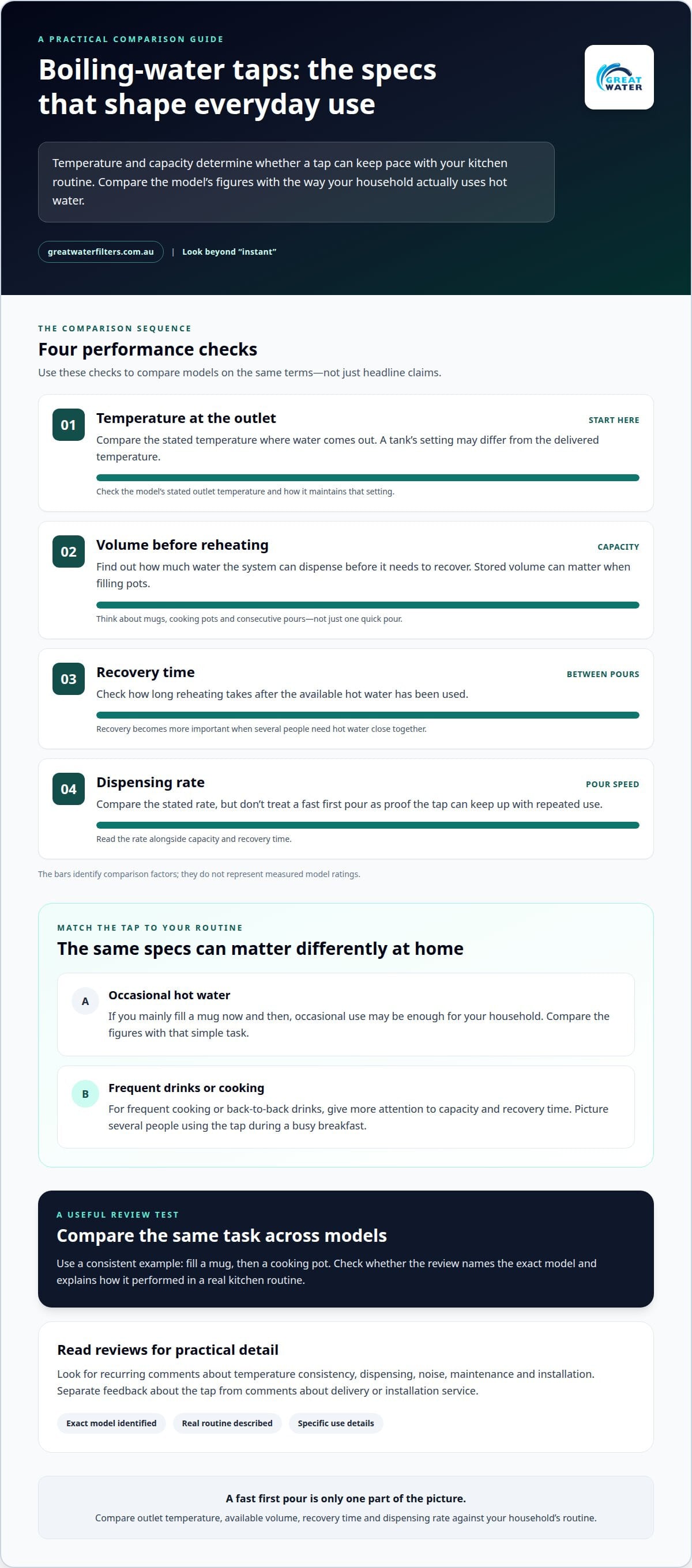
Temperature and capacity determine whether a tap can keep pace with your kitchen routine. Compare the manufacturer’s figures for delivered temperature, dispensing rate and recovery time. These specifications vary between models, so one tap’s performance won’t represent every 3-in-1 system. Australian reviews of 3-in-1 boiling water taps can add context, especially when reviewers identify the model.
Start with temperature. A tank’s stated setting may differ from the water temperature at the spout. The distance between tank and tap, pipework and recent use can affect delivery. After several cups are dispensed, for example, the system may need time to heat more water. Look for the stated outlet temperature and details on how the model maintains it.
Output capacity is more than the speed of a single pour. Check how much water the system dispenses before recovery and how long reheating takes. Picture a breakfast rush: one person fills a mug, another prepares a saucepan, and someone else wants tea. A model suited to occasional cups may feel limiting when several people use it at once.
- Compare the stated boiling-water temperature at the outlet.
- Note dispensing rate and volume available before reheating.
- Check recovery time after consecutive pours.
- Match those details to a busy routine, such as filling a mug while cooking.
These figures help distinguish headline claims from practical performance. A fast initial pour doesn’t necessarily mean the system can fill several containers consecutively. A larger stored volume may matter more than maximum flow when filling pots. When comparing 3-in-1 boiling water tap reviews in Australia, use the same task for each model, such as filling a mug and then a cooking pot.
Consider the other water functions too. The term “3-in-1” can describe different combinations, so identify the streams each model provides. Check whether boiling, chilled or filtered water has separate controls, and whether each function has its own capacity information. That keeps comparisons useful across systems with different features.
Finally, read the operating instructions for temperature adjustment and refill behaviour. Clear controls make it easier to understand the selected setting. Use the manufacturer’s figures to judge whether the tap meets your demand, rather than relying on the word “instant” alone. Occasional mug-filling may be enough for a small household; frequent cooking or back-to-back drinks makes capacity and recovery more important. Reviews can show how specifications work in daily use, but the exact model’s figures are the practical basis for comparison.
Customer reviews and installations
Customer reviews are most useful when they identify the exact model and describe a real kitchen routine. Look for recurring comments about temperature consistency, dispensing, noise, maintenance and installation. A brief “works well” tells you little; a review describing use during breakfast gives more context. Separate comments about the tap itself from feedback about delivery or installation service.
Australian reviews of 3-in-1 boiling water taps can help compare brands, but they don’t establish a universal winner. Zip, Billi, Insinkerator and Oliveri offer different models and specifications. Compare the exact model’s functions, controls, filtration arrangements, warranty terms and installation requirements. Feedback about one model may not reflect another from the same brand.
When comparing 3-in-1 boiling water tap reviews in Australia, look for specific examples rather than broad impressions. Repeated reports about leaks, unclear controls or slow recovery may be useful, especially when reviewers explain their usage. Balance these accounts with the manufacturer’s product information. A single review describes one person’s experience, not necessarily a consistent issue across all kitchens.
Installation requirements depend on the model and kitchen. These systems use water connections and electrical power, so setup involves both. Under-sink space, access to power and tap placement can affect installation. In Australia, the plumbing and electrical arrangements depend on the unit and site. The manufacturer’s installation instructions set out the requirements for that model.
Reviews can illustrate what owners experienced, but they don’t determine what a specific kitchen needs. A renovated kitchen, for example, may have different under-sink access from an older one. Model instructions and the actual layout are more useful for installation planning than another household’s experience alone.
Warranty, servicing and filter requirements also vary by model. Read the Australian warranty terms for the exact Zip, Billi, Insinkerator or Oliveri tap. Note the manufacturer’s servicing guidance and cartridge replacement instructions. Filter types and replacement schedules differ between systems. Keep the model documents together to make maintenance requirements easier to follow.
Use the same criteria for each model you’re comparing:
- Confirm that reviews identify the exact model.
- Look for practical details about regular use.
- Distinguish installation feedback from product performance.
- Compare warranty and filter guidance with model documentation.
This approach makes customer feedback more useful. It keeps your comparison focused on a product’s actual functions, installation needs and maintenance terms, rather than brand impressions alone.
Energy-saving and environmental features
Energy features affect how a boiling water tap uses power between pours. Look for information about tank insulation, standby settings and heating controls. These details help explain whether the unit keeps water hot continuously or adjusts its operation. Compare the product information with your household’s pattern of use.
An insulated tank can reduce heat loss, while standby controls may limit unnecessary heating. Their effect depends on the model and how it’s operated. A household using boiling water throughout the day, for example, has a different pattern from one that uses it occasionally. The manufacturer’s energy figures offer a more useful comparison than a general “energy-saving” label.
To understand the impact on your Australian electricity bill, consider the unit’s power consumption, time in standby and your electricity tariff. Higher standby demand can matter if the system stays powered between uses. A feature that lowers standby use may help, but its value depends on actual consumption and your routine. Compare model-specific figures rather than assuming all taps perform alike.
- Compare stated energy use for active heating and standby.
- Look for insulation and adjustable operating modes.
- Consider how often your household draws boiling water.
- Check the manufacturer’s instructions for energy settings.
Environmental impacts extend beyond electricity. A boiling tap may change how you heat water: you can dispense the amount a recipe needs instead of boiling a full kettle. The benefit depends on the quantity used and the system’s standby demand. Instant access doesn’t automatically mean lower overall energy use.
Filtration also raises an ongoing materials question. If a model uses replaceable cartridges, consider the replacement schedule and how used filters are handled. Packaging and replacement parts contribute to a product’s footprint. Follow the manufacturer’s instructions for filter changes and use the specified cartridge to keep the system operating as designed.
Build a practical comparison around your kitchen. Note each model’s standby consumption, heating controls, insulation and filtration requirements. Then match those details to a real example, such as making one cup of tea each morning or preparing hot drinks throughout the day. This makes the trade-offs clearer than broad claims about efficiency.
A suitable energy profile balances convenient access with the way your household uses the tap. Prioritise documented energy information, clear operating settings and maintenance requirements. These details help you assess day-to-day impact without treating an energy feature as a guaranteed bill saving.
How instant boiling taps work
An instant boiling tap uses an under-sink unit to heat and hold water. A cold-water connection feeds the tank, where an electric heating element raises the water’s temperature. A thermostat monitors the tank and controls reheating. When activated, the tap dispenses hot water through a dedicated channel.
After a pour, incoming cold water replaces the dispensed volume. The heating element warms this replacement water, so recovery takes time. Filling several mugs in succession, for example, may use stored hot water faster than it can be reheated. The model’s capacity and recovery details help explain how it performs during busy periods.
Controls vary between systems. Some require a specific sequence to release boiling water, while others use a separate handle or button. Follow the model’s operating instructions to understand each control. In a household with children, the operating sequence also matters when assessing access and safe use.
A three-in-one tap can combine different water functions at one fixture, though the exact combination depends on the model. A system may supply boiling water alongside filtered or chilled water, using separate internal paths and controls. The under-sink unit may therefore include additional filtration or chilling components. Check the product description to see which functions it provides.
Where filtration is included, water passes through a cartridge before dispensing. The cartridge type and replacement schedule are model-specific. A filter affects the maintenance routine, but it isn’t part of the heating process itself. Keep the operating and maintenance instructions together so the correct cartridge and settings are clear.
The basic sequence is straightforward:
- Cold water enters the under-sink unit.
- A heating element and thermostat bring stored water to the system’s set temperature.
- The tap control opens the relevant water channel.
- Dispensed water is replaced, and the unit reheats it.
This helps distinguish an instant boiling system from a kettle. The tap holds heated water ready to dispense, while a kettle heats water in its own vessel when switched on. That difference affects how each appliance fits your routine. A tap needs under-sink space and connected services; a kettle sits on the benchtop. For a combined boiling, chilled and filtered setup, consider the tap, tank and any additional components as one system. Their arrangement determines the space and connections needed beneath the sink.
Great Water Filters: Instant Boiling, Chilled & Sparkling Water Systems
Great Water Filters offers Instant Boiling, Chilled & Sparkling Water Systems for kitchens where one tap needs to serve different preferences. If you’ve weighed temperature, output, reviews and energy use and want to explore a system combining several water functions, this is a practical next step. Great Water Filters provides professional installation across major Australian metro areas.
Start by identifying the functions that matter in your home. You may want boiling water for hot drinks and cooking, chilled water for everyday drinking, or sparkling water as an alternative to bottled drinks. A system combining these options may suit a household with varied routines. The right fit depends on which functions you’ll use regularly and the space available in your kitchen.
Think through how the tap would work during a normal day. Imagine making tea while another person fills a glass with chilled water. Then consider whether sparkling water would be useful often enough to be part of your kitchen setup. These everyday examples help clarify which functions should guide your decision.
Before settling on a system, organise your priorities:
- List the water functions your household uses most.
- Consider how several people may use the kitchen at once.
- Think about the available space beneath the sink.
- Review the system’s operating and maintenance information.
These points are a useful starting place for choosing a kitchen system. They also keep the decision focused on your household’s needs, rather than features that won’t make a difference in daily life.
Great Water Filters also offers residential filtration options, including the ES5Q Hi Flow Wellness Whole House Water Filter System and the Elite Series 3 Reverse Osmosis Water Filter System. These are separate offerings for households considering broader water treatment alongside a kitchen tap system. Each addresses a different part of the home’s water setup.
Installation is included with your package within our service locations. The kitchen layout and chosen system shape the practical requirements, including where components sit and how the finished setup fits into your routine. Clear priorities make it easier to weigh those details against the functions you want.
If you’re ready to discuss an instant water system for your kitchen, contact Great Water Filters.
Frequently Asked Questions
What are the best-reviewed 3-in-1 boiling water taps in Australia?
There isn’t one model that’s best for every Australian kitchen. Compare reviews for the exact Zip, Billi, Insinkerator or Oliveri model you’re considering, rather than choosing by brand alone. Look for detailed accounts of day-to-day operation, installation and maintenance. A review is most useful when it identifies the model and describes a household’s actual experience, not just an overall star rating.
What do Australian customer reviews say about reliability, water temperature and ease of use?
Reviews can offer individual accounts of reliability, temperature and controls, but experiences vary between models and households. Give more weight to comments that name the model and describe a specific situation, such as using the tap during a busy meal preparation. Check whether feedback discusses consistent operation over time, clear controls or servicing. These details help you judge usability without treating one person’s experience as a guarantee.
How much electricity do 3-in-1 boiling water taps use in Australia?
Electricity use depends on the model, its standby consumption and how often it heats water. To estimate household use, apply the manufacturer’s stated energy figures to your electricity tariff. A tap used throughout the day, for example, has a different usage pattern from one used occasionally. Compare like-for-like figures for the exact models, including standby operation, rather than relying on a general estimate.
What are the running costs and filter replacement costs for boiling water taps?
Ongoing costs can include electricity, replacement filters and servicing, where the model requires them. Filter prices and replacement schedules vary, so use the exact model’s documentation to plan future maintenance. For a useful household estimate, consider how frequently you’ll use the system and the manufacturer’s cartridge guidance. Don’t assume every 3-in-1 tap uses the same filter or has identical replacement requirements.
What are the common problems and drawbacks reported in Australian 3-in-1 boiling water tap reviews?
Look for reviews that describe specific issues with the exact model, rather than assuming every system shares the same drawbacks. Comments may mention controls that feel awkward, maintenance that takes more effort than expected, or installation that didn’t suit a particular kitchen layout. Check whether several detailed reviews report the same issue. Also consider under-sink space and ongoing upkeep before deciding.
Are 3-in-1 boiling water taps suitable for Australian water quality and different household sizes?
Suitability depends on the model’s filtration design, your water supply and household demand. A small household may use less water each day than a larger family preparing drinks and meals at the same time. Check the manufacturer’s guidance for the model and its filter, if included. Match the system’s stated capacity and functions to your kitchen routine and water needs.
COMMENTS