
Protect your family with pure water for drinking, bathing, and appliances.


Alkaline water may support hydration, but it is not a proven performance shortcut. For athletes in Brisbane, potential benefits are best weighed against the evidence, rather than assumed from a higher pH alone.
It is understandable to look for a simple way to feel and perform better during training, especially in Brisbane’s warm conditions. This guide reviews the potential benefits of alkaline water for athletes in Brisbane, what hydration and performance claims say, and how to interpret them carefully.
You’ll also see how alkaline water’s pH and mineral content compare with regular drinking water. This can help you decide whether an alkaline water filter suits your home, without assuming a change in water alone will improve athletic performance.
Key Takeaways
- Alkaline water may affect hydration measures, but claims of better athletic performance need careful interpretation.
- Understand how exercise-related changes in acid-base balance relate to muscle performance before treating water pH as a training solution.
- Alkaline water typically has a pH between 8 and 10, while regular drinking water generally ranges from 6.5 to 8.5.
- Mineral content matters too: compare the electrolytes in a water choice with what your training and hydration routine requires.
- If you want alkaline water at home, the Elite Series 2 Alkaline Water Filter is a filtration option from Great Water Filters.
What Is Alkaline Water And What Does It Do?
Alkaline water has a higher pH than neutral water, commonly because of dissolved minerals or treatment. Its pH describes acidity or alkalinity, not how effectively it fuels exercise. Claims about benefits for athletes in Brisbane include improved hydration and recovery, but performance results are not conclusive.
During intense exercise, working muscles produce acids as they use energy. This can contribute to exercise-induced metabolic acidosis, a temporary change in the body’s acid-base balance. A double-blind study reported that water at pH 9.3 increased resting and post-exercise blood pH, while reducing metabolic acidosis after intensive exercise. That finding concerns measured blood markers; it doesn’t establish that athletes run faster or sustain harder efforts.
Muscle performance also depends on training, available fuel, temperature and fluid balance. Exercise physiologist Josh Garner says alkaline water probably makes no difference to performance compared with other water. A change in a laboratory measure does not automatically mean a measurable improvement in training or competition. Alkaline water is not a treatment for disease or a substitute for medical care.
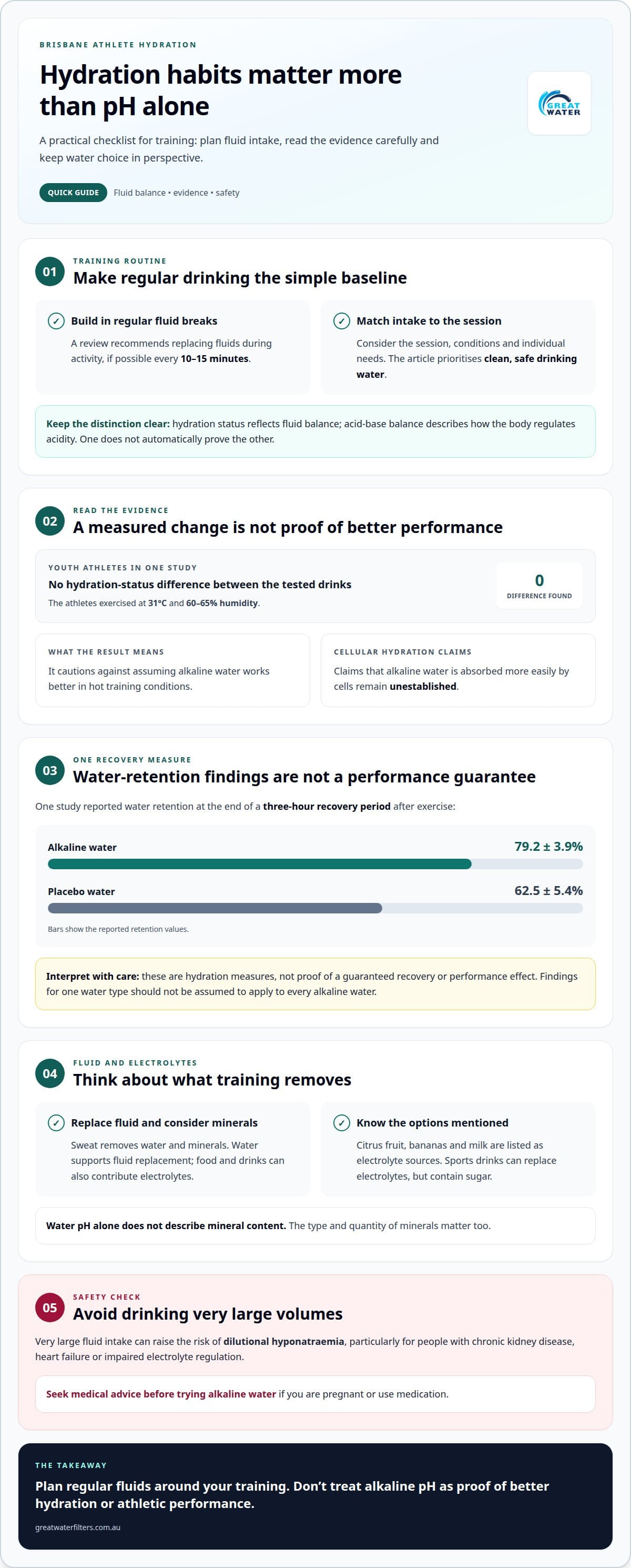
Rehydration after anaerobic exercise has attracted attention because repeated sprints and other short, intense efforts can involve substantial exertion. One study reported a significant decrease in urine specific gravity among athletes drinking alkaline, low-mineralised water after high-intensity interval exercise. Another reported water retention of 79.2 ± 3.9% with alkaline water, compared with 62.5 ± 5.4% with placebo water, at the end of a three-hour recovery period. These results describe hydration measures, not a guaranteed recovery or performance effect.
Other research has compared mineral water with spring water or sports drinks after exercise. One study concluded that deep-ocean mineral water shows promise as a rehydration source. Minerals can contribute electrolytes, but the type and quantity matter: “alkaline” alone does not explain a water’s mineral profile. Findings about one water type should not be assumed to apply to every alkaline water.
Exercise testing has also assessed performance after athletes completed stress tests with expired-gas analysis. A comparison conducted two weeks after testing considered performance, not pH alone. These measures help separate physiological changes from outcomes athletes care about, such as exercise capacity. Current findings do not show that alkaline water consistently improves anaerobic performance.
In Brisbane, tap-water costs depend on household water charges, while bottled-water prices vary by product and retailer. Bottled alkaline water and water made using a home filter have different purchase and ongoing costs, so compare cost per litre and any filter replacement expenses.
Risks matter during intense exercise. Drinking very large volumes can raise the risk of dilutional hyponatraemia, particularly for people with chronic kidney disease, heart failure or impaired electrolyte regulation. Pregnancy and medication use are also reasons to seek medical advice before trying alkaline water.
Alkaline water and cellular hydration claims
Alkaline water is sometimes promoted as hydrating cells more effectively than ordinary water. Evidence is mixed, so athletes should distinguish claims about water structure from practical hydration habits.
Australian health authorities’ practical priority is clean, safe drinking water. Alkaline water’s pH alone does not establish that it improves hydration or athletic performance.
Cellular Hydration Claims
“Cellular hydration” describes the idea that water enters and hydrates body cells more effectively. Claims that alkaline water is absorbed more easily by cells remain unestablished. That claim does not establish a performance benefit. The useful distinction for athletes is between a proposed mechanism and an outcome measured during training, such as hydration status or exercise capacity.
Hydration Status and Acid-Base Balance
Hydration status reflects the body’s fluid balance, while acid-base balance describes how the body regulates acidity. These are related aspects of exercise physiology, but one doesn’t automatically prove the other. A study of youth athletes exercising at 31°C and 60-65% humidity found no hydration-status difference between the tested drinks. That result cautions against assuming alkaline water works better in hot training conditions.
Hydration During Training and Performance
Replacing fluid during exercise helps limit the effects of sweat loss. A review recommends replacing fluids during activity, if possible every 10-15 minutes. Athletes can use that interval to plan regular drinking rather than waiting until a session ends. The choice of water still matters less than matching fluid intake to the session, conditions and individual needs.
Hydration can affect aerobic performance: a review reports that dehydration of 5% may reduce aerobic capacity by 20-30%. That figure illustrates why fluid replacement deserves attention, but it doesn’t show that alkaline water prevents the decline. Likewise, lactic acid is often mentioned in discussions of hard exercise, yet water pH shouldn’t be treated as a direct way to control muscle fatigue.
During intense training, sweat removes water and minerals. Water supports fluid replacement, while food and drinks can also contribute electrolytes. Citrus fruit, bananas and milk are examples of foods listed as electrolyte sources. Sports drinks can replace electrolytes lost through sweat and activity, but they contain sugar. The right choice depends on session demands and overall nutrition, not pH alone.
For hydration planning, use clean, safe water and spread fluid intake across training. A claim about smaller molecular clusters isn’t a substitute for that practical approach. If you’re considering a home option, explore alkaline water filtration options as a way to make alkaline water available at home.
Alkaline water and high-intensity anaerobic performance
Anaerobic exercise involves short, intense efforts, such as repeated sprints, wrestling exchanges or heavy lifts. Athletes often ask whether alkaline water can help sustain these efforts. The key question is whether measured changes in hydration or acid-base balance translate into better performance, not simply whether a drink has a higher pH.
A study involving combat sports professionals indicated that alkalised water improved hydration status, acid-base balance and high-intensity anaerobic exercise performance. These findings relate to training that relies on repeated powerful efforts. However, they describe the athletes and conditions studied; they do not show that every sport, session or bottle of alkaline water produces the same result.
Hydration status can affect how an athlete tolerates hard exercise. Sweat loss reduces body fluid, while replacing fluids helps support normal circulation and temperature control. In a boxing session, for example, an athlete may alternate intense rounds with recovery periods. Water choice is only one part of the plan, alongside training load, rest, food and individual needs.
Acid-base balance is another measure discussed in alkaline-water studies. High-intensity exercise changes the body’s internal chemistry as muscles produce energy. A reported improvement in acid-base balance is not, by itself, proof of greater anaerobic capacity. To assess performance, researchers need exercise-related outcomes, such as how well participants complete intense efforts, rather than relying solely on a laboratory marker.
The authors of one study recommended that combat sport athletes drink 3-4 L of highly alkaline mineralised water daily to improve hydration and anaerobic performance during training and competition. That recommendation belongs to the study’s context. It shouldn’t be treated as a universal prescription for Brisbane athletes, since fluid needs vary with sweat losses, exercise conditions, body size and other factors.
Minerals matter too. Sodium lost in sweat supports muscle contraction and relaxation, nerve impulses and fluid balance in cells. Potassium supports carbohydrate storage for muscle fuel and affects muscle contractions. An alkaline label does not tell athletes how much of either mineral the water contains, so pH alone cannot describe its usefulness during intense exercise.
Alkaline water may be one hydration option, but it does not replace a considered training and nutrition plan. Studies report possible benefits for anaerobic exercise, yet the results do not establish a dependable performance increase for all athletes. Match fluid replacement to each session’s demands and assess performance through training outcomes, rather than relying on a claim printed on a bottle.
Alkaline water pH and mineral content
Two details help describe alkaline water: its pH and its dissolved minerals. For athletes, these properties explain what is in the water, not whether it improves sports performance.
Alkaline Water pH
The pH scale runs from 0 to 14, with values above 7 classed as alkaline. Alkaline water typically sits between 8 and 10, but its pH can vary by product and treatment. A higher figure describes alkalinity; it doesn’t measure hydration quality, mineral balance or exercise effects.
Some recommendations suggest choosing alkaline water that maintains a pH of 9 or higher after the bottle is opened. That detail matters because exposure to air can affect pH. A label’s pH value may describe water at bottling, so the reading after opening is a separate consideration.
For Brisbane athletes comparing products, pH is only one part of the picture. A combat sport competitor and a distance runner may have different fluid and electrolyte needs, but pH alone cannot show whether a water suits either athlete. It also does not indicate how much sodium, potassium or magnesium the water contains.
Mineral Content
Mineral content describes dissolved substances in water, including electrolytes. Sodium, potassium and calcium support critical body functions. Athletes may also look for magnesium and phosphate, but an alkaline label alone does not establish the amounts present. Comparing pH and mineral information as separate properties gives a clearer picture.
Prolonged or intense exercise can involve fluid and mineral losses through sweat. Sodium supports fluid balance and muscle and nerve function, while potassium contributes to muscle activity. These roles explain why mineral content can matter alongside water intake; they do not mean every athlete needs mineralised alkaline water.
Recommendations for athletes sometimes favour alkaline water containing natural electrolytes such as sodium, potassium, calcium, magnesium and phosphate. Treat this list as minerals to consider, not proof that a particular product has an effective composition. Comparing the amount of each mineral is more useful.
For example, two alkaline waters may both fall within the typical pH range of 8 to 10 while containing different minerals. A bottle with a higher pH doesn’t necessarily contain more electrolytes. Comparing the listed mineral profile with your training demands gives more context than choosing by pH alone.
These distinctions help keep claims in perspective. pH describes acidity or alkalinity; mineral content describes dissolved minerals. Neither measurement alone establishes better recovery or performance. In Brisbane, athletes can use both details to understand a water choice, while treating hydration and sports nutrition as broader parts of training.
Differences between alkaline and regular drinking water
Alkaline and regular drinking water differ mainly in pH and, sometimes, mineral content. For Brisbane athletes, those measurements describe the water but do not establish which choice improves exercise performance.
The pH scale runs from 0 to 14, with 7 at its neutral centre. Alkaline water typically has a pH between 8 and 10. Regular municipal or bottled drinking water generally ranges from 6.5 to 8.5. These ranges overlap, so a water’s label or source alone doesn’t tell you its exact pH.
Regular water is usually near neutral, though its pH can vary slightly between locations because natural mineral content differs. For example, two municipal water supplies can fall at different points within the regular-water range. A pH reading describes acidity or alkalinity, not whether the water is suitable for drinking or training.
Total dissolved solids, or TDS, refer to minerals and other dissolved substances in water. Regular municipal or bottled drinking water generally contains less than 500 mg/L of TDS. That figure offers a broad comparison, not a complete mineral profile. It doesn’t identify how much sodium, potassium, calcium or magnesium a particular bottle contains.
Alkaline water’s higher pH does not automatically mean it contains more minerals. Some alkaline water is mineralised, while other water has its pH changed through treatment. When comparing two bottles, consider pH and mineral content separately. Neither measurement alone shows the water’s effects on hydration or athletic performance.
Scientific claims sometimes describe alkaline water as better for hydration or recovery. Consider them alongside the actual study outcomes, rather than inferring benefits from a higher pH. A pH difference is a property of the water, not evidence by itself of fewer symptoms, faster recovery or improved sports results.
For everyday drinking, the practical difference is straightforward: regular water is commonly closer to neutral, while alkaline water has a higher pH. Brisbane athletes can use pH and mineral details to understand what they are choosing. Training demands, food and overall fluid intake remain separate considerations; changing water type does not replace a broader hydration plan.
Compare alkaline water filtration options for your home.
Great Water Filters: Elite Series 2 Alkaline Water Filter
The Elite Series 2 Alkaline Water Filter gives households an option for alkaline drinking water at home. It may suit Brisbane athletes who prefer this type of water as part of their everyday routine, without assuming it will improve training or performance.
Great Water Filters supplies and professionally installs its Smarter & Healthier water filter systems, with Free Installation Australia Wide. A home water-treatment system is an option for your household, not a substitute for hydration planning, sports nutrition or medical advice.
For a straightforward discussion about the Elite Series 2 Alkaline Water Filter, contact Great Water Filters.
Choose a water option that fits your routine
Understanding the potential benefits of alkaline water for athletes in Brisbane means looking beyond the label and choosing a home water option that fits your preferences. Let your hydration routine, training plan and individual needs guide that decision. An alkaline water filter can provide an at-home option, but it is not a substitute for sound training or sports nutrition.
If you’re also considering household water treatment, Great Water Filters offers the ES5Q Hi Flow Wellness Whole House Water Filter System, Elite Series 3 Reverse Osmosis Water Filter System and Whole House Water Filter Softener. These options address different household water needs, so the right direction depends on what you want your home system to do.
Choose a water setup that suits your household and routine. A clear, considered choice is a good place to start.
Frequently Asked Questions
What are the claimed benefits of alkaline water for athletic performance and recovery?
Claims include improved hydration, better acid-base balance and support for recovery after demanding exercise. Some studies have also reported changes in hydration measures or anaerobic performance. These are specific findings, not proof that alkaline water consistently improves an athlete’s results. A change in a hydration marker, for example, does not necessarily mean faster recovery or better performance in the next training session.
What does scientific evidence say about alkaline water and exercise hydration?
Scientific findings are mixed and depend on the participants, water tested and exercise protocol. One study of 100 healthy adults reported alkaline water was twice as hydrating as regular water after exercise. That result is a reported study finding, not a guarantee for every athlete or training session. Other research has found no hydration-status difference between tested drinks, so alkaline water hasn’t been established as consistently superior.
How does alkaline water compare with regular water and sports drinks for athletes?
Alkaline water differs from regular water in pH, while sports drinks can provide electrolytes lost through sweat and activity. Sports drinks also contain sugar, which may matter to athletes managing their overall nutrition. A drink’s label does not show whether it suits every session. An athlete’s needs during a short workout may differ from those during prolonged, demanding exercise.
Does alkaline water improve endurance, strength, or post-exercise recovery?
Current findings do not establish reliable improvements in endurance or strength for all athletes. Research involving combat sport professionals has indicated possible improvements in anaerobic performance, but findings from one training context cannot be assumed to apply to every sport. Recovery also depends on more than fluid choice, including rest, training load and nutrition. Track how you feel and perform across sessions, rather than relying on a water claim alone.
Can alkaline water affect blood pH or reduce exercise-related acidity?
One double-blind study reported that highly alkaline water at pH 9.3 increased resting and post-exercise blood pH and reduced metabolic acidosis after intensive exercise. This suggests a possible effect on measured acid-base markers under the study conditions. It doesn’t show that alkaline water reliably changes every athlete’s blood pH or removes exercise-related fatigue. A laboratory result and a meaningful performance benefit are different outcomes.
COMMENTS