
Protect your family with pure water for drinking, bathing, and appliances.
The right water softener for your Brisbane home depends on more than how many people live there. Household size matters, but so do your water hardness, daily use and peak-time demand. Choosing by tank size alone can leave you with a system that doesn’t suit the way your household uses water.
This guide to water softener sizing Brisbane homeowners can use explains how to compare treatment capacity with flow rate, what affects salt use and regeneration, and what information to gather before choosing a system. You can prepare a useful comparison without getting bogged down in an industrial calculator.
Great Water Filters supplies and professionally installs residential whole-house water softeners, with Free Installation Australia wide and Transparent upfront Pricing. Our service covers Melbourne, Perth, Sydney, Brisbane, the Gold Coast, Adelaide, Alice Springs, Hobart and Launceston. With 100% No Risk, No Upfront Payment Required, and Only Pay when Fully Installed & Happy, you can plan for Smarter & Healthier water filter systems with less uncertainty.
Key Takeaways
- For water softener sizing Brisbane homes, match treatment capacity and flow to household demand, not occupancy alone.
- Use a water hardness result alongside your household’s water-use patterns to understand treatment demand and regeneration.
- Compare capacity and peak flow together. A system with a larger capacity isn’t automatically the best fit.
- Record your water supply, hardness, typical use and busiest periods before comparing residential softener specifications.
- These details give you a practical starting point for selecting and planning installation of a suitable system.
Water softener sizing in Brisbane: what determines the right fit?
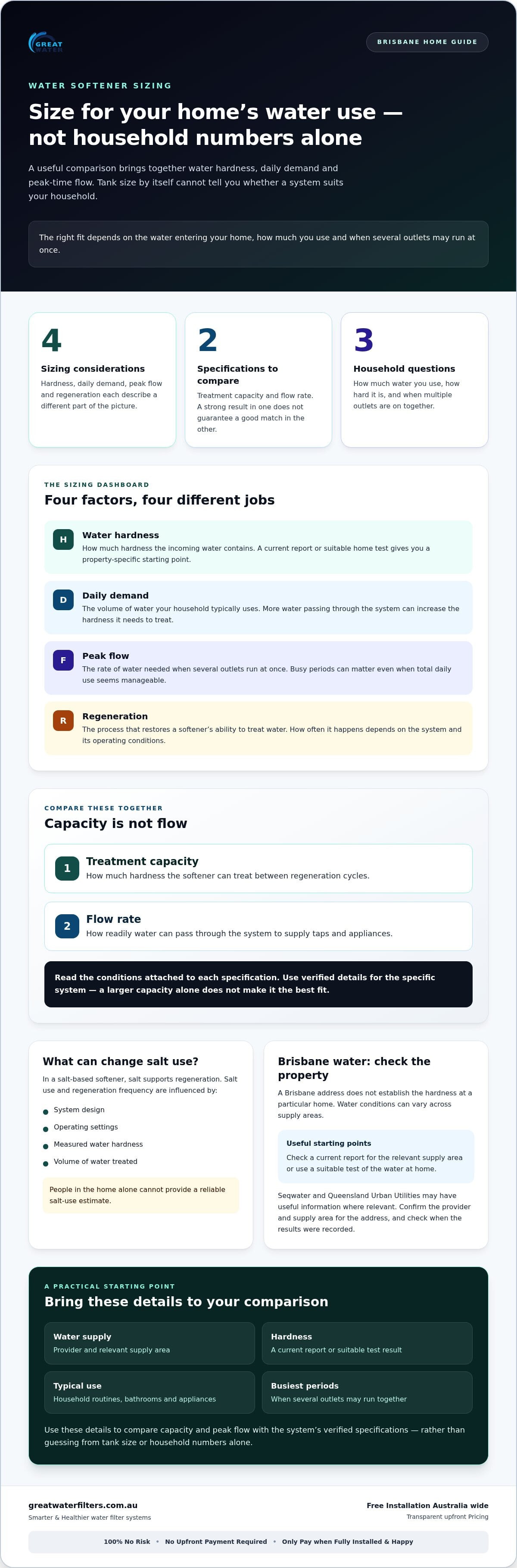
Choosing a residential softener isn’t simply a matter of counting people or picking the biggest unit available. Water softener sizing Brisbane homeowners can use means matching a system’s treatment capacity and flow to the property’s water conditions and patterns of use. A good comparison considers how much hardness the system must treat, how much water the household uses and when demand is highest.
Occupancy is one useful clue, but routines matter too. Two homes with the same number of residents may have different demands: one might run showers, a dishwasher and a washing machine at the same time, while another spreads water use across the day. The number of bathrooms, appliances and household habits all help describe demand. Regeneration, the process that restores a softener’s ability to treat water, is another consideration. These factors relate to one another, but they measure different things.
- Hardness: the amount of hardness minerals in the incoming water.
- Daily demand: the volume of water the household typically uses.
- Peak flow: the rate of water needed when several outlets are running.
- Regeneration: how often the softener needs to restore its treatment capacity.
Understanding how softening works can make product specifications easier to interpret. Understanding Water Softening offers an overview of the process and its underlying principles.
What does water softener capacity mean?
Capacity describes how much hardness a softener can treat between regeneration cycles. Flow rate is different: it describes how readily water can pass through the system to supply taps and appliances. A unit may have ample treatment capacity but still be a poor match if its flow performance doesn’t suit the home’s busiest periods. Compare both measures and read the conditions attached to each figure. Use the specific system’s verified specifications rather than relying on a generic capacity number.
Why Brisbane water conditions need a property-specific check
A Brisbane address alone doesn’t establish the hardness of water entering a particular home. Water conditions can vary across supply areas, so don’t assume a city-wide description applies to your street or property. Start with a current water-quality report for the relevant supply area or a suitable test of the water at your home.
Seqwater and Queensland Urban Utilities may provide useful water-quality information where relevant. First identify which provider and supply area apply to your address, then check that the report covers that area and note when its results were recorded. A local report or test is a more useful starting point for assessing hardness than a broad Brisbane label. You can then compare the result with household demand, peak-flow needs and the softener’s specifications instead of guessing at tank size.
How water hardness, household demand and salt use affect softener sizing
Hardness and water use work together to determine how quickly a softener’s treatment capacity is used. Hardness describes the amount of dissolved minerals, mainly calcium and magnesium, in water. A test result gives you a property-specific measure to compare with system specifications. Without it, an estimate based only on household numbers can miss a key part of the sizing picture.
How hardness and daily water use affect capacity
Think of hardness as the concentration the softener must treat and daily water use as the amount of water passing through it. If either increases, the system may need to treat more hardness overall. Its available capacity may be used sooner, and regeneration may happen more often, depending on the system’s design and settings.
For example, two households with similar routines may have different treatment needs if their incoming water has different hardness. A larger household using more water may also place greater demand on a softener than a smaller household supplied by water with lower hardness. These comparisons help explain the factors involved, but they aren’t sizing calculations. A worked estimate is only useful when its water-test result, usage assumptions and system specifications are stated and technically checked.
What salt use and regeneration can, and cannot, tell you
In a salt-based softener, regeneration restores the system’s ability to treat hardness. Salt supports this process, but the amount used isn’t determined by one factor alone. System design, operating settings, measured hardness and the volume of water treated all influence salt use and regeneration frequency.
So salt consumption can’t be reliably estimated from the number of people in a home or from a general Brisbane figure. A product’s stated salt use is meaningful in the context of its specifications and the conditions behind that figure. Treat it as a guide for that particular system, not a universal household allowance.
Keep these three questions separate as you assess your household’s needs:
- How much water is used across a typical day? This helps indicate overall treatment demand.
- How hard is the incoming water? A reliable test helps establish how much hardness the softener must address.
- When do several outlets run at once? Short periods of high simultaneous use affect peak flow, which is different from total daily treatment demand.
A busy morning may make flow performance especially relevant, while daily demand and hardness help explain how quickly capacity is used. Neither measure replaces the other. Consider both alongside the system’s regeneration requirements.
For a residential option, compare these factors with the specifications of a whole-house water filter softener. This keeps the comparison grounded in your water test and household use rather than assumptions about a typical home. You can then factor in salt use as part of the system’s operating needs, without relying on an unsupported fixed estimate.
Compare softener capacity and peak flow for a Brisbane household
Capacity and flow rate answer different questions, so compare both. Capacity concerns how much hardness a softener can treat before regeneration. Flow rate concerns how quickly water can pass through it. For water softener sizing Brisbane households need, looking at both helps avoid choosing a system that appears suitable on paper but doesn’t match the home’s actual use.
Capacity versus flow rate: two different sizing checks
A system with ample treatment capacity may still be a poor fit if its flow rate doesn’t meet demand when several outlets are in use. The reverse can also be true: a system that supports the home’s peak flow may not have treatment capacity suited to its water hardness and daily use. Check the specifications for both measures, including the conditions behind them. Avoid comparing figures from different systems as if they were measured on the same basis.
Use this comparison to organise the details:
Capacity: How much hardness can the system treat between regeneration cycles? Compare its stated capacity with your water test and household demand.
Flow rate: How quickly can water pass through the system? Consider the outlets and appliances likely to run at the same time.
Regeneration approach: How does the system restore its treatment capacity? Review the stated method and any operating information in its specifications.
Household-use questions: How many bathrooms are in regular use? Do showers, taps or appliances commonly overlap?
How household routines affect peak flow
Picture a busy morning: someone is showering while another person uses a kitchen tap and the washing machine is running. That overlap creates a different demand from the household’s total water use across the day. The number of bathrooms and the fixtures that tend to run together help describe likely peak flow, without needing to calculate an industrial-style demand figure.
Think about a normal busy period, rather than an unusual one-off event. Note which outlets are likely to overlap and how regularly that happens. These details make the flow comparison practical, but they don’t replace a hardness test or determine the right model on their own.
A high-capacity softener isn’t automatically the best match. Capacity alone doesn’t show whether the system’s flow performance suits the household or whether its regeneration approach fits the treatment demand. Weigh these factors together against the property’s water conditions and normal routines.
When reviewing a whole-house water softener, keep its stated capacity, flow rate and regeneration details together. This makes it easier to compare relevant specifications rather than tank size alone, and gives you a clearer starting point for a system suited to your home.
A practical Brisbane checklist for estimating your water softener needs
A few well-organised notes make it easier to compare residential softeners without relying on a guess. Use this checklist to prepare a preliminary estimate of your home’s needs. It won’t determine the final system selection on its own, but it gives you useful information to review against specifications and plan the next steps in water softener sizing Brisbane homeowners can follow.
- Identify your water supply. Record the property address and relevant water source or supply area. This helps you find information that applies to your location rather than relying on a broad Brisbane-wide description.
- Get a reliable hardness result. Save the test result and note its units and date, if provided. A property-specific result is more useful for comparing treatment needs than an assumption based on suburb alone.
- Estimate household use. Note the usual number of people in the home, daily routines and water-using appliances. Household water-use records can help inform an estimate, but occupancy isn’t a complete measure of demand.
- Assess peak flow. List the bathrooms and outlets that may be used together. Consider regular overlap, such as showers running while a kitchen tap or appliance is in use.
- Compare system specifications. Review stated treatment capacity, flow rate and regeneration information alongside your hardness result and use patterns. Keep the specifications with your notes so comparisons stay consistent.
Information to gather before comparing systems
Keep the details together in one place: your water supply, hardness result, occupancy, typical daily use, likely overlapping water demand and any known site constraints. These might include limited installation space or access considerations. Recording them won’t establish that a particular system will fit, but it makes a residential comparison more relevant to your property and helps with installation planning.
How to read a sizing estimate responsibly
A useful estimate should account for hardness, household demand, peak flow and regeneration, not just the number of occupants. If you use a calculator, check what information it asks for and how it treats the result. Missing inputs or broad assumptions can affect the estimate, so regard its output as a starting point rather than a guaranteed final selection.
Before moving from an estimate to installation planning, bring your notes and the system specifications together. A whole-house water softener installation guide explains the practical planning stage, including how property details fit into the process. A suitable recommendation should reflect the actual home and its water needs, not a generic household profile.
Get a properly sized water softener installed in Brisbane
Once you’ve gathered your water and household-use details, you’re ready to move from an initial estimate towards a solution suited to your property. Carry those details into the planning process so the system choice reflects your home rather than a generic assumption. Great Water Filters supplies and professionally installs residential whole-house water softeners, making it easier to take the next step without working through every technical decision alone.
What a supported installation pathway offers
A supported process connects your sizing information with a residential whole-house water softener and the practicalities of fitting it in your home. Clear communication helps you understand the decisions along the way. We look after the process with you, so you can Sit Back & relax while the plan takes shape.
A straightforward next step for Brisbane homeowners
Have your water test, household-use notes and relevant property details ready. They provide a useful starting point for shaping a solution around your needs. The discussion can then focus on the system and installation considerations that matter for your home, rather than asking you to choose by guesswork.
There’s no need to rush. When you’re ready, use the information you’ve gathered to make the process clear and manageable.
Take the next step towards a better-fit system
A good sizing decision gives you a practical starting point, not a reason to second-guess every specification. Keep your property's water information and household notes together so they're easy to refer to as you consider a suitable system. If your routines or water-use patterns change, those details can also help guide a future review.
With your preparation in place, water softener sizing Brisbane homeowners can feel confident about becomes a clearer conversation about their own home. A tailored solution can take your household's needs into account rather than relying on a broad assumption about Brisbane properties. You don't need every technical detail worked out before taking the next step.
Register to begin planning a residential water softener solution for your home. Great Water Filters provides residential water treatment and installation in Melbourne, Perth, Sydney, Brisbane, the Gold Coast, Adelaide, Alice Springs, Hobart and Launceston. The team can help turn the information you've gathered into a straightforward path forward.
Register for a tailored water softener solution
A considered choice starts with the right information. Register when you're ready and take the next step towards a system suited to your household.
Frequently Asked Questions
How do I size a water softener for a Brisbane home?
Use a property-specific water result and household information to get a preliminary estimate, then compare it with the specifications of a residential softener. Note the assumptions used in any online calculator, including the hardness value entered and how water use was estimated. If those assumptions change, the result may change too. Treat the estimate as a comparison aid, not a final system selection.
Does Brisbane tap water have the same hardness across every property?
No. Check that a water-quality report applies to the supply area serving your address and note when its results were recorded. A zone average can describe reported conditions in an area, but it isn’t a measurement taken at your tap. If you’re comparing a report with a test, check that both use the same hardness units before drawing conclusions.
How much salt does a household water softener use?
There’s no single salt-use figure that applies to every home and system. After installation, follow the system’s operating instructions and keep a simple record of when salt is added and how much is used. That record can help you understand your own usage over time. Product information and operating settings are more useful than a general estimate based only on household size.
Can a water softener be too large for a home?
Yes, a system can be a poor match if its design doesn’t suit the home’s actual requirements. A larger capacity number alone doesn’t tell you how the system will operate under your conditions or what its salt use will be. Read the specifications as a whole, including the stated operating and regeneration information, rather than treating capacity as a stand-alone measure of suitability.
Does water softener sizing depend on peak water flow?
Yes. Check how the system’s flow information is presented, including any conditions attached to the stated rate. Specifications may describe performance under particular operating conditions, so a number on its own can be difficult to interpret. Think about your household’s normal busy period and use that routine to assess whether the published flow information is relevant, rather than relying on an unusual combination of outlets.
Is a water hardness test needed before choosing a softener?
A reliable test is a helpful basis for choosing, especially when comparing estimates or system specifications. Check that the sample represents the incoming water you want to treat, not water taken after an existing treatment device. Keep the result, its units and the test date together. This makes it easier to understand what information a sizing estimate uses and to revisit the result later if needed.
Does Great Water Filters provide installation in Brisbane?
Yes. Great Water Filters supplies and professionally installs residential water treatment systems, including whole-house water softeners, in Brisbane. Free Installation Australia wide makes the installation process straightforward. To begin a tailored request, use the registration form and have your property details available. This gives you a practical starting point for discussing your home’s needs and planning installation.
COMMENTS