
Protect your family with pure water for drinking, bathing, and appliances.

A Perth water-quality report describes the water supplied to your area, but it isn’t a test of every home’s tap. If you’re looking for the Perth water quality report 2026, note the reporting dates: as of October 2026, Water Corporation’s latest comprehensive annual report covers 2024-2025, while its latest available quarterly report covers the quarter ending 31 March 2026.
Regional tables and technical terms can make it hard to know what the figures mean for your household. A result that meets health-based guidelines can sit alongside differences in taste, hardness or other aesthetic qualities. Regional results also don’t account for every home’s plumbing or tell you exactly what comes from your own tap.
This guide explains where to find Water Corporation’s reports, how to identify their reporting periods and read results in context, and how to decide whether household water treatment suits your preferences. Filtration is a personal choice, not a sign that Perth’s public drinking water is unsafe.
Key Takeaways
- Use the Perth water quality report 2026 to understand the public supply, not as a direct test of water at your own tap.
- Check the report’s area and reporting period before comparing results, so you’re looking at data relevant to your location and timeframe.
- Understand what measurements such as hardness, turbidity and total dissolved solids tell you, and how they differ from health-based compliance.
- Use household preferences, such as taste or scale build-up, to decide whether filtration is relevant. A filter is a personal choice, not a requirement for everyone.
- Great Water Filters supplies Smarter & Healthier water filter systems, including a whole-house option, with Free Installation Australia wide.
Perth Water Quality Report 2026: What It Covers and Who Publishes It
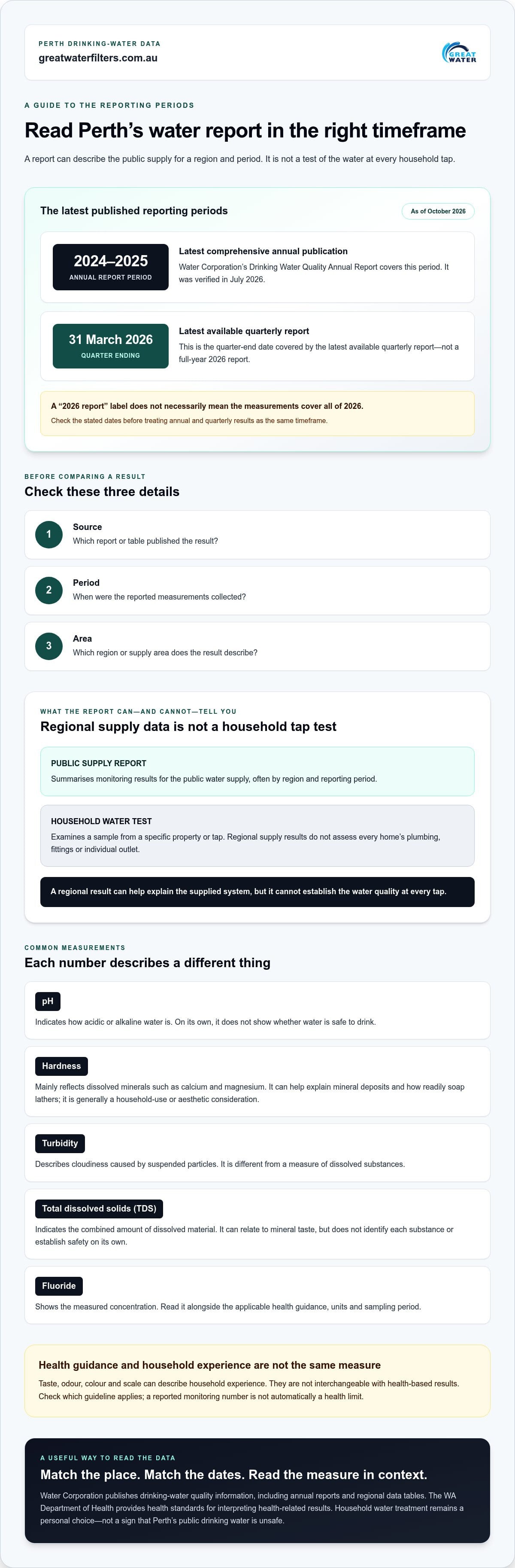
A drinking-water quality report describes the public supply monitored by the water utility. It can help you understand reported results for a region, but it isn’t a test of the water flowing from a particular kitchen tap. Regional supply data doesn’t assess household plumbing, fittings or conditions within a property, so it can’t establish the quality at every individual outlet.
Perth’s water supplier is Water Corporation, which publishes drinking-water quality information, including annual reports and regional data. The WA Department of Health is the relevant health authority. Its published health standards provide important context for health-related results, which are distinct from measures of taste or appearance.
Water-quality report: Summarises monitoring results for the public water supply, often by region and reporting period.
Household water test: Examines a sample taken from a specific property or tap. Regional supply results aren’t a substitute for this.
Where to find Perth’s official drinking-water data
Start at Water Corporation’s drinking-water quality page. Look for the annual Drinking Water Quality Annual Report and the Perth Region data tables. They serve different purposes: an annual report gives a broad view across its stated period, while regional tables help you focus on results associated with Perth. Check the report notes or table headings for the dates covered.
Before using a figure, note three details alongside it:
- Source: the report or table that published the result.
- Period: the dates when the reported measurements were collected.
- Area: the region or supply area the result describes.
What does ‘2026 report’ mean?
The year in a page title, article or search result doesn’t necessarily tell you when the water was measured. As of October 2026, Water Corporation’s latest comprehensive annual publication is the Drinking Water Quality Annual Report 2024-2025, verified in July 2026. Its latest available quarterly report covers the quarter ending 31 March 2026. So a reference to the Perth water quality report 2026 may mean newer quarterly data, not an annual report covering all of 2026.
Keep the label precise when you read or compare results. For example, describe a figure as coming from the Perth Region table for its stated period, rather than calling it a current 2026 measurement if the table covers earlier dates. This prevents older annual data and newer quarterly information from being treated as though they describe the same timeframe. For useful comparisons, match the geographic area and reporting period before drawing conclusions about trends or your household’s tap water.
How Perth’s Water Supply and Quality Measurements Are Reported
Water-quality results make more sense when you know what was sampled and what each measurement describes. Monitoring can include water at its source, after treatment and as it moves through the distribution network. These checks cover different stages of the supply system, so a result from one stage shouldn’t automatically be treated as a measurement from every household tap.
Water Corporation’s reported supply sources include desalination, dams and groundwater. Its 2023-24 source mix also included groundwater replenishment. These are system-wide figures for that period, not a promise that each Perth suburb receives the same blend at all times. Read sources and results with their stated locations and dates in mind.
What common water-quality measurements tell you
In the Perth water quality report 2026, measurement names can look technical, but each gives a particular piece of information. None is a complete verdict on water quality in isolation.
- pH indicates how acidic or alkaline water is. It doesn’t, by itself, show whether water is safe to drink.
- Hardness mainly reflects dissolved minerals such as calcium and magnesium. It can help explain mineral deposits on taps or appliances and how readily soap lathers. Hardness is generally an aesthetic or household-use consideration, not a stand-alone health measure.
- Turbidity describes cloudiness caused by suspended particles. It’s different from a measure of dissolved substances, and its meaning depends on the reported result and applicable guidance.
- Total dissolved solids (TDS) indicates the combined amount of dissolved material in water. It can relate to mineral taste, but a TDS reading doesn’t identify each substance or establish safety on its own.
- Fluoride results show the measured concentration. Read them alongside the applicable health guidance and the report’s units and sampling period, rather than comparing a figure without context.
Taste, odour, colour and scale are useful clues about household experience, but they aren’t interchangeable with health-based results. For information about standards and water-quality management in Western Australia, consult the Western Australian Department of Health. Check which guideline applies to a measurement, then compare the result with that guidance. A number may be reported for monitoring without being a health limit.
How Perth’s water sources and monitoring fit together
Source water is treated before it enters the distribution network, and monitoring across these stages helps describe the supplied system. A regional result isn’t necessarily a measurement from your street, and a source proportion doesn’t identify the exact water reaching your home. Use the report’s location, units and measurement period to make fair comparisons.
If the data raises a household preference around taste or mineral deposits, it can help you decide whether treatment is worth considering. Great Water Filters offers household water filtration options for people weighing that choice.
Is Perth Tap Water Safe? Reading the Data Without Misinterpreting It
Health-based compliance and water that tastes or looks appealing answer different questions. Water Corporation’s 2021-22 report recorded 100% compliance with the health-related requirements set by the WA Department of Health. That result applies to the requirements and reporting period stated, not automatically to every later year or every household tap.
As of October 2026, Water Corporation’s latest comprehensive annual report covers 2024-2025. Don’t attach the 2021-22 compliance figure to that newer reporting period unless its own results support it. Check the relevant report’s findings and scope before drawing a conclusion about the current supply.
Health-based standards versus taste, hardness and scale
A health-based result compares monitored water with health requirements. Taste, odour, colour and hardness describe other qualities, including how water feels to drink or how mineral deposits may affect household cleaning. An aesthetic concern doesn’t, by itself, establish a health risk, and a difference in taste alone doesn’t mean filtration is necessary.
Use the report’s own wording and dates. Keep the health question separate from household preferences, then consider each result in context rather than treating one measurement as a complete safety score.
| What you’re assessing | What it can tell you | What it can’t establish |
|---|---|---|
| Health-based compliance | Whether reported results met the health-related requirements for the stated period and scope. | The condition of every tap or plumbing system in an individual home. |
| Aesthetic measures | Reported qualities such as taste, colour, odour or hardness that may affect household experience. | A health risk based on appearance or taste alone. |
| Household-specific observations | What you notice at a particular tap, such as an unusual taste or visible deposits. | Whether the public supply across Perth has the same characteristic. |
Why a Perth-wide or suburb figure may not match your tap
Regional results and postcode profiles summarise a defined area, sample set or period. They aren’t necessarily measurements taken at your property. Plumbing and household storage can also affect water between the supply network and an individual tap. That’s why a city-wide average or a single suburb figure can’t confirm the precise condition of water in your home.
Third-party scores and recommendations can help organise information, but treat them as interpretations, not official Water Corporation findings. Check how they define the area, when the data was collected and whether a score combines health and aesthetic measures. The Perth water quality report 2026 is most useful when you keep those distinctions clear. If you have a concern specific to your property, assess it separately from public-supply monitoring results.
How Perth Residents Can Use the 2026 Water Quality Information
A clear reading starts with a focused question. Are you checking a reported feature of Perth’s public supply, comparing results over time, or trying to understand something specific at home? Keeping those questions separate helps you use the right evidence and avoid treating a regional figure as a diagnosis of your property.
A simple process for checking the Perth report
Use this sequence to make the official information easier to interpret:
- Open Water Corporation’s drinking-water quality page and locate the Perth Region information.
- Identify the document or table, then record the reporting period it covers. A page published in 2026 may present measurements collected earlier.
- Note the indicator and its unit together. A number without its measurement name and unit can be misleading.
- Read any accompanying guideline or explanatory notes. Check whether the comparison relates to health requirements or an aesthetic characteristic.
- Compare results only when the area, measurement, units and reporting periods match. If a table covers a different region or timeframe, it may not support a like-for-like comparison.
For example, before comparing two hardness figures, check that both refer to the same kind of measurement and comparable geographic areas and periods. If the source or timeframe isn’t clear, treat the comparison cautiously rather than assuming a change has occurred.
This is especially useful with the Perth water quality report 2026, because the phrase can refer to information published during 2026 without meaning every result was measured that year. Keep the source and period beside any figure you save or share. That makes it easier to revisit the data without losing its context.
When a household concern needs a different answer
Water Corporation’s report describes monitoring of the public supply. It doesn’t test the plumbing or storage within your home, or establish the exact condition of water at a particular tap. If your concern is specific to your property or how you use water, separate that question from the regional results.
Start by describing what you’ve noticed and where, rather than reacting to one headline number. A taste preference, visible deposits and a concern about a household tap are different issues, and a city-wide or suburb summary won’t resolve them all. A water-quality report provides useful supply context, but it isn’t a substitute for household-specific assessment. Keep the report’s findings in perspective, then consider what information would address your concern. This section focuses on reading public-supply data, not choosing a test or recommending treatment.
Considering a Perth Home Water Filter After Reading the Report
A water-quality report can inform your thinking, but it can’t decide whether a filter is right for your household. Filtration is a personal choice, not proof that Perth’s drinking water is unsafe. Start with what matters to you, such as your preferred drinking-water setup or whether you want treatment across the home. Then explore options that suit that preference rather than reacting to a single figure without its context.
The Perth water quality report 2026 helps explain the public supply, but it can’t tell you which household system suits you. A reported aesthetic characteristic may prompt questions about taste or scale, while an interest in drinking water may lead to a different choice. Neither automatically means treatment is needed.
Choosing between whole-house and drinking-water filtration
The key difference is where the system is intended to treat water. A whole-house system is designed for the home’s incoming supply, while a drinking-water system is intended for a drinking-water point. These categories differ in scope. Don’t assume either will address a particular substance or concern unless claims for the specific system support it.
If you’re considering treatment throughout your home, explore whole-house water filtration as a category. The ES5Q Hi Flow Wellness Whole House Water Filter System is one option. If your interest is limited to drinking water, focus on that point-of-use preference instead. Match the system type to how you want to use treated water, not to a regional result that doesn’t describe your individual tap.
A useful starting question is whether you want to treat water throughout the home or mainly at a drinking-water point. That practical distinction can help narrow the type of system to explore, without turning a public-supply report into a product recommendation.
A straightforward next step with Great Water Filters
Great Water Filters supplies and professionally installs residential water-treatment systems in Perth. The team can look after the process, making it easier to explore Smarter & Healthier water filter systems based on your household’s preferences.
Great Water Filters also provides Free Installation Australia wide, supporting households in Perth as well as Melbourne, Sydney, Brisbane, the Gold Coast, Adelaide, Alice Springs, Hobart and Launceston.
Make Your Next Water Choice With Confidence
Let the Perth water quality report 2026 inform your thinking, but let your household’s priorities guide what you do next. You don’t need to make a change simply because a report contains technical measurements. Identify what you’d like to improve or understand at home, then explore options that align with that preference.
If a water filter feels like the right fit, take the next step at your own pace. Great Water Filters can help make the process straightforward, from considering a suitable residential system through to professional installation. There’s no need to feel pressured to choose before you’re ready.
Clear information makes for a more confident decision. Whether you choose a system or decide your current setup suits you, you can move forward with greater peace of mind.
Frequently Asked Questions
Is Perth tap water safe to drink in 2026?
Water Corporation monitors the public supply against health requirements, but a report can’t guarantee the condition of every household tap. As of October 2026, its latest comprehensive annual report covers 2024-2025, and the latest available quarterly report covers the quarter ending 31 March 2026. The cited 100% health-compliance result is from 2021-22, so use the findings for the relevant reporting period when assessing current information.
Where can I find the official Perth water quality report?
Look on Water Corporation’s drinking-water quality page for the annual Drinking Water Quality Annual Report and Perth Region tables. To locate the right document, note its exact title and reporting period, then look for the Perth Region section or table. In a downloaded report, use its contents page or document search to find the relevant section. Check the table notes before relying on a figure.
Does Perth tap water contain fluoride?
Yes, fluoride is added to Perth’s water supply. A secondary Perth water profile reports an average of 0.84 mg/L, below the Australian Drinking Water Guidelines health guideline maximum of 1.5 mg/L. Treat that as a profile figure, not a measurement from every suburb or tap. For the official result relevant to a location and timeframe, consult Water Corporation’s regional data and its stated units.
Why does Perth tap water leave scale on appliances?
Scale is commonly associated with hardness, which reflects dissolved minerals such as calcium and magnesium. As water is heated, mineral deposits can build up in kettles, around taps and on appliance surfaces. The amount can vary by supply area, so a scale ring in your kettle doesn’t establish a health problem or show the precise hardness at your home. It describes a household maintenance concern.
Can water quality vary between Perth suburbs?
Yes, some reported characteristics, including hardness, can differ between supply areas. Secondary water profiles report a range from 29 mg/L as calcium carbonate in Dwellingup to 228 mg/L in Two Rocks. Those figures aren’t a suburb-by-suburb reading of every home. Check the Perth Region table’s coverage and avoid applying a result from another area to your address.
Does a Perth water quality report describe the water at my home?
No, a regional utility report doesn’t test your individual kitchen tap. A result for a supply area won’t show whether a particular tap has a local plumbing issue or whether water held in household storage has changed. If you’re investigating a specific taste, appearance or fitting concern, note where and when it occurs. Keep that observation separate from the public-supply figures.
Should I use a water filter with Perth tap water?
It’s a household choice, not a requirement for everyone or proof that public water is unsafe. Start by naming what matters to you: perhaps the taste of drinking water or having a treatment system for water throughout the home. Then look for a system suited to that intended use. Don’t assume a filter addresses a particular substance unless claims for that specific system support it.
Are Perth water quality figures from third-party websites official?
No. A third-party chart, postcode profile or score is an interpretation, not a Water Corporation finding. It may be useful for orientation, but check the cited original source, measurement period, area and units before using its figures. If those details aren’t clear, don’t treat the number as a current official result for your suburb. Give priority to the relevant Water Corporation report or regional table.
COMMENTS