
Protect your family with pure water for drinking, bathing, and appliances.

UV light can disinfect well water, but its effectiveness depends on the water conditions. Great Water Filters helps you assess your Hobart home well’s water clarity and quality, including whether iron, manganese or other debris could absorb or scatter UV light and reduce treatment effectiveness.
We look after the process of finding a suitable way to treat your household water, starting with understanding what is in the well. We help you choose a UV system to match your water and household demand, with appropriate pre-filtration, a reliable power supply and safeguards for low UV intensity.
This guide explains how UV disinfection works through household plumbing and what water testing can reveal. It also covers treatment classifications, Australian standards, routine maintenance and power safeguards, so we can help you consider whether UV suits your home and what needs to be in place for it to work as intended.
Key Takeaways
- We help match the UV treatment classification to the organisms the system is intended to inactivate, including bacteria, viruses or protozoa.
- For whole-home disinfection, we help ensure the system treats household demand, with plumbing arranged to avoid breaks or backflow.
- We use water test results and the home’s peak flow needs to guide UV system selection, rather than choosing by lamp size alone.
- We look for relevant Australian standards and WaterMark requirements when assessing a domestic treatment unit.
- We help plan routine manufacturer-recommended maintenance, low-UV alarms and a dependable power supply.
Maintenance and water testing
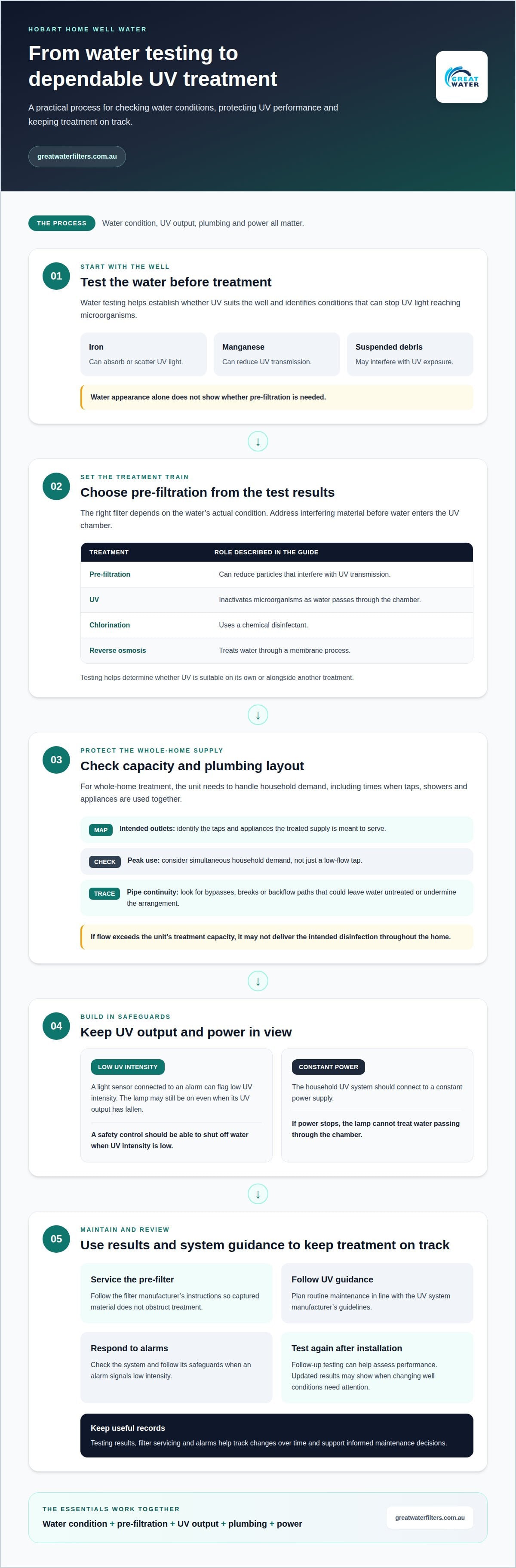
Water testing helps establish whether UV treatment suits a Hobart well. Results can identify conditions that affect how light reaches microorganisms, including iron, manganese and suspended debris, which can absorb or scatter UV light. A pre-filter should address these materials before water enters the UV chamber. The right filter depends on the water’s actual condition, not appearance alone.
UV, chlorination, filtration and reverse osmosis serve different treatment roles. UV inactivates microorganisms, while filtration can reduce particles that interfere with UV transmission. Chlorination uses a chemical disinfectant, and reverse osmosis treats water through a membrane process. Testing helps determine whether UV suits the water on its own or alongside other treatment.
A useful assessment considers well water before treatment and treated water after installation. Initial results guide system selection and pre-filtration. Follow-up testing can help assess whether the installed treatment is performing as intended. If well conditions change, updated results may show that the treatment setup needs attention.
The company can look after maintenance in line with the UV system manufacturer’s guidelines. A light sensor connected to an alarm can alert the company when UV intensity is low. This matters because the lamp may still be on even when its UV output has fallen. The company can also ensure a safety control is able to shut off the water supply when UV intensity is low.
- Water assessment: the company can review iron, manganese and debris that could reduce UV transmission.
- Pre-filter maintenance: the company can service the pre-filter according to its manufacturer’s instructions so captured material does not obstruct treatment.
- Low-intensity alerts: the company can respond to an alarm and check the system, rather than assuming disinfection continues normally.
Include power in the maintenance plan. A household UV disinfection system should connect to a constant power supply. If power stops, the UV lamp cannot treat water passing through the chamber. The low-UV safety control should prevent inadequately treated water from continuing into household plumbing.
Testing and maintenance work together. For example, if testing identifies iron or manganese, the company can arrange pre-filtration to address those materials before water reaches the UV stage. If an alarm signals low intensity, the company can follow the system’s safeguards and manufacturer instructions. This approach brings water condition, filter performance, UV output and power supply into one maintenance plan.
For a Hobart well, the company can plan servicing around the system’s instructions and water test results. The company can keep records of testing, filter servicing and alarms. These details help track changes over time and support informed maintenance decisions, without relying on a fixed schedule that ignores the well’s conditions.
Disinfection across household plumbing
A UV unit disinfects water as it passes through its chamber. For whole-home treatment, it must handle the water the household needs, including periods of simultaneous use. A unit sized only for a low-flow tap may not meet demand when showers, kitchen taps and appliances run together. We assess system capacity and plumbing layout together as part of our service.
Placement matters too. A household UV disinfection system should be located as close to the point of use as possible. The intended treatment area needs a clear route from the UV unit to the taps and appliances it serves. A bypass, untreated branch or connection around the unit could leave some outlets outside the treated supply. We account for every intended outlet when assessing the layout and installing the system.
Plumbing connected to UV treatment should have no breaks or backflow paths. A break can create a route for contamination after water passes through the chamber. Backflow can move water in the wrong direction and undermine the intended treatment arrangement. Our professional installation considers pipe connections, branches and return paths, not just the UV unit.
Classification helps define which microorganisms a UV system is designed to inactivate. Class IIa means the system will remove or inactivate bacteria. Class IIb means it will remove or inactivate viruses. Class IIc means it will remove or inactivate Cryptosporidium and Giardia, but not bacteria or viruses unless it also passes Classes IIa and IIb. These labels describe treatment capabilities, not household flow capacity.
- Map the treated supply: we identify the outlets the system is intended to serve.
- Account for peak use: we assess simultaneous demand from taps, showers and appliances.
- Review plumbing continuity: we identify bypasses, breaks and possible backflow routes.
- Match classification to need: we consider which organisms the system is intended to inactivate.
For example, several outlets may draw water from the same treatment system at once. If flow exceeds the unit’s treatment capacity, it may not deliver the intended disinfection throughout the home. We consider rated capacity, household demand and pipe arrangement as part of our assessment. Selecting UV water treatment for a home well system in Hobart means assessing how the plumbing distributes water, not just where the unit fits.
Filtration can address a different part of the treatment plan, such as removing material before UV exposure. We consider a whole-house setup in relation to plumbing layout and outlet coverage. For UV water treatment in a Hobart home well system, our design accounts for every intended outlet and the flow reaching it.
How UV light disinfects water
UV treatment exposes water to ultraviolet light inside a treatment chamber. Great Water Filters matches the system’s treatment classification, water conditions and flow to your household’s needs.
UV disinfection process
As water moves through the chamber, UV light inactivates susceptible microorganisms by disrupting their ability to function and reproduce. It does not physically filter them out. The treated water then continues through the plumbing. UV is a disinfection step, not a complete treatment for every substance in well water.
Classification indicates which groups of microorganisms a system is designed to inactivate. Class IIa covers bacteria. Class IIb covers viruses. Class IIc covers Cryptosporidium and Giardia, but not bacteria or viruses unless the system also passes Classes IIa and IIb. Great Water Filters considers these distinctions when matching treatment to your well-water concerns.
Great Water Filters assesses water-test results and intended use when planning your system. Clear water helps UV light reach microorganisms; particles or dissolved materials that affect transmission can interfere with exposure. That is why system design may include pre-treatment before water enters the UV chamber. UV does not remove dissolved minerals or other substances simply because water passes under the lamp.
For example, a system intended to address bacteria needs the relevant classification, while a concern involving Giardia calls for attention to Class IIc. A broader treatment goal may require more than one process. Testing helps Great Water Filters distinguish disinfection needs from filtration needs, so each part of your system has a defined role.
Dose and flow-rate suitability
UV dose describes the exposure delivered to water as it passes through the chamber. Flow rate affects that exposure: the faster water moves, the less time it spends in the treatment zone. Great Water Filters matches the dose and flow to household demand, water quality and the microorganisms the system is designed to inactivate.
There is no single dose or flow rate that suits every Hobart well. A home with several taps running at once has different peak demand from one using a single outlet. Great Water Filters accounts for maximum household flow, not just the usual draw at one tap, and matches the unit to the water flowing through it at that demand.
ANSI/NSF Standard 55 is relevant when choosing a UV light system. Great Water Filters considers the system’s classification and capacity together, rather than treating a dose figure alone as proof of suitability. Water clarity and pre-treatment also affect how much UV reaches microorganisms. The assessment accounts for these factors and your home’s actual flow.
Great Water Filters connects three details in its assessment: water-test findings, required treatment classification and peak flow. This helps match the UV system to your well and household plumbing, with a clear basis for choosing equipment without assuming every home needs the same configuration.
What UV dose and flow rate are suitable for a Hobart home well system?
There is no single UV dose and flow rate that suits every Hobart well. The right choice depends on the treatment target, water condition and household demand. We can assess these with you and select a system that delivers its intended UV treatment at the flow passing through it. Choosing by lamp size alone can overlook important factors.
We can review your well-water test results to help guide the system design. Iron, manganese and suspended debris can absorb or scatter UV light, reducing the light that reaches microorganisms inside the treatment chamber. A pre-filter can address these materials before the UV stage. We can recommend the type of pre-filtration based on the test results, not simply on whether the water looks clear.
We can also assess how your household uses water. One tap running is different from several outlets operating together. Showers, kitchen taps and appliances can contribute to simultaneous demand. We’ll match the system to the water flowing through it under that household load. If demand exceeds its treatment capacity, the intended exposure may not be delivered.
UV dose and flow rate work together. Water moving through the chamber needs sufficient exposure to UV light. Faster flow means less time in the chamber, so the system’s treatment performance must suit the expected flow. We can consider the system’s stated capacity alongside your home’s peak use, rather than relying on average use alone.
- Define the treatment target: we can work with you to identify which microorganisms the system needs to inactivate.
- Review the water condition: we’ll account for iron, manganese and debris that can affect UV transmission.
- Estimate household demand: we can include outlets likely to run at the same time.
- Match capacity and performance: we’ll compare the system’s treatment classification with its rated flow.
ANSI/NSF Standard 55 is relevant when choosing a UV light system. We can consider it alongside the treatment classification and the manufacturer’s stated operating conditions. A standard reference does not replace a water assessment or household flow calculation. Both help us determine whether the system suits your well and its intended use.
For example, a Hobart home with several bathrooms may need a different flow capacity from a small household using fewer outlets at once. The deciding factor is water demand through the UV unit, not the number of bedrooms alone. We can also use water-test results to shape the design, because pre-treatment can affect how effectively UV light reaches microorganisms.
We can bring together test findings, treatment target, peak flow and system performance in a professional assessment. This gives the installation design a clear basis. We’ll select equipment that treats the required flow under your home’s actual water conditions, rather than asking you to choose a dose or capacity without context.
Are there Tasmanian or Australian regulations or guidelines for private well water and UV disinfection?
For a Hobart private well, relevant Australian standards address treatment appliances and plumbing. AS/NZS 4348 covers performance requirements for domestic-type water treatment appliances. AS/NZS 3497 covers plumbing requirements for drinking water treatment units. Great Water Filters can help assess how these standards relate to your household UV installation.
AS/NZS 4348 relates to appliance performance. Great Water Filters can help assess a domestic water treatment unit against its stated treatment capability. For a UV system, that capability needs to align with its treatment classification. A classification explains which organisms the system is designed to remove or inactivate.
AS/NZS 3497 relates to plumbing requirements for drinking water treatment units. This matters because a UV appliance operates within the home’s water supply, not in isolation. Great Water Filters can assess how the installation layout, plumbing connections and intended outlets affect how treated water reaches household taps, and help with the plumbing side of the treatment setup.
A UV system should carry the WaterMark symbol and comply with at least one listed water-treatment standard and treatment classification level. Great Water Filters can help check the symbol, relevant standard and classification. A system’s classification describes its treatment capability; the standard relates to requirements for the appliance or its plumbing context.
When choosing UV treatment, Great Water Filters can help assess whether the unit carries WaterMark, which standard it complies with and which classification applies. These details help connect the product’s stated role with your household’s treatment needs. We can consider them alongside well-water test results, pre-filtration needs and the expected flow through the unit.
- Appliance performance: AS/NZS 4348 covers domestic-type water treatment appliance performance.
- Plumbing requirements: AS/NZS 3497 covers plumbing requirements for drinking water treatment units.
- Product marking: look for the WaterMark symbol on the UV system.
- Treatment scope: consider the classification level and its stated organism coverage.
These standards do not replace water testing. A unit suited to one treatment target may not address another. For instance, the classification needed for bacteria differs from the one covering Cryptosporidium and Giardia. Great Water Filters can help bring test results together with the relevant standard and classification to assess the treatment objective and the system’s intended performance.
For a private well, Great Water Filters can bring these considerations together. We can assess appliance performance, plumbing arrangement, WaterMark marking and treatment classification alongside the well’s water condition and household demand, helping ensure the installation is suited to its intended use.
Great Water Filters: ES5Q Hi Flow Wellness Whole House Water Filter System
The ES5Q Hi Flow Wellness Whole House Water Filter System gives households a whole-home filtration option. Great Water Filters also offers an Ultra Violet (UV) Water Filter Steriliser, so filtration and UV disinfection can be considered as distinct parts of a water-treatment plan.
Great Water Filters describes its approach as “Smarter & Healthier water filter systems”, with “Free Installation Australia wide” and “Transparent upfront Pricing”. Its stated payment wording includes “100% No Risk”, “No Upfront Payment Required” and “Only Pay when Fully Installed & Happy”.
For a Hobart home, the suitable option depends on water-treatment needs. Contact Great Water Filters to discuss the available systems and your household requirements.
Plan the right next step for your well
Choosing UV water treatment for a home well system in Hobart is a starting point for a broader water-treatment plan. The next step is to connect your well-water needs with the treatment you want at home, giving disinfection and any additional filtration clear, separate roles.
Great Water Filters offers the ES5Q Hi Flow Wellness Whole House Water Filter System, the Elite Series 3 Reverse Osmosis Water Filter System and the Whole House Water Filter Softener. These are different options for household water treatment, not substitutes for assessing whether UV disinfection suits your well. The right combination depends on the treatment goals and water conditions already considered in this guide.
A considered plan can make the choice clearer. You can discuss the treatment approach that fits your household and take the next step without pressure.
Clear information is a sound foundation for making informed water-treatment decisions at home.
Frequently Asked Questions
Does UV light work in all water conditions?
No. UV treatment can be less effective when materials in the water absorb or scatter light. Iron, manganese and suspended debris can interfere, even if the water looks clear. We can help arrange a well-water test and use the results to assess whether pre-filtration is needed before UV treatment. This helps ensure the setup suits your Hobart well.
Is UV light effective against all microorganisms?
No. Effectiveness depends on the UV system’s treatment classification. Class IIa covers bacteria, Class IIb covers viruses, and Class IIc covers Cryptosporidium and Giardia. Class IIc alone does not cover bacteria or viruses unless the system also passes Classes IIa and IIb. We can help identify your treatment goals and select a system with the right classification.
Should a professional clean the pipe system downstream from a UV water treatment unit?
A professional can assess your downstream plumbing and determine whether cleaning is appropriate. We can review pipe condition, connections and the treated-water outlets you intend to use. For example, unused branches or a bypass may need attention in the plumbing layout, not just at the UV chamber. We can help arrange suitable cleaning and recommissioning in line with the system’s instructions.
How can a professional determine whether your water needs filtering before UV light disinfection?
We can use well-water test results to assess materials that may affect UV transmission. Iron, manganese and suspended debris are relevant because they can absorb or scatter UV light. The findings help us determine whether a pre-filter is needed and what it should address. For instance, a test identifying iron points to a different filtration consideration from one identifying suspended debris.
Should a professional test water treated with UV light?
Testing treated water can help us assess your setup alongside the original well-water results. We can use the results to consider whether the chosen treatment addresses the identified water concern. For example, if the initial test informed a particular disinfection goal, follow-up results can provide useful information about treated water. Testing complements maintenance and system checks; it does not replace them.
What happens if the electricity fails?
Without power, the UV lamp cannot disinfect water passing through the chamber. A household UV system should have a constant power supply, and a safety control should be able to shut off water if UV intensity is low. We can explain the manufacturer’s instructions to follow during an outage before you rely on treated water again. A professional can assess whether the power and shut-off safeguards suit your installation.
What is UV light?
UV means ultraviolet, a form of light used in a treatment chamber to inactivate susceptible microorganisms in water. Water passes the UV source and receives exposure as it flows through the unit. Unlike a physical filter, UV does not strain particles from water. We can help assess how filtration and UV can each play a role in your well-water treatment setup.
Is UV water treatment recommended for private well water in Hobart, Tasmania?
UV can suit a private well when test results, treatment goals and household flow support its use. It is not a universal answer for every well condition. We can help assess your water, identify a suitable system classification and ensure the plumbing is designed for your intended outlets. For Hobart households, we can account for local well-water results and the particular organisms requiring treatment.
COMMENTS