
Protect your family with pure water for drinking, bathing, and appliances.

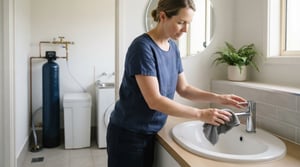
A water softener can make everyday cleaning easier by reducing the calcium and magnesium that contribute to scale and residue. It uses ion-exchange resin to capture these minerals and replace them with sodium, then periodically flushes the accumulated minerals and recharges the resin. The benefits of soft water for cleaning in Brisbane can include less soap scum and limescale on surfaces, and less mineral build-up in appliances.
If you’re dealing with stubborn marks on taps, shower screens or dishes, water hardness may be part of the problem. This article explains how softeners work and what softer water can mean for cleaning, laundry, fixtures and household appliances. It also covers the limits, so you can understand what a water softener may change in your home and what it won’t.
Key Takeaways
- Learn how water hardness contributes to soap residue and marks on bathroom and kitchen surfaces.
- Brisbane water hardness varies by supply area, so the effects you notice at home can differ.
- Understand how ion exchange softeners reduce calcium and magnesium in household water.
- See how softer water can help limit scale build-up in appliances, pipes and fixtures.
- Find out why less mineral residue may help laundry feel softer and retain colour.
Soap scum and mineral deposits on fixtures and surfaces
Calcium and magnesium in hard water can leave mineral residue on taps, shower screens, sinks and tiles. Soap can combine with these minerals to create stubborn scum that takes extra scrubbing to remove. Softer water contains fewer dissolved hardness minerals, so soap can lather more readily and rinse away more completely. This may mean less residue on bathroom fixtures and kitchen surfaces after washing.
Soft water can also help reduce water spots and streaks on glassware and dishes. Instead of repeatedly scrubbing a cloudy shower screen or polished tap, routine cleaning may take less effort. The benefits of soft water for cleaning in Brisbane can include using less soap and relying less on harsh cleaning products. Results depend on the surface, the residue and the cleaning product.
There’s an important distinction: softened water is not the same as exterior soft washing. A water softener changes the mineral content of household water. Soft washing is an exterior cleaning method that combines low pressure with biodegradable solutions to remove dirt, mould, algae and other organic growth. In Brisbane, humidity, frequent rain and warmth can contribute to this build-up on outdoor surfaces.
Choose the washing method for the material and the type of dirt. Soft washing typically uses 100-500 PSI, while pressure washing typically uses 1500-4000 PSI. High pressure can strip paint, splinter timber or chip stone and stucco. Each exterior surface needs a suitable approach, particularly if it’s older, delicate or already showing wear.
- Soft washing: rendered walls, roof tiles, Colorbond roofing, weatherboards, timber, eaves, soffits, painted fences and timber fences.
- Pressure washing: concrete driveways and paths, brick paving, pool surrounds and garage floors with heavy grime, oil, rubber marks or staining.
Rendered walls and stucco need particular care because forceful washing can damage their finish. Soft washing uses specialised biodegradable cleaning solutions to loosen dirt and organic growth, then gently rinses the surface. Older brick structures can also be vulnerable to cracking and mortar deterioration, so high pressure may be unsuitable. Delicate or historic Brisbane surfaces are recommended for soft washing at least once a year.
For home interiors, softer water can help limit soap scum and mineral marks on shower screens, taps and tiles. For exterior walls and roofs, soft washing addresses organic growth rather than water hardness. Keeping these methods distinct helps match the cleaning process to the cause, whether it’s mineral residue indoors or mould and algae outdoors.
Does Brisbane Have Hard Water?
Brisbane water hardness varies by supply zone, so households can experience different effects from their tap water. The Moreton zone averages 53.0 mg/L, while Logan averages 85.2 mg/L and Redland averages 70.2 mg/L. Brisbane’s inner-city supply zone averages 114.8 mg/L as calcium carbonate. These figures help explain why soap lather and shower-screen residue can differ between homes.
Using the listed hardness categories, water from 0-60 mg/L CaCO3 is soft, 61-120 mg/L is moderately hard, and 121-180 mg/L is hard. Water at 181 mg/L CaCO3 or more is very hard. On this scale, Moreton’s average falls in the soft range; Logan, Redland and the inner-city average fall in the moderately hard range. Independent laboratory readings have reached 154 mg/L in some Brisbane suburbs.
Hardness becomes visible during ordinary washing. At levels above 100 mg/L, water can be associated with white kettle scale, reduced soap lather and a film on shower screens. Soap, shampoo and laundry products may lather less readily because calcium and magnesium interfere with soap’s action. A shower screen can then show a cloudy film that needs more wiping, while soap residue may remain after rinsing.
With softer water, soap can lather more effectively and rinse away more completely. That can reduce residue on skin and hair, and may mean less soap is needed for a wash. The same principle can apply to shampoo and laundry detergent: follow the product directions, and don’t add extra simply because the lather looks different. The amount needed also depends on the product, load size and soil on clothing.
A water filter and a water softener don’t necessarily do the same job. A filter’s function depends on its treatment media, while a softener is intended to reduce hardness minerals. Brisbane’s water systems vary by zone, so a suburb-wide average won’t describe every home. Look for recurring shower-screen film, poor soap lather or kettle scale, then consider whether hardness is the likely cause.
These signs don’t mean Brisbane drinking water is unsafe. The dissolved minerals discussed here affect cleaning performance and residue, not the stated safety of the water. Different water hardness across Brisbane supply zones can help explain why households use different amounts of soap, even with similar routines. A water softener is most relevant when mineral build-up and lathering problems persist, rather than when the main concern is another water-quality issue.
How Do Water Softeners Work?
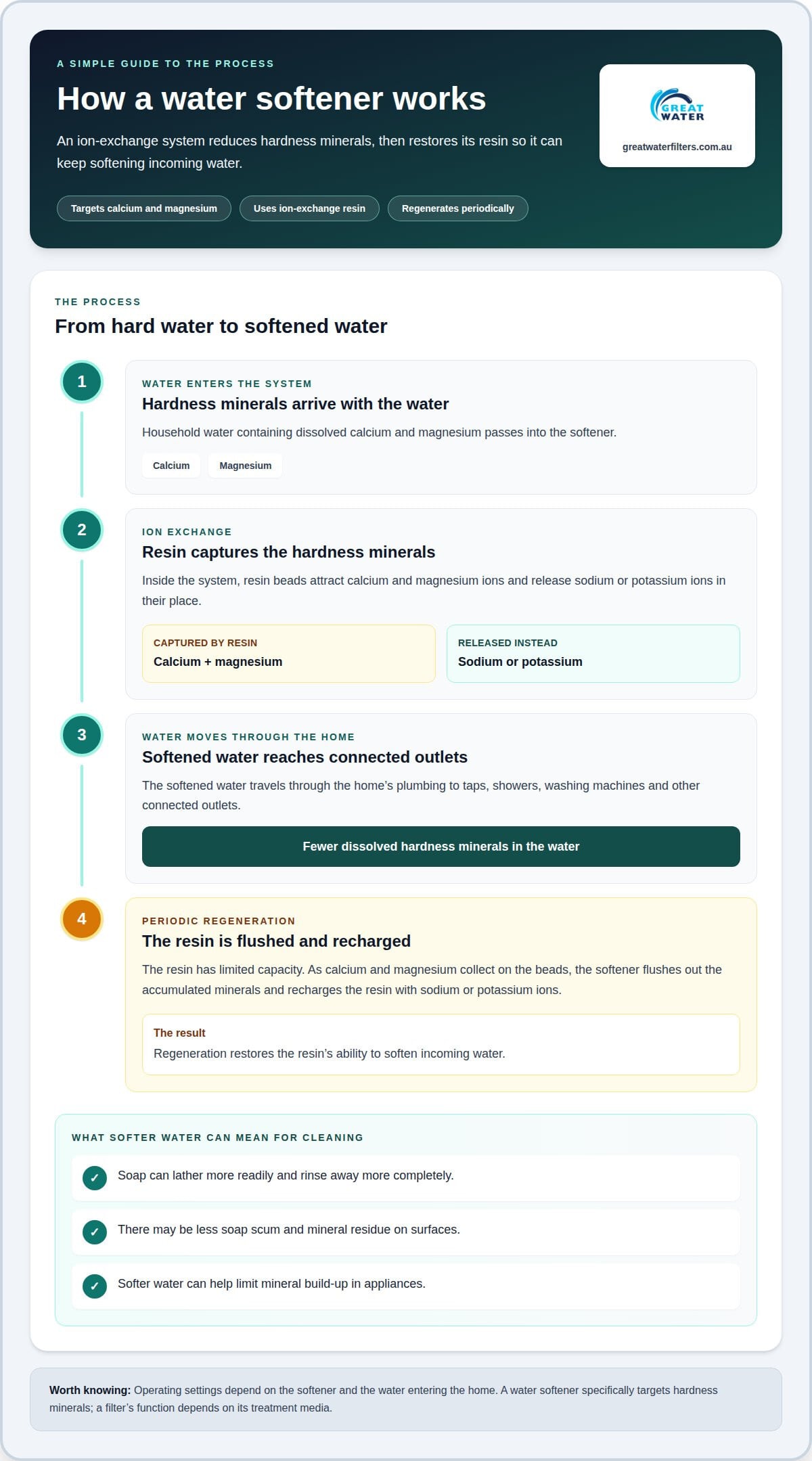
An ion-exchange water softener reduces hardness by removing calcium and magnesium from household water. Inside the machine, resin beads attract these mineral ions and release sodium or potassium ions in their place. The softened water then travels through the home’s plumbing to taps, showers, washing machines and other connected outlets. Unlike a filter designed for other treatment purposes, a softener specifically targets hardness minerals.
The resin has a limited capacity to hold minerals. As water passes through, calcium and magnesium collect on the beads until the system regenerates. During regeneration, the softener flushes out the accumulated minerals and recharges the resin with sodium or potassium ions. This restores the resin’s ability to soften incoming water. Operating settings depend on the system and the water entering the home.
Ion exchange is a common type of water softening in Australia. Other water-treatment equipment may filter or treat water for different purposes, but those functions shouldn’t be confused with hardness removal. A water filter and a softener aren’t interchangeable simply because both connect to household water systems. For example, a filter that treats water for drinking may not remove the calcium and magnesium responsible for scale.
In Brisbane, supply-zone hardness varies, so the surrounding water conditions matter when considering a softener. The inner-city average is 114.8 mg/L as calcium carbonate, compared with 53.0 mg/L in the Moreton zone. Those averages illustrate why a system’s suitability and settings should reflect the incoming water, rather than an assumption that every Brisbane home has identical water.
Softening changes the mineral balance: ion exchange replaces calcium and magnesium with sodium or potassium. That change is relevant to drinking-water decisions, particularly for households managing sodium intake. A softener addresses hardness; it shouldn’t be treated as a complete drinking-water treatment system. Plumbing suitability also depends on the home’s existing installation and the softener’s setup. Regeneration flushes accumulated minerals from the resin, so its method is also an operating and environmental consideration.
For a Brisbane home, the useful distinction is the problem you want to address. Persistent scale and poor soap performance point towards hardness; concerns about other water characteristics call for a different treatment function. A correctly matched softener treats hardness in water supplied to connected outlets, while a separate filter may serve a specific purpose, such as treating drinking water. Understanding the difference helps you avoid choosing equipment based on the word “filter” alone.
- Softener: exchanges calcium and magnesium for sodium or potassium through resin.
- Filter: treats water according to its specific filtration media and purpose.
Hardness and limescale on appliances and fixtures
Yes. Soft water can reduce mineral scale in Brisbane plumbing, fixtures and water-using appliances by lowering calcium and magnesium levels. This can limit deposits where water is heated or left to evaporate.
Scale on appliances and plumbing
Hard-water scale is a mineral deposit, mainly associated with calcium and magnesium, that can collect inside pipes and appliances. In a Brisbane home, it may appear as residue around a tap or build up inside a kettle. Hidden deposits matter too: scale can narrow water pathways and make equipment work harder.
Scale can form where water is heated or repeatedly used, including dishwashers, washing machines and water heaters. A kettle provides a visible example, while deposits inside pipes are harder to spot. In one Brisbane supply zone with hardness of 115 mg/L, quarterly kettle descaling is recommended. That gives households a practical example of how local hardness can affect routine maintenance.
Appliance efficiency and lifespan
Appliance efficiency describes how effectively a machine performs its task; scale can interfere with that operation. For example, deposits in a dishwasher or washing machine may restrict water flow or build up on internal surfaces. Soft water can reduce mineral deposits in these appliances, helping them operate efficiently for longer.
Water heaters can also be affected because scale may collect on heating surfaces. Soft water can help limit that build-up, allowing a heater to warm water more quickly. Less scale may also reduce the energy needed to heat water and lower energy bills. These are potential household benefits, not a reason to assume every appliance problem comes from water hardness.
Other faults, such as a blocked filter or worn component, can also affect performance. Distinguishing a scale issue from an unrelated mechanical fault helps keep maintenance focused. Organic material, for instance, isn’t limescale and needs a different response.
Reducing scale on cleaning appliances
A water softener reduces the calcium and magnesium that contribute to mineral scale. That can help limit deposits in dishwashers and washing machines, as well as in household plumbing and fixtures. For appliances, less scale may also mean less residue to remove from internal surfaces during routine care.
Soft water won’t remove scale that has already formed. Existing deposits may still need suitable cleaning and maintenance, while a softener reduces further mineral build-up from treated water. The result depends on water hardness, how much water an appliance uses and whether it heats that water.
For Brisbane homes, the main benefit is prevention: reducing hardness can limit the conditions that encourage scale in pipes, fixtures and appliances. Less build-up may mean fewer cleaning demands and help prolong the lifespan of household plumbing. A softener addresses mineral hardness, not every cause of reduced appliance performance.
Laundry softness and colour retention
Mineral residue can affect how freshly washed clothes feel and look. Soft water can help fabrics feel softer and retain their colours longer by reducing that residue. For Brisbane homeowners, the difference may be easiest to notice in frequently washed items such as towels, school uniforms or dark cotton tops. These are everyday examples, not a promise that water treatment will reverse wear or restore faded fabric.
Hardness minerals, including calcium and magnesium, can remain on fabric after washing. Residue may leave clothes feeling less smooth, while mineral deposits can make colours appear less clear over time. Softer water contains lower concentrations of dissolved calcium and magnesium, reducing one source of mineral residue. Fabric type, detergent and washing conditions also shape the result, so water is just one factor in laundry care.
Detergent and water work together in a washing machine. With less hardness mineral content, detergent can work without the same contribution to residue on clothes. A softener may therefore support a cleaner rinse and softer-feeling laundry. Follow the detergent label for each load rather than adding extra to chase a particular level of foam. Different products and load sizes call for different amounts.
Colour retention matters for items such as black jeans, bright tea towels and patterned cotton bedding. Soft water can help prevent mineral residue from settling on these fabrics, which may help colours stay clearer through regular washing. It won’t stop colour loss caused by fabric wear, unsuitable wash settings or dye transfer. Separating a new red garment from pale towels remains a separate laundry decision.
Filtration and softening have different jobs. A water filter treats water according to its filtration media, while a softener targets hardness minerals. For laundry, the relevant question is whether calcium and magnesium are contributing to residue, rather than whether water has been filtered for another purpose. Matching the treatment method to the issue helps clarify what may change in the washing machine and what still depends on fabric care.
Softer laundry is one possible household effect of reducing hardness, alongside fewer mineral deposits elsewhere in the home. A softener treats water supplied to connected outlets, including the washing machine when it’s connected to the treated supply. Changes in fabric feel and colour appearance develop through washing, not as an instant repair to existing damage. Care labels, fabric type and detergent instructions still guide each load.
Great Water Filters: ES5Q Hi Flow Wellness Whole House Water Filter System
The ES5Q Hi Flow Wellness Whole House Water Filter System is one option for whole-home water treatment. For households focused on hardness, the Whole House Water Filter Softener is the relevant offering to consider. Great Water Filters provides Smarter & Healthier water filter systems, with Free Installation Australia wide.
The right fit depends on your household’s water concerns and treatment priorities. Great Water Filters also offers the Elite Series 3 Reverse Osmosis Water Filter System. Transparent upfront Pricing helps make the decision clear. No Upfront Payment Required, and you Only Pay when Fully Installed & Happy.
Great Water Filters’ offer is 100% No Risk. Contact Great Water Filters to discuss an option for your home.
Make a considered choice for your home
The next step is to match water treatment to how your household uses water. Consider which concerns matter most in your routine, such as cleaning effort, appliance care or laundry, and whether you want treatment across the home or for a specific use. This keeps the decision practical instead of choosing equipment based on a label alone.
Understanding the benefits of soft water for cleaning in Brisbane can help you make that decision. Think about the changes you’d value most, then consider how a suitable system could fit your home. A clear view of your priorities can help turn general information into a considered choice.
With an approach suited to your household, you can feel more confident about your water-treatment decision.
Frequently Asked Questions
Understanding Soft Water: What Is It?
“Soft water” describes water by its mineral content, not by whether it has passed through a filter. The term alone doesn’t say whether water has been treated for chlorine, bacteria or other substances. A water softener and a drinking-water filter, for example, serve different purposes. Understanding that distinction helps match treatment to the household concern rather than relying on a general label.
What Is Water Hardness?
Water hardness measures dissolved calcium and magnesium and is commonly reported as milligrams per litre of calcium carbonate. A laboratory or water-quality report may use that unit, making readings comparable when the same measure is used. Hardness is only one water characteristic; it doesn’t describe every dissolved substance. Read a hardness result as a specific measure, not a complete water-quality assessment.
How does soft water improve cleaning compared with hard water?
One practical difference is less mineral residue left behind as rinse water dries. That can make routine tasks, such as wiping a tap after use or drying a glass, less prone to visible spots. This is most relevant to mineral marks. Grease, food stains and mould have different causes, so they still need suitable cleaning products and methods rather than relying on water softness alone.
Does soft water reduce soap and detergent use, and by how much?
There isn’t one reliable detergent amount for every Brisbane household. Product formulation, washing-machine load size, soil level and incoming water all affect how much is needed. As a practical guide, follow the manufacturer’s dosage directions for the load and don’t treat foam volume as a measure of cleaning performance. A change in water may alter how products behave, but it doesn’t replace the detergent packaging instructions.
How does soft water affect laundry cleanliness, colours and fabric lifespan?
Water treatment can’t reverse fading, pilling or fibre damage that has already occurred. To protect garments, follow each care label, separate colours where needed and choose a wash setting suited to the fabric. These steps address common causes of wear that water hardness alone can’t control. If a garment’s colour changes suddenly, dye transfer or unsuitable washing conditions may be more relevant than the home’s water supply.
What are the benefits of soft water for dishwashing and glassware?
For glassware, using a clear drying cloth and drying items promptly can help prevent water marks from becoming noticeable, regardless of the treatment method. Dishwasher results also depend on the cycle, detergent and how the machine is loaded. Keep spray arms clear of obstructing dishes so water can reach the load. These routine factors still matter when assessing spots or film on dishes.
How much can a household save on cleaning products with a water softener?
Household savings depend on current product use, local water hardness and how often you clean and do laundry. There’s no single savings figure that applies to every home. To assess any difference, note how quickly you use regular products before and after a change, while keeping household routines and product choices consistent. That comparison gives a more relevant picture than a general estimate.
What is Brisbane tap water hardness, and does it vary by suburb?
Brisbane tap-water hardness varies between supply zones, so suburb-level averages provide context rather than an exact reading for every property. A home’s supply zone and local distribution conditions affect the water it receives. A hardness test measures the water at a specific property. Keep the result’s unit and test date with household records when comparing later readings or considering treatment options.
COMMENTS