
Protect your family with pure water for drinking, bathing, and appliances.
The reverse osmosis membrane lifespan in Perth is typically 2 to 5 years, depending on usage and local water quality. But age alone doesn’t tell you whether a membrane is still performing well.
If your reverse osmosis system is producing water more slowly or its performance has changed, it’s reasonable to wonder whether the membrane needs replacing. For Perth households, the best guide is measured performance over time, not a calendar reminder alone.
This guide explains common signs of a failing RO membrane and how changes in water flow, TDS readings and operating pressure can help assess it. You’ll also learn how pre-filter condition affects membrane wear, why usage and application matter, and when cleaning may help distinguish fouling from a membrane that has reached the end of its useful life. These checks give you a clearer basis for deciding what to do next.
Key Takeaways
- In Perth, an RO membrane typically lasts 2 to 5 years, but usage and water quality influence its service life.
- Falling water flow or changing TDS readings can signal reduced membrane performance; consider these alongside the system’s operating pressure.
- Pre-filters typically need replacing every 6 to 12 months, while post-filters should be replaced once a year.
- Membrane lifespan varies by application, and calcium scale can affect performance when hard water is involved.
- Learn how to distinguish possible fouling from a membrane that may need replacing, and when an RO system could suit your home.
How do you know when an RO membrane needs replacing?
Compare treated-water TDS and flow with the system’s baseline to assess the membrane. Declining performance can point to fouling, scaling or a membrane nearing replacement.
Recognising replacement signs
Look for measurable changes in flow and salt rejection, rather than relying on age alone. Tracking these trends can help distinguish a worn membrane from an issue that servicing may resolve.
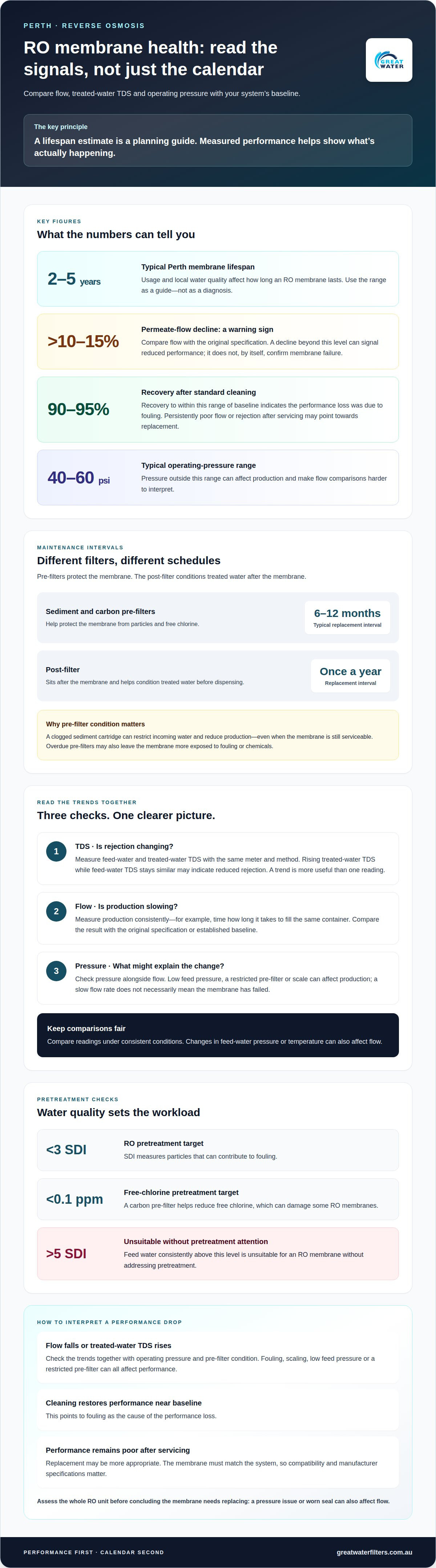
A permeate-flow decline of more than 10 to 15 per cent from the original specification is a warning sign. A drop in salt rejection alongside rising differential pressure can indicate mineral scaling. Compare readings under consistent conditions, since changes in feed-water pressure or temperature can also affect flow.
For a basic performance check, measure TDS in the feed water and treated water, then compare the readings with earlier results. Rising treated-water TDS can indicate reduced rejection, but one reading alone may not reveal the cause. Check it alongside flow and pressure trends before deciding whether the membrane needs replacing.
Servicing and replacement options
Servicing helps assess whether cleaning can restore performance; replacement is for a membrane that remains below its expected performance. Fouling may be reversible, while a persistently weakened membrane may need replacing.
After standard cleaning, recovery to within 90-95% of baseline indicates that performance loss was due to fouling. If flow or rejection remains poor after servicing, replacement may be the more appropriate option. The membrane must also match the system, so compatibility and the manufacturer’s specifications matter.
Assess the whole RO unit, not just its membrane. A restricted pre-filter, pressure issue or worn seal can affect flow and be mistaken for membrane failure. Identifying the cause first helps avoid replacing a membrane when another component is responsible.
Pricing is transparent and provided upfront. Costs depend on membrane compatibility, the work involved and whether other components need attention, so the precise price depends on the particular system and replacement scope.
For Perth households, membrane life typically ranges from 2 to 5 years, depending on usage and local water quality. Treat that range as a planning guide, not a diagnosis: compare measured performance with the system’s baseline before choosing servicing or replacement.
Pre-filter condition and membrane protection
RO pre-filters protect the membrane by reducing particles and contaminants before water reaches it. Their condition matters: a clogged or exhausted cartridge can restrict flow or allow damaging material through.
How does RO membrane lifespan compare with sediment and carbon filter lifespan? Sediment and carbon pre-filters typically need replacing every 6 to 12 months, while a membrane in Perth typically lasts 2 to 5 years. These components have different roles, so their replacement intervals differ.
A sediment filter catches suspended particles that could block or abrade the membrane surface. A carbon pre-filter helps reduce free chlorine, which can damage some RO membranes. Overdue cartridges may leave the membrane more exposed to fouling or chemicals. Replacing pre-filters on schedule helps maintain the protection the RO stage relies on.
Pre-filter condition also affects system output. A clogged sediment cartridge can restrict incoming water and reduce production, even if the membrane is still serviceable. That can make a pre-filter issue look like membrane failure. During a performance check, compare flow and pressure with the system’s usual baseline, then assess whether the pre-filter needs attention.
Feed-water quality affects the workload. RO pretreatment targets an SDI below 3 and free chlorine below 0.1 ppm. SDI measures particles that can contribute to fouling. If feed water consistently has an SDI above 5, it is unsuitable for an RO membrane without addressing pretreatment. These measures explain why pre-filtration is more than a routine cartridge change.
The post-filter sits after the membrane and helps condition treated water before dispensing. Replace RO post-filters once a year. Unlike sediment and carbon pre-filters, a post-filter does not protect the membrane, so changing it cannot make up for overdue pre-filter maintenance.
Use the system’s maintenance schedule to keep each cartridge on its correct interval. Replacement Filter Cartridges help maintain the filtration stages, while membrane performance should be assessed separately. If you’d like help with the right replacement parts for your system, get in touch about filter replacements.
Monitoring TDS, flow rate and operating pressure
Track treated-water TDS, production flow and operating pressure together. These readings show whether the RO system is performing consistently and help identify changes before you assume the membrane has failed.
A TDS meter measures total dissolved solids in water. Compare feed-water and treated-water readings using the same meter and testing method each time. If treated-water TDS rises while feed-water TDS stays similar, the membrane may be rejecting fewer dissolved substances. A trend over time is more useful than a single result.
Flow rate shows how much treated water the system produces over a set period. Measure it consistently, for example, by timing how long the system takes to fill the same container. Compare the result with the system’s original specification or established baseline. A gradual decline can point to fouling, scale, low feed pressure or a restricted pre-filter, not necessarily membrane failure.
Pressure readings add context to a slow flow rate. RO systems typically operate best between 40-60 psi. A reading outside that range can affect production and complicate comparisons with earlier results. Check pressure at the same point in the system each time, because readings from different locations may not be directly comparable.
Look for linked changes, not an isolated number. For example, reduced flow with rising differential pressure can indicate a restriction or fouling. A 15% rise in differential pressure is a trigger for immediate investigation. Normalised permeate flow dropping by 10% is a point to initiate membrane cleaning, rather than treating the reading alone as proof that replacement is necessary.
After cleaning, compare the same measurements with the original baseline. If TDS rejection and flow return to within 10 to 15% of their original specifications, the membrane still has usable life. If the readings remain below baseline, the results help show that cleaning has not restored performance.
Keep a simple record of the date, feed and treated-water TDS, flow measurement and pressure. For example, steady feed TDS alongside gradually rising treated-water TDS is easier to assess in a log than from memory. Consistent testing conditions make comparisons more meaningful.
Typical RO membrane lifespan by application
RO membrane life varies with the water being treated, system use and pretreatment. A household unit has different operating conditions from an industrial plant, so replacement planning differs too.
For municipal or drinking-water applications, membranes typically last 5-7 years. Industrial ultrapure-water membranes typically last 3-5 years, while wastewater reclaim or reuse membranes typically last 2-4 years. High-fouling industrial feed can shorten expected life to 1-3 years. These ranges show why one replacement interval cannot suit every application.
Industrial systems also vary within the same broad category. A well-maintained industrial membrane can typically last 3 to 7 years under proper operating conditions. For normal industrial operation, a 3-5 year replacement planning horizon provides a practical estimate. Feed-water quality, fouling and maintenance help explain the difference between that planning range and longer service life.
Calcium matters when feed water is hard. It can contribute to mineral scale on the membrane surface, restricting water passage and affecting performance. Treating hard water with a softener before it reaches the RO system can help address this risk. Calcium levels and the effectiveness of pretreatment affect the membrane’s operating conditions.
Seawater RO is a distinct application. Its membranes are engineered for high-salinity feed and the elevated operating pressures needed to overcome osmotic pressure. Brackish-water membranes are not designed for seawater use. Choose a membrane to match the source water, rather than by lifespan alone.
Start maintenance planning with the application. A wastewater-reuse plant treating fouling-prone feed has a different membrane workload from a drinking-water system. In either case, compare performance with the system’s baseline and consider pretreatment, operating conditions and feed-water changes together.
For a Perth household, membrane lifespan depends on system use and local water quality. Industrial figures do not apply directly to a domestic unit. Treat lifespan estimates as planning guides, then assess the actual application and operating conditions before deciding whether service or replacement is appropriate.
Reverse osmosis membrane lifespan
For Perth homes, an RO membrane typically lasts 2 to 5 years, depending on usage and local water quality. That range is a planning guide, not a replacement deadline.
Membrane lifespan in Perth homes
In a Perth home, membrane lifespan means how long the membrane maintains useful water production and contaminant rejection. The typical 2 to 5 year range helps with maintenance planning, but performance matters more than age alone.
Two households with similar systems may need a replacement at different times. One may use its RO system regularly, while another draws less water. Feed-water quality and maintenance also affect the membrane’s workload. Use calendar estimates alongside observed system performance.
Factors affecting membrane lifespan
Usage, feed-water quality, pretreatment and operating conditions all affect membrane life because they determine how much work the membrane does over time.
For example, overdue pre-filters can allow more particles or chlorine to reach the membrane. Hard water can contribute to mineral scale, while a water softener can treat it before it reaches the RO system. Regular servicing and suitable pretreatment help limit avoidable strain.
Operating habits matter too. RO systems should not run continuously, as constant operation can overwork the pump and membrane. Periodic inspections can catch leaks or worn seals before they contribute to wider system issues. Sanitising the system at least once a year is also part of routine care.
Consider a household that uses its system heavily and misses pre-filter changes. Its membrane may face more strain than one in a lightly used, well-maintained system. Conversely, stable operating conditions and disciplined pretreatment can support longer service life. Some facilities report more than 7 years in stable, low-fouling conditions, but that industrial example is not a household lifespan target.
The practical takeaway is to use 2 to 5 years as a Perth household planning range, then weigh actual performance, maintenance and water conditions. A membrane that still performs well may not need replacing simply because it has reached a particular age.
Great Water Filters: Elite Series 3 Reverse Osmosis Water Filter System
The Elite Series 3 Reverse Osmosis Water Filter System from Great Water Filters may suit households considering reverse osmosis for their home. It provides a residential system option when you’re planning a new setup, rather than simply assessing an existing membrane.
A change in an existing system doesn’t automatically mean you need a new one. If you’re weighing up a new RO system, consider what you want from home water filtration and whether reverse osmosis fits that need. The Elite Series 3 is one option to discuss for household use. It’s a separate decision from diagnosing reduced performance in a system you already own.
The Elite Series 3 Reverse Osmosis Water Filter System is part of Great Water Filters’ range of Smarter & Healthier water filter systems. Great Water Filters supplies and professionally installs residential water treatment systems, with Free Installation Australia wide.
Great Water Filters’ payment terms are designed to make the purchase process clear. No Upfront Payment Required means you pay only when the system is fully installed and working. The company describes this as “100% No Risk” and says, “Only Pay when Fully Installed & Happy.” Transparent upfront Pricing is part of setting out the cost clearly before proceeding.
The Frozen Price Guarantee locks in the price at the time of order and includes full installation. The No-fit-no-fee guarantee means you’re not charged for installation if the system doesn’t fit. These terms clarify the payment approach before you decide.
If you’re considering broader household filtration rather than an under-sink RO system, Great Water Filters also offers the ES5Q Hi Flow Wellness Whole House Water Filter System and the Whole House Water Filter Softener. These options address different household filtration needs, so the choice depends on the kind of system you’re considering.
If the Elite Series 3 Reverse Osmosis Water Filter System sounds relevant to your household, contact Great Water Filters to discuss it.
Choose the next step that suits your home
Understanding reverse osmosis membrane lifespan in Perth can help you make a considered decision, whether you’re maintaining an existing system or planning a new one. Start with what your household needs from water filtration, then choose an option that suits that purpose.
For drinking-water filtration, the Elite Series 3 Reverse Osmosis Water Filter System is a relevant option to explore. If you’re considering broader household treatment, compare it with the ES5Q Hi Flow Wellness Whole House Water Filter System or the Whole House Water Filter Softener. Each addresses a different filtration need, so the best starting point is the outcome you want at home.
Great Water Filters can help you discuss these residential water treatment options and decide what aligns with your requirements. There’s no need to rush the decision. A clear conversation about your system and priorities can make the next step easier.
With clear information about your system’s performance and household needs, you can make a considered choice for your home.
Frequently Asked Questions
Can RO membranes be cleaned to extend their life?
Yes. Cleaning can restore performance when fouling or mineral scale is the cause. The method depends on the deposit: low-pH cleaning targets mineral scale, while high-pH cleaning addresses organic matter and biofilm. Cleaning won’t repair every kind of membrane damage. Compare flow and rejection after servicing with the system’s baseline to see whether cleaning helped or replacement is still needed.
Does high TDS feed water shorten membrane life?
High feed-water TDS can make an RO membrane work harder to separate dissolved substances, affecting production and performance. TDS alone does not establish that a membrane has failed. Compare feed and treated-water readings, and consider changes in flow and pressure too. Rising treated-water TDS alongside reduced rejection is more informative than a high feed-water reading by itself.
Does water temperature affect how quickly an RO membrane degrades?
Yes. Feed-water temperature can affect membrane performance and water production. A warmer reading may change flow, so compare measurements taken under similar conditions. Temperature changes alone do not prove that a membrane is degrading. Keep the system within its manufacturer’s operating specifications, and assess temperature alongside TDS, flow and pressure when readings shift.
How long should an RO membrane actually last?
There isn’t one lifespan that applies to every RO system. Application and operating conditions matter: drinking-water membranes typically last 5-7 years, while membranes treating wastewater for reuse typically last 2-4 years. These are planning ranges, not automatic replacement dates. For a household system, use its performance and maintenance history to decide whether it remains effective.
How often should I schedule preventive maintenance to get the most out of my RO membrane?
Inspect an RO system every few weeks for leaks or worn seals, and sanitise it at least once a year. These checks can catch issues beyond the membrane. A damaged seal, for example, may cause a leak, while a missed service can leave system hygiene unattended. Keep a dated maintenance record to compare changes across inspections.
How long does a reverse osmosis membrane last in Perth?
The typical reverse osmosis membrane lifespan in Perth homes is 2 to 5 years, depending on usage and local water quality. A household using its system heavily may put more demand on the membrane than one with lighter use. Treat the range as a maintenance-planning guide, then consider how the system is performing before scheduling a replacement.
How does Perth tap water quality affect RO membrane life?
Feed-water characteristics affect the membrane’s workload. Dissolved solids, hardness and chlorine can all matter, and calcium can contribute to mineral scale. Pretreatment helps protect the membrane from some of these challenges. Perth households should assess system performance in the context of their actual feed water, rather than assume every home’s supply creates identical operating conditions.
How often should you replace a reverse osmosis membrane in Perth?
Use the 2 to 5 year household lifespan range as a guide, not a fixed replacement timetable. Replace the membrane when performance remains below expectations after other causes, such as restricted pre-filtration or a pressure issue, have been addressed. This approach helps separate membrane wear from faults elsewhere in the system and avoids using age alone to decide.
COMMENTS