
Protect your family with pure water for drinking, bathing, and appliances.

Your tap water might meet national health guidelines, but that doesn't mean it's enjoyable to drink or gentle on your hair and skin. If you've noticed a strong chemical smell when running the tap, you're likely searching for how to remove chlorine from tap water to restore its natural purity. While chlorine is vital for keeping our mains supply safe from bacteria, the aesthetic threshold is often exceeded in many Australian homes, leading to that unmistakable swimming pool taste and odour.
We know how frustrating it is to deal with itchy skin after a shower or drinking water that tastes like a lab experiment. You deserve water that's as crisp and clean as a mountain spring. This guide explores the most effective ways to eliminate chlorine and disinfection by-products from your home. We'll walk you through everything from simple kitchen hacks to professional whole-house solutions that look after everything for you. Whether you're considering a smarter and healthier wellness system or a high-purity drinking filter, we'll help you find a "set and forget" solution with free installation Australia wide and no upfront payment required.
Key Takeaways
- Understand why Australian water authorities use chlorine and the impact it has on your home's water taste, odour, and your family's skin health.
- Discover the technical differences between activated carbon and reverse osmosis to find out how to remove chlorine from tap water most effectively for your specific needs.
- Compare the benefits of targeted under-sink filters with whole-house wellness systems like the ES5Q for a complete home water transformation.
- Learn why professional installation looks after everything for you, ensuring your smarter and healthier water filter system is perfectly configured without the risk of leaks.
- Benefit from a stress-free experience with free installation Australia wide and a 100% no risk guarantee where you only pay when fully installed and happy.
Why Chlorine is in Your Australian Tap Water (and Why You Want it Out)
Most Australian councils rely on chlorine to keep our mains supply safe. Water chlorination is the primary method used to eliminate harmful bacteria and pathogens during the long journey from the catchment area to your kitchen sink. While this process is vital for public health, it comes with a trade-off. Many homeowners find the distinct "swimming pool" taste and odour a major drawback to drinking straight from the tap.
The issue isn't just the smell. When chlorine reacts with organic matter in the pipes, it can create disinfection by-products known as Trihalomethanes (THMs). In warmer cities like Perth or Brisbane, water authorities often increase chlorine dosages during the summer months to combat accelerated bacterial growth in the heat. This is typically when residents start looking for how to remove chlorine from tap water to restore the crisp, clean quality they expect from their home supply.
The Impact on Your Skin and Hair
Chlorine is a powerful oxidant that effectively strips natural oils from your body. If you've noticed dry, itchy skin or brittle hair after a morning shower, the chemical levels in your water are likely the culprit. This impact extends beyond just the feel of your skin.
- Chlorinated steam in the shower can trigger respiratory sensitivity for some individuals.
- Australians living with eczema often find that dechlorinated water provides a much gentler experience for sensitive skin.
- Removing these chemicals helps preserve hair colour and maintains the natural shine of your locks.
Australian Drinking Water Guidelines vs. Personal Preference
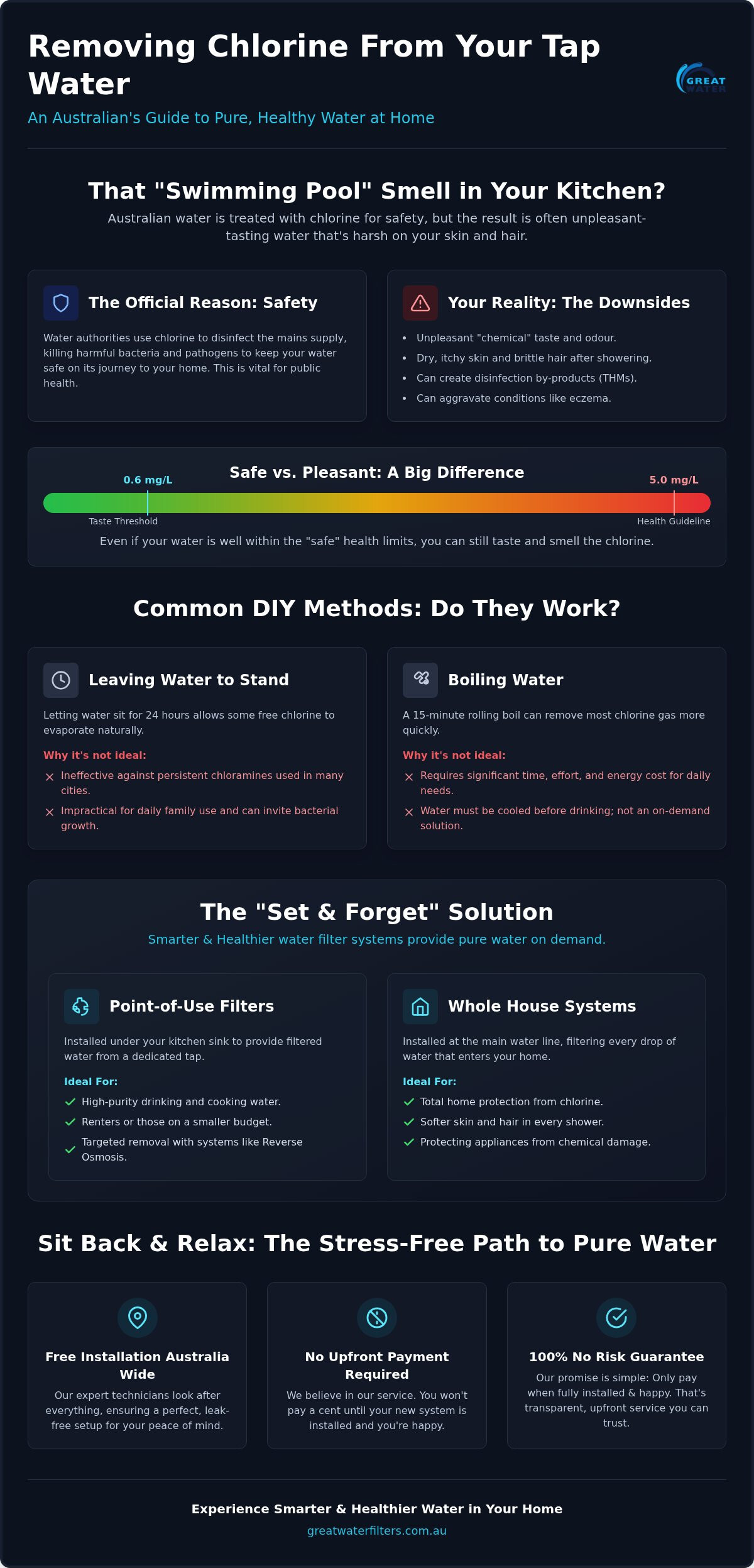
The Australian Drinking Water Guidelines (ADWG) currently set a health-based limit for chlorine at 5 mg/L. However, most people can detect the taste and smell of chlorine at levels as low as 0.6 mg/L. What local councils define as "safe" may not align with your standards for a refreshing glass of water. Your experience also depends heavily on your local infrastructure. If you live close to a treatment plant, your water may have a significantly higher concentration than a home further down the line.
Modern water treatment in some regions has also shifted towards using chloramines, which is a combination of chlorine and ammonia. These are more persistent and harder to remove than free chlorine alone. Achieving a higher standard of purity usually requires a whole house water filter designed to handle these specific Australian conditions. By choosing smarter and healthier water filter systems, you can ensure your water meets your personal quality standards, regardless of the minimum requirements set by the council.
Common DIY Methods to Dechlorinate Water at Home
Many Australians start their journey by looking for simple, cost-free ways to improve their drinking water quality. If you're wondering how to remove chlorine from tap water without installing permanent equipment, you've likely come across a few common household hacks. While these methods can work for very small amounts of water, they often require significant time and manual effort. According to WA Health, chlorine is an essential tool for public safety, but it's understandable why many residents prefer to strip it out before the glass reaches their lips.
The Evaporation Method: Pros and Cons
The most basic approach involves leaving a jug of water on the kitchen bench for 24 hours. Because chlorine is a volatile gas, it will naturally dissipate into the air over time. It's a natural way to reduce free chlorine levels and requires no special tools. However, this method has significant limitations in a modern Australian home. It's largely ineffective against chloramines, which are a combination of chlorine and ammonia. Many water authorities in major cities now use chloramines because they stay in the pipes longer. Additionally, leaving water standing at room temperature for a full day can invite bacterial growth. You might be removing the chemical taste, but you're potentially trading it for a different hygiene concern.
Why Boiling Isn’t a Long-Term Solution
Boiling water is a faster way to drive off chlorine gas. Fifteen minutes of a rolling boil will usually do the trick. But consider the daily logistics. For a busy family, boiling and then cooling several litres of water every day is a massive energy drain and a constant chore. It's also counterproductive for certain other contaminants. While chlorine leaves as a gas, non-volatile substances like heavy metals or fluoride actually become more concentrated as the water volume reduces through steam. It's hardly a practical way to manage your family's hydration needs on a permanent basis.
Another common hack involves using Vitamin C, also known as ascorbic acid. A small amount can neutralise chlorine almost instantly, which makes it a popular choice for treating bath water for those with sensitive skin or eczema. However, adding supplements to every glass of water you drink isn't ideal for everyone. The biggest hurdle with all DIY methods is scale. They only address a few litres at a time. If you want to stop the chemical smell in the shower or protect your hair and skin, these manual fixes simply won't help. Most homeowners eventually realise that manual fixes are a lot of labour for very little reward. If you'd rather sit back and relax while a professional system handles the work, you can register your interest online to find a more reliable, permanent alternative.
Carbon Filtration vs. Reverse Osmosis: Which is Better for Chlorine?
When choosing a professional system, the two most effective technologies are activated carbon and reverse osmosis. While both are excellent at addressing chemical tastes, they work in fundamentally different ways. Understanding these differences helps you decide which smarter and healthier water filter systems best suit your household's specific goals. While carbon is the primary worker for chlorine removal, reverse osmosis provides a more comprehensive level of filtration for those seeking total purity.
Activated carbon is widely considered the industry standard for neutralising chlorine. Instead of simply straining particles, carbon uses a process called adsorption. The chemicals are chemically attracted to the surface of the carbon block and trapped within its highly porous structure. This is the most direct answer to how to remove chlorine from tap water for most Australian homes, as it effectively removes the swimming pool odour without stripping away essential minerals.
The Power of Activated Carbon Blocks
The effectiveness of a carbon filter depends heavily on contact time. This refers to how long the water stays in contact with the carbon as it flows through the system. High-quality carbon blocks are designed with a dense, uniform structure that ensures every drop is thoroughly treated. If you're researching how to remove chlorine from tap water to improve your daily drinking experience, these blocks offer an efficient and reliable solution. High-flow designs are particularly beneficial as they provide consistent results even when the kitchen tap is running at full speed. For many, this provides the perfect balance of performance and convenience.
When to Choose Reverse Osmosis
For those who want the absolute gold standard in water purity, the Elite Series 3 Reverse Osmosis system is the preferred option. While carbon is fantastic for chlorine, reverse osmosis (RO) goes several steps further. It uses a semi-permeable membrane to remove up to 99.9% of all contaminants, including fluoride, lead, and heavy metals that carbon alone might leave behind.
RO systems typically include a dedicated tap for the purest possible drinking water. This makes them ideal for families prioritising absolute purity for cooking and hydration. If you are debating between different types of advanced filtration, you might find our Reverse Osmosis vs Alkaline Water guide helpful for making a final decision. Regardless of which technology you choose, our team looks after everything with free installation Australia wide and a 100% no risk guarantee. You only pay when fully installed and happy, ensuring total peace of mind from the start.
Whole House vs. Point-of-Use: Solving the Problem for Good
Choosing between a point-of-use filter and a whole-house system is the most significant decision you'll make when deciding how to remove chlorine from tap water. Point-of-use systems, such as our under-sink models, focus specifically on the water you consume. They provide a high-purity solution for drinking and cooking right at the kitchen tap. However, if you want to eliminate the chemical smell from every outlet in your home, a whole-house system is the more comprehensive choice.
A whole-house system treats the water at the point it enters your property. This means you aren't just filtering what you drink; you're protecting your entire home. Chlorine doesn't only affect taste and odour. It can be harsh on your laundry, dishwasher, and even your hot water service. Over time, these chemicals can degrade seals and components in expensive appliances. By filtering every drop, you extend the life of your household hardware while creating a chemical-free environment for your family.
The Advantages of the ES5Q Whole House Wellness System
The ES5Q Hi Flow Wellness Whole House Water Filter System is engineered for the modern Australian lifestyle. Unlike basic filters that might slow your water flow to a trickle, this system maintains high-flow performance. You won't notice a drop in your shower pressure, which is a common concern for many homeowners researching how to remove chlorine from tap water. This is a critical factor for wellness. When you remove chlorine from your shower, you protect your skin and hair from the drying effects of chemical exposure. It's a holistic approach that turns every tap into a source of pure water. You can find more details on our Whole House Water Filter page.
Which One is Right for Your Home?
Your choice often comes down to balancing your budget with your desire for total home protection. Under-sink systems are highly effective for drinking water, but they don't address the "swimming pool" smell in the bathroom or the impact on your clothes in the wash. When you compare integrated systems to the ongoing cost and hassle of manual filter jugs, the value of a permanent, professional solution becomes clear. For a deeper look at the benefits, refer to The ES5Q Whole House Water Wellness System guide.
We make the process simple. Our professional licenced plumbers look after everything for you, so you can sit back and relax. We offer Transparent upfront Pricing and Free Installation Australia wide. With our 100% No Risk guarantee and No Upfront Payment Required, you only pay when the job is done.
Professional Installation: The Stress-Free Path to Pure Water
While many online guides suggest DIY kits as a quick fix, the reality of Australian plumbing often makes this a risky path. Attempting a home installation can lead to significant insurance headaches if a leak occurs. Most home insurance policies require work on mains water lines to be performed by a licenced professional. If you're investigating how to remove chlorine from tap water, the safest and most reliable method is to choose a "Sit Back & relax" service that prioritises long-term peace of mind.
Our professional licenced plumbers look after everything for you. This approach eliminates the stress of technical setups and ensures your system is perfectly configured for your home's unique layout. We offer Free Installation Australia wide, meaning there are no hidden fees or surprise charges when our team arrives at your door. By letting an expert handle the connection, you avoid the common pitfalls of improper sealing or incorrect pressure settings that often plague DIY attempts.
Transparent Upfront Pricing and Service
We believe in a transparent and customer-centric approach. That's why No Upfront Payment Required to get your system organised. You shouldn't have to pay for a promise; you should only pay for results. Our unique satisfaction guarantee means you Only Pay when Fully Installed & Happy. This 100% No Risk model ensures you have total peace of mind before any money changes hands.
Beyond the initial setup, we act as your long-term service partner. We provide ongoing support and proactive reminders for when your cartridges need changing, so you never have to worry about your water quality dipping. For more details on maintaining your system, you can consult our When to Change Your Water Filter guide. This methodical approach ensures your family continues to enjoy the best possible water quality for years to come.
Smarter & Healthier Water for Every Australian Home
From the inner suburbs of Sydney to the coastal reaches of Perth, our network ensures professional service is available locally. We don't believe in a one-size-fits-all approach. Every council area has a slightly different water profile, and our specialists understand the nuances of local mains supplies. This local expertise is vital when deciding how to remove chlorine from tap water effectively, as chemical concentrations can vary significantly between regions.
By customising your setup, we provide smarter & healthier water filter systems that are specifically tuned to the challenges of your region. Whether you're dealing with high chloramine levels or seasonal spikes in chlorine, our authoritative guides help you navigate the best options for your family. If you're ready to transform your home's water quality without the stress, book your free consultation today and let our experts handle the rest.
Start Enjoying Pure, Refreshing Water Throughout Your Home
Finding the best method for how to remove chlorine from tap water doesn't have to be a technical headache or a daily chore. While kitchen bench hacks might offer a temporary fix for a single glass, they can't protect your skin in the shower or look after your home's appliances. Investing in one of our smarter and healthier water filter systems ensures every tap in your house delivers crisp, refreshing water that's free from chemical odours. You'll notice the difference in every sip and every shower.
We believe the process should be entirely stress-free. Our professional licenced plumbers handle the entire setup, so you can sit back and relax. With transparent upfront pricing and free installation Australia wide, there are no hidden surprises. We stand by our work with a 100% no risk guarantee. You only pay when fully installed and happy, and there's no upfront payment required to get your system organised.
It's time to enjoy the peace of mind that comes with pure, mountain-spring quality water right from your own tap. We look forward to helping you transform your home's water quality.
Frequently Asked Questions
Is it safe to drink chlorinated tap water in Australia?
Yes, tap water in Australia is considered safe as it must meet the Australian Drinking Water Guidelines (ADWG) health limit of 5 mg/L. However, safety and quality are two different things. Most people notice a chemical taste and odour at levels as low as 0.6 mg/L. Many homeowners choose smarter and healthier water filter systems to remove these aesthetic issues and disinfection by-products for a more pleasant drinking experience.
How long does it take for chlorine to evaporate from a jug of water?
It typically takes about 24 hours for free chlorine to evaporate from a jug left at room temperature. This timeframe depends on the surface area of the container and the water temperature. However, this method is ineffective against chloramines, which are increasingly used in Australian cities. For a faster and more reliable solution, professional filtration removes these chemicals instantly without the risk of bacterial growth in standing water.
Does boiling water remove chlorine and chloramines?
Boiling water for about 15 minutes will remove free chlorine, but it's much less effective against chloramines. While the heat drives off volatile gases, it can actually concentrate other non-volatile contaminants like heavy metals. If you're looking for how to remove chlorine from tap water on a permanent basis, boiling is an energy-intensive and impractical chore compared to a professionally installed under-sink or whole-house system.
Can I use a shower filter to remove chlorine?
Yes, shower filters can reduce chlorine levels, but they often have limited capacity and can reduce your water pressure. For a truly effective result that protects your skin and hair, a whole-house wellness system is the superior choice. These systems treat the water at the entry point, ensuring every shower and bath in your home is free from harsh chemicals without compromising the high-flow performance you expect.
What is the difference between free chlorine and chloramine?
Free chlorine is a traditional disinfectant that dissipates quickly, while chloramine is a combination of chlorine and ammonia designed to stay in the pipes longer. Many Australian water authorities use chloramines because of their stability over long distances. Because chloramines are harder to remove than free chlorine, they require specialised carbon blocks or reverse osmosis systems to ensure your water is truly pure and odour-free.
Will a carbon filter remove all the chlorine from my whole house?
A high-quality activated carbon filter is extremely effective at removing chlorine and its associated odours. These systems use adsorption to trap chemical molecules within a porous structure. When correctly sized by our professional plumbers, a whole-house carbon system provides a comprehensive solution. It protects your laundry, appliances, and bathrooms from chemical exposure with Free Installation Australia wide to ensure the system is perfectly integrated into your home.
Does reverse osmosis remove chlorine better than a standard filter?
Reverse osmosis systems include high-grade carbon pre-filters that remove chlorine, but the RO membrane adds an extra layer of protection against 99.9% of other contaminants. While a standard carbon filter is excellent for taste and odour, RO is the gold standard for total purity, removing fluoride and heavy metals too. If you're researching how to remove chlorine from tap water while also seeking absolute purity, reverse osmosis is the ultimate choice.
How often do I need to replace filters that remove chlorine?
Most high-quality filter cartridges should be replaced every 12 months to maintain peak performance. Over time, the carbon becomes saturated and loses its ability to adsorb chemicals. We look after everything for you by providing proactive reminders when your system is due for a service. This "set and forget" approach ensures your smarter and healthier water filter systems continue to provide pure water year-round without any guesswork or stress.
COMMENTS