
Protect your family with pure water for drinking, bathing, and appliances.

That pristine glass of water you poured this morning might be hiding a secret if your filter cartridge has quietly passed its use-by date. Most Australian homeowners install a high-quality system with the best intentions, only to lose track of the maintenance schedule amidst the busyness of daily life. It's a common frustration to notice a slight change in taste or a drop in tap pressure and wonder if it's time for a replacement. Understanding how to know when to change water filter systems shouldn't involve guesswork or the fear of bacterial growth inside an old cartridge.
We understand that your family's health depends on consistent water quality, and you deserve a solution that provides total peace of mind. This 2026 guide reveals the sensory signs, technical indicators, and expert timelines required to keep your water Smarter & Healthier. You'll discover a clear checklist of expiration signs, specific schedules for Elite Series systems, and how our professional maintenance service looks after everything for you. We'll show you how to move from uncertainty to a "set and forget" lifestyle where pure water is a guaranteed standard, not a daily question mark.
Key Takeaways
- Identify sensory indicators like the "chlorine punch" or a metallic taste that signal your filter is no longer effective.
- Understand the professional benchmarks for how to know when to change water filter cartridges, typically ranging between 6 and 12 months in Australia.
- Learn the different maintenance needs for multi-stage systems, including the Elite Series 3 Reverse Osmosis and ES5Q Whole House models.
- Recognise the hidden health risks of using expired cartridges, such as bacterial re-contamination and chemical bypass.
- Discover how to simplify your home wellness with an automated reminder service that manages your replacement schedule for you.
Telltale Sensory Signs Your Water Filter Cartridge is Past Its Prime
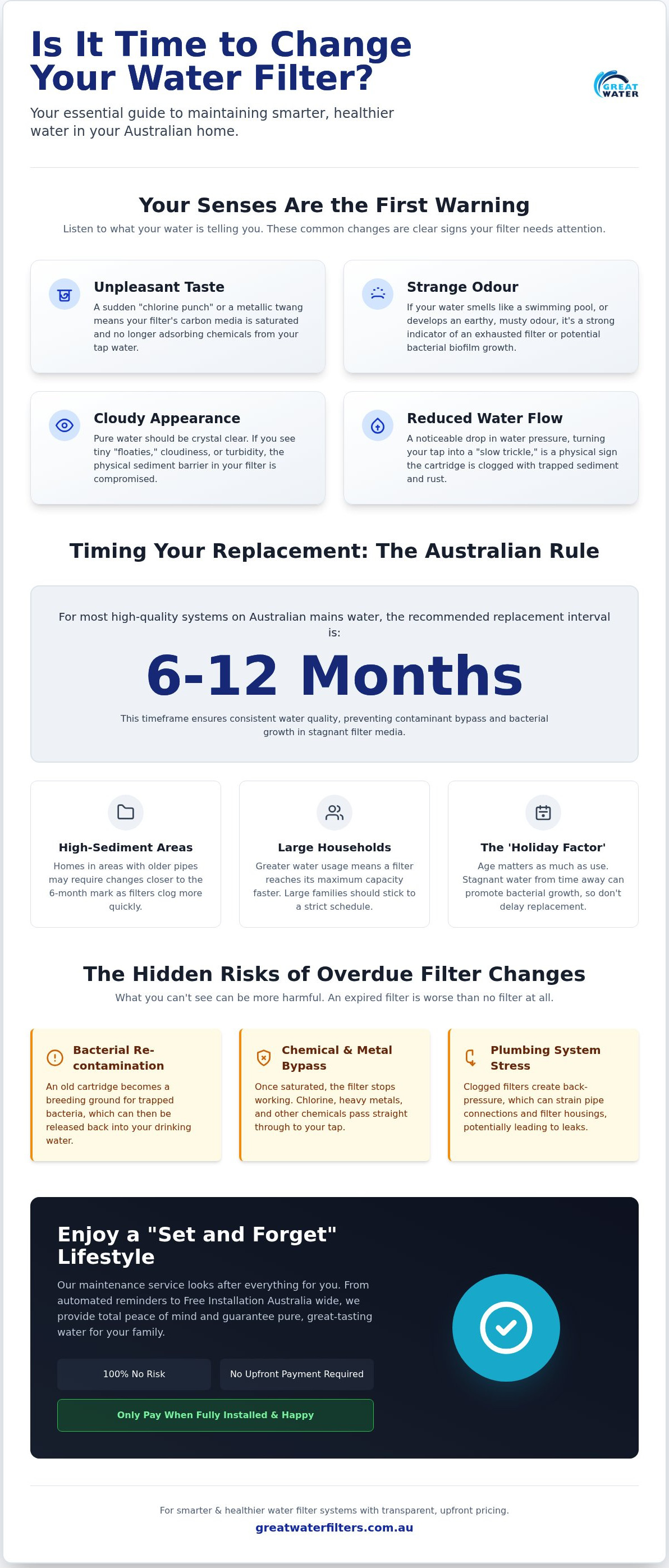
Your body is surprisingly adept at detecting when your filtration system is struggling. While technical indicators are helpful, your senses often provide the first warning. If you've been wondering how to know when to change water filter cartridges, the answer is often found right in your morning glass of water. Our noses and taste buds are fine-tuned to notice even slight deviations from the pure, neutral profile of freshly filtered water.
The "Chlorine Punch" is perhaps the most frequent indicator. High-quality water purification methods rely heavily on activated carbon to remove disinfectants used by municipal suppliers. When the carbon reaches its saturation point, it can no longer effectively adsorb these chemicals. This leads to that unmistakable "swimming pool" scent returning to your kitchen tap. It's a clear signal that the chemical barrier is exhausted.
A "Metallic Twang" or sharp aftertaste is another common sensory cue. This often suggests that minerals or heavy metals are bypassing the filter media, which is particularly common in older Australian suburbs with aging copper or iron pipes. You should also keep an eye out for visual cues like turbidity. If your water looks cloudy or you notice tiny "floaties" in your glass, the physical sediment barrier has likely been compromised and requires immediate attention.
For those using a whole house water filter softener, pay attention to your daily shower routine. If you notice a "slippery feeling" on your skin that won't rinse away, or if your soap suddenly fails to lather as it used to, the softening resin is likely exhausted. This change in water hardness is a reliable sign that your system's maintenance is overdue.
Taste and Odour: Your First Line of Defence
Activated carbon works through a process called adsorption, where contaminants stick to the surface of the carbon pores. Once every available pore is filled, the filter reaches its saturation point and simply stops working. Beyond chemical tastes, you might occasionally notice an earthy or musty odour. This can indicate the development of a bacterial biofilm inside the cartridge housing. A simple way to confirm your suspicions is a side-by-side taste test with a fresh bottle of spring water. If the difference is jarring, your cartridge is no longer providing the protection your family needs.
Performance Drops: Water Pressure and Flow Rate
A physical drop in water pressure is a loud cry for help from your filtration system. As a cartridge traps sediment, rust, and silt, its internal pores become physically blocked. You'll notice a "slow trickle" from your filtered tap that gradually worsens over several weeks. Ignoring this doesn't just lead to frustration when filling a kettle; it can also create unnecessary back-pressure on your internal plumbing and filter housings. This pressure build-up can eventually lead to minor leaks at connection points, making a timely cartridge change essential for protecting your home.
Timing Your Replacement: The 6 to 12-Month Australian Rule
A standard 12-month benchmark applies to most high-quality water systems connected to Australian mains water. This timeframe ensures that the carbon media remains effective and the physical barriers haven't been compromised by local pipe debris. However, determining how to know when to change water filter cartridges isn't always as simple as checking a calendar. Your specific location and household size play a significant role in how quickly a filter reaches its limit.
High-sediment areas or large families often require a 6-month replacement interval. If your home is in a region with older infrastructure or if you're filtering water for a family of five, the internal pores of the cartridge will fill much faster. This is dictated by the "Micron Rating" of your filter. A 1-micron filter provides exceptional clarity but will clog more quickly than a 5-micron alternative because it captures far smaller particles. Understanding this balance helps you maintain a consistent flow without sacrificing water quality.
The "Holiday Factor" is a trap many Australians fall into. You might think that because you were away for three months, your filter still has plenty of life left. The reality is that stagnant water sitting inside a cartridge housing can encourage bacterial growth. Even if the volume of water used is low, the age of the filter media remains a critical safety factor. For the best results, you can register your system online to receive automated alerts tailored to your installation date.
Factors Influencing Your Cartridge Lifespan
Usage volume is the most obvious variable. A couple living in an apartment will naturally get more life out of a cartridge than a busy suburban household. Local water quality also creates massive discrepancies. Adelaide is known for its higher mineral content and hardness, which can tax a filter far more than the relatively soft water found in Melbourne or Hobart. If you want to protect your under-sink system from these local challenges, installing a whole house water filter provides a vital first line of defence. This pre-filtration stage removes heavy sediment at the entry point, allowing your specialized internal cartridges to last significantly longer.
Volume vs. Time: Which Metric Should You Trust?
While some people use "Total Dissolved Solids" (TDS) meters to check performance, time is often the more reliable metric for home safety. This is because meters don't always detect the risks of overdue water filter changes, such as the gradual accumulation of bacteria or the exhaustion of chemical-bonding sites. The saturation point is the moment a filter can no longer hold contaminants. Once this threshold is crossed, the cartridge can no longer guarantee the removal of chlorine or heavy metals. Stick to the 12-month rule as your maximum limit to ensure your water remains Smarter & Healthier year-round.
System-Specific Indicators: From Reverse Osmosis to Whole House
Different filtration technologies have unique maintenance requirements. A whole-house system protecting your entire property operates differently than a high-precision under-sink unit. When considering how to know when to change water filter components, you must look at the specific architecture of your system. Multi-stage units, for example, don't require every cartridge to be replaced at the same interval. Understanding these System-Specific Indicators ensures you aren't throwing away perfectly good filters while unknowingly leaving exhausted ones in place.
For those with an alkaline system, like the Elite Series 2, the primary indicator isn't always taste or flow. These systems use a specialized mineral cartridge to raise the water's pH and add beneficial minerals. Over time, these minerals naturally deplete. The only definitive way to check the health of an alkaline filter is through a simple pH liquid test kit. If your water's alkalinity begins to drop back toward neutral, the mineral-rich media has been exhausted and needs a fresh cartridge to continue providing wellness benefits.
Reverse Osmosis (RO) Membrane vs. Pre-Filters
In a sophisticated system like the Elite Series 3, the maintenance is split into two categories. The sediment and carbon pre-filters act as a protective shield for the delicate RO membrane. These pre-filters should be replaced every 12 months to prevent chlorine and large particles from reaching the membrane. If these are maintained properly, the high-performance membrane itself can often last between two and three years. A telltale sign that the membrane has finally been breached is a subtle "salty taste" in your water. This happens because the membrane can no longer effectively reject the total dissolved solids (TDS) that it usually strips away.
Whole House Systems and Sediment Build-up
Maintaining an ES5Q Hi Flow Wellness Whole House Water Filter System requires a different approach. Because these systems process every drop of water entering your home, they are highly sensitive to external environmental factors. Seasonal heavy rain in Australia can stir up sediment in municipal pipes or increase the turbidity of tank water supplies. You can monitor the system's health by checking the pressure gauges on the unit. A significant difference in pressure between the inlet and outlet gauges indicates that the cartridges are heavily clogged and require a swap. For a deeper look at managing these high-capacity units, refer to our ES5Q Whole House guide to ensure your property remains protected.
The Hidden Risks of Overdue Water Filter Changes
While noticing a change in taste is an obvious prompt to act, the most significant dangers of an expired cartridge are often completely invisible. Understanding how to know when to change water filter systems is about more than just maintaining flavour; it's a vital part of home risk management. When a filter is neglected, it can transform from a protective barrier into a source of contamination through a process known as desorption. This occurs when a saturated filter can no longer hold onto the chemicals it has trapped, effectively "dumping" a concentrated dose of contaminants back into your drinking water.
Beyond chemical bypass, an overdue filter creates mechanical stress within your home. As sediment builds up and restricts flow, your water-reliant appliances have to work significantly harder. This increased back-pressure can lead to micro-leaks in your plumbing or cause premature wear on the internal pumps of expensive coffee machines and dishwashers. Proactive maintenance is a small investment that protects these larger household assets from avoidable damage.
Bacterial Growth and Biofilm Accumulation
The dark, damp interior of a filter housing is an ideal environment for the development of biofilm. This is a thin, slimy layer of bacteria that can colonise the filter media once the disinfectant-removing carbon has reached its limit. While many Australian municipal supplies are treated with chlorine, an expired filter removes that protection and then sits idle, allowing microbes to multiply. If your system has been sitting unused for more than 48 hours, such as after a weekend away, we recommend flushing the tap for two minutes to clear any stagnant water. For those on older plumbing systems or tank water, a UV steriliser is an excellent companion to ensure your water remains biologically safe.
Scaling and Damage to Household Appliances
In many parts of Australia, "hard water" minerals like calcium and magnesium are a constant challenge for home maintenance. Expired softeners or scale-reduction cartridges allow these minerals to bypass the system, leading to rapid white crust build-up in kettles and steam irons. This scaling doesn't just look unsightly; it acts as an insulator on heating elements, forcing them to run longer and hotter to reach temperature. For a comprehensive look at protecting your home's infrastructure, our Whole House Water Softener guide provides detailed strategies for asset protection. Remember that Smarter & Healthier water filter systems rely on consistent cartridge swaps to maintain these protective benefits for your appliances and your family's skin health.
Stress-Free Maintenance with Great Water Filters
Managing a household involves a never-ending list of tasks, and it's easy for filter maintenance to slip through the cracks. We believe that providing your family with pure water should be a stress-free experience, which is why we've designed a service that looks after everything for you. While this guide explains how to know when to change water filter cartridges through sensory and technical signs, our "Sit Back & relax" approach means you never have to guess. We take the responsibility of tracking your system's health so you can enjoy the benefits of Smarter & Healthier water filter systems without the mental load of scheduling.
Choosing a professional service partner over a DIY approach ensures that your system remains in peak condition for the long term. Our network of licensed plumbers understands the specific water conditions across Australia, from the high-sediment areas of regional Queensland to the hard water challenges in Adelaide. By trusting experts, you avoid the risks of improper installation or using generic cartridges that could compromise your water quality or system warranty. We provide a 100% No Risk solution that prioritises your peace of mind and your family's wellness.
Our Automatic Reminder Service & Cartridge Supply
The biggest hurdle to clean water is simply forgetting when the last service occurred. To solve this, we track your installation date and reach out proactively when it's time for a refresh. This automated reminder service removes the need for manual logs or calendar alerts that are easily ignored. Once your service is due, we arrange for genuine replacement cartridges to be delivered directly to your door. We maintain Transparent upfront Pricing for all our replacement sets, ensuring there are no hidden costs or "bill shocks" when your system requires attention. This consistent supply of genuine media is essential for maintaining the high standards of filtration your system was designed to provide.
Professional Installation and Satisfaction Guarantee
We've built our reputation on reliability and a customer-centric service model. We offer Free Installation Australia wide for our new systems, and this commitment to professional standards extends to our ongoing maintenance support. Our "Only Pay when Fully Installed & Happy" model is a cornerstone of our business, ensuring that you are completely satisfied with the flow rate and water quality before any payment is finalised. This No Upfront Payment Required policy eliminates financial risk and reinforces our role as a long-term caretaker for your home's water. By using our professional support, you ensure that every cartridge change is performed correctly, protecting your plumbing and keeping your "100% No Risk" guarantee firmly intact.
Secure Your Family's Long-Term Water Wellness
Mastering how to know when to change water filter cartridges is the first step toward a healthier home, but consistent maintenance is what provides lasting peace of mind. By paying attention to sensory shifts like the "chlorine punch" and sticking to the 12-month Australian benchmark, you protect your family from hidden risks like bacterial growth and chemical desorption. Whether you're managing an Elite Series 3 RO or a whole-house system, proactive care ensures your water remains Smarter & Healthier.
We make this process effortless with our "Sit Back & relax" approach. Our automated reminder service looks after everything for you, ensuring you never miss a critical update. With our 100% No Risk guarantee and the promise that you Only Pay when Fully Installed & Happy, you can trust that your home is in expert hands. We even offer Free Installation Australia wide to make your transition to pure water as smooth as possible.
It's time to enjoy the security of a professional maintenance schedule that prioritises your health and your home's infrastructure.
Frequently Asked Questions
How often should I change my reverse osmosis water filter?
Reverse osmosis systems like the Elite Series 3 require a staggered maintenance schedule to remain effective. You should replace the sediment and carbon pre-filters every 12 months to protect the core components from chemical damage. The high-performance RO membrane generally lasts between two and three years, provided the pre-filters are changed on time. This approach ensures your water remains pure and prevents expensive damage to the delicate membrane.
Can an old water filter make you sick?
An expired cartridge can potentially compromise your wellness if left too long. Once the carbon is saturated, it can no longer remove disinfectants, which may allow a bacterial biofilm to develop in the dark, damp housing. Additionally, a process called desorption can occur, where the filter "dumps" concentrated contaminants back into your drinking water. Keeping a regular schedule is the best way how to know when to change water filter units to avoid these health risks.
What happens if I don’t change my water filter for two years?
Neglecting your system for two years often leads to a complete failure of the filtration barrier. You will likely experience a significant drop in water pressure as sediment physically blocks the cartridge pores. Internally, the media will have reached its saturation point, allowing heavy metals and chemicals to bypass the system entirely. This neglect doesn't just affect water quality; it also puts unnecessary strain on your home’s plumbing and water-reliant appliances.
Is it okay to use a water filter after its expiration date?
Using a filter past its expiration date is not recommended as it offers a false sense of security. The media inside has a finite capacity for adsorption and mechanical filtration. Once this limit is reached, the filter is essentially a hollow pipe that provides no protection against contaminants. It's much safer to follow our "Sit Back & relax" maintenance model to ensure your family always has access to genuine, effective filtration.
How do I know if my water filter is clogged?
A noticeable drop in flow rate is the most common indicator of a clogged cartridge. If your filtered tap has turned into a slow trickle or if you notice a drop in pressure across your whole house system, the filter has likely reached its capacity. This physical blockage happens as the cartridge successfully traps rust, grit, and silt. Replacing the unit promptly will restore your flow and protect your plumbing from back-pressure.
Does the 12-month rule apply to whole house water filters?
The 12-month rule is the standard benchmark for whole house systems like the ES5Q in most Australian capital cities. However, if you live in a regional area with high sediment or use tank water, you may need a change every six months. Monitoring the pressure gauges on your system is a reliable way how to know when to change water filter cartridges on high-capacity units before they impact your home’s water supply.
Can I clean and reuse a water filter cartridge?
You cannot effectively clean or reuse modern water filter cartridges. These units rely on complex chemical bonding and microscopic pores that are permanently altered once they capture contaminants. Rushing water over the surface won't clear the internal blockages or restore the carbon’s ability to adsorb chemicals. To maintain your "100% No Risk" guarantee and system warranty, always replace the old cartridge with a genuine new one.
Why does my water taste like chlorine even though I have a filter?
A return of the chlorine taste usually means your activated carbon has reached its saturation point. Carbon filters work by trapping chemical molecules in tiny pores; once those pores are full, the chlorine simply passes straight through. This is a clear sensory signal that your 12-month maintenance is overdue. Swapping to a fresh cartridge will immediately restore that clean, neutral taste your family expects from a high-quality system.
COMMENTS