
Protect your family with pure water for drinking, bathing, and appliances.
A boiling water tap can save time, but it won’t automatically save energy or money.
It makes sense to weigh everyday convenience against electricity use and upkeep. Households that boil a kettle four or more times a day could find a boiling water tap more cost-effective over time, while occasional use may make a kettle the more practical choice.
This guide explains how integrated boiling, chilled and sparkling water systems work, what affects their energy use, and what to consider when installing one in an existing Adelaide kitchen. It also covers safety features, filter maintenance and situations where a tap system may suit your household.
Key Takeaways
- Compare a boiling water tap’s standby energy use with how often you boil the kettle to judge its value for your household.
- Energy-saving settings and regular use can affect running costs, so consider your daily kitchen habits as well as convenience.
- An existing kitchen may suit a retrofit when there’s enough under-sink space and suitable plumbing connections.
- Look for clear safety controls and allow room beneath the sink for the unit and routine maintenance.
- Integrated systems can bring boiling, chilled and sparkling water to one tap, with filtration and ongoing cartridge care to factor into your decision.
How Much Does It Cost To Run A Boiling Water Tap?
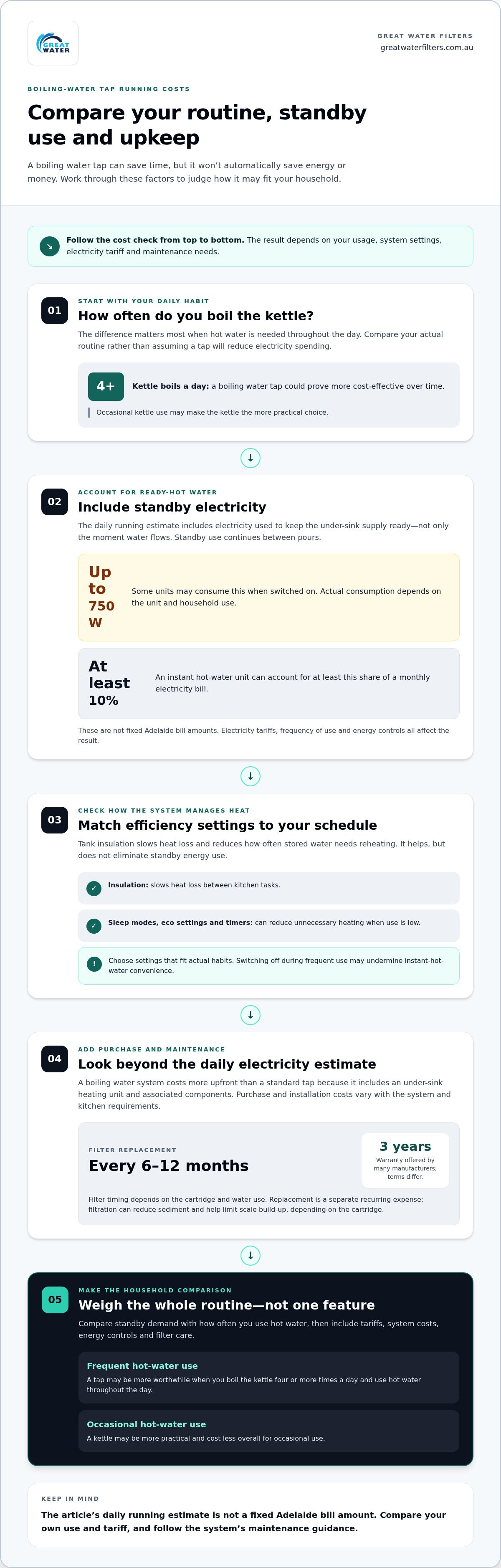
A boiling water tap’s running cost depends on its electricity use and how often your household needs hot water. Compare the estimated daily cost with your kettle habits, then factor in filter replacement and the higher upfront cost compared with a standard tap.
Boiling tap costs versus kettle use
A boiling water tap keeps hot water ready, while a kettle heats water for each use. The difference matters most for households that boil water several times a day. If you use a kettle four or more times daily, a tap could prove more cost-effective over time.
Daily electricity and standby costs
The daily running estimate includes electricity used to keep the under-sink supply ready, not just the moment water flows. Some units may consume up to 750 watts when switched on, while standby use continues between pours. Actual consumption depends on the unit and household use. This matters because an instant hot-water unit can account for at least 10% of a monthly electricity bill.
That estimate isn’t a fixed Adelaide bill amount. Electricity tariffs, frequency of use and the unit’s energy controls all affect the result. Occasional kettle use may cost less overall, while frequent hot-water needs can make the convenience more worthwhile. Compare your routine rather than assuming a tap will automatically reduce electricity spending.
Upfront, a boiling water system costs more than a standard tap because it includes an under-sink heating unit and associated components. The overall purchase and installation cost varies with the system and kitchen requirements, so it should be considered separately from daily electricity use. Many instant hot-water tap manufacturers offer a 3-year warranty, but warranty terms differ by manufacturer.
Ongoing upkeep also affects ownership costs. Most filters used with boiling, chilled and sparkling tap systems require replacement every 6-12 months, depending on the cartridge and water use. A replacement filter is a separate recurring expense, and the interval affects how often homeowners need to maintain the system. Filtration can reduce sediment and help limit scale build-up, depending on the cartridge.
Adelaide homes don’t automatically need filtration or descaling just because they’re in Adelaide. The need depends on the property’s water hardness and the tap system’s scale-management requirements. Follow the system’s maintenance guidance to determine whether filtration or descaling is appropriate.
Boiling-water tap energy and cost savings
Energy efficiency depends on how the under-sink tank retains heat and manages heating cycles. For Adelaide households, daily use patterns and settings matter as much as convenience.
Energy efficiency and insulated tanks
Tank insulation slows heat loss, reducing how often the system needs to reheat stored water. That matters because heating cycles use electricity even when nobody is drawing water.
A well-insulated tank helps keep hot water ready between kitchen tasks. However, insulation doesn’t eliminate standby energy use. Weigh this ongoing demand against how often you use instant boiling water, particularly during quieter periods or overnight.
Compare a system’s insulation and energy-control information before choosing a premium unit. A household using hot water throughout the day has a different pattern from one making an occasional cup of tea. Usage affects how worthwhile the standby convenience is.
Energy use and efficiency features
Efficiency features control when a system heats water and how long it stays ready. Sleep modes, eco settings, timers and energy-saving controls can reduce unnecessary heating when use is low.
For example, a timer can align heating with your regular morning routine, while a sleep mode can reduce readiness outside those hours. These settings work best when they match actual habits. A setting that switches off during frequent kitchen use may undermine the convenience of instant boiling water.
Check how the controls work with the system’s safety features and normal operation. Choose energy controls to suit your household’s schedule, rather than by name alone. Filters also need routine attention, so follow the system’s maintenance requirements.
Energy efficiency and water waste
Energy use and water waste are linked to how much water a household heats, draws and discards. A boiling tap stores heated water for dispensing, while a kettle heats a chosen amount for each boil.
Neither option automatically prevents waste. Filling a kettle beyond what you need leaves unused hot water; drawing more from a tap than a recipe requires also wastes treated water and heating energy. Dispense the amount needed for the task, whether filling a mug or measuring water for cooking.
Filtration can be part of an integrated system, but it doesn’t remove the need to use water thoughtfully. Consider how often your household pours away surplus boiled water and whether the tap controls make measured dispensing straightforward. These habits help show whether the convenience supports more deliberate use.
For Adelaide homeowners, the practical comparison is between standby demand and the energy avoided by matching water use to the task. Review insulation, timers, eco settings and everyday habits together. This gives you a clearer sense of whether an efficient system suits your kitchen routine, rather than relying on one feature to determine savings.
Can I install one in an existing kitchen?
Yes, many boiling, chilled and sparkling water systems can be retrofitted into an existing kitchen. The key considerations are under-sink space and suitable plumbing connections. A retrofit can avoid a full renovation, provided the cupboard accommodates the system and leaves room for servicing.
The convenience is most valuable when hot water is part of your routine throughout the day. A household preparing tea, coffee, porridge and cooking water can draw hot water as needed instead of repeatedly filling and waiting for a kettle. On-demand access can simplify busy kitchen tasks.
Shared kitchens can benefit too. When several family members prepare breakfast or cook at once, a kettle takes up benchtop space and becomes one more appliance to work around. A tap system keeps the hot-water source at the sink, making meal preparation or regular entertaining more convenient.
Plan the space before purchase. The under-sink unit shares cupboard space with bins, cleaning supplies and plumbing, so measure the available area rather than looking only at the tap. Leave clearance around the tank for servicing and keep the filter accessible. A system that fits but disrupts everyday cupboard use can make storage less practical.
Tank dimensions vary by system. For example, listed dimensions for a 4-litre tank are 197 mm wide, 290 mm deep and 260 mm high. A listed 2.4-litre tank measures 178 mm wide, 245 mm deep and 275 mm high. These examples show why measuring cupboard width, depth and height helps assess fit before planning the installation.
Consider the sink and tap position too. The spout should suit your usual tasks, such as filling a mug, saucepan or reusable bottle. If the system includes filtered water, think about how you’ll use it alongside hot water. Good positioning helps keep the sink comfortable for washing and food preparation.
Frequent cooking, limited benchtop space and regular entertaining can make instant access especially useful. By contrast, households that need hot water only occasionally may get less practical value from a dedicated system. Compare your routine with the available cupboard space and plumbing to judge whether a retrofit suits your Adelaide kitchen.
Installation and safety considerations in Australia
A boiling water tap combines plumbing, an under-sink tank and an electricity supply. Planning the fit and controls helps the system suit your kitchen and household routine.
Installation considerations
Installation involves fitting the tap and connecting its under-sink unit to the required services. The tank needs enough room to operate and remain accessible.
Before choosing a position, consider the cupboard, existing plumbing and nearby power supply. Leave space around the tank for servicing, and keep the filter accessible for maintenance. A cramped cupboard can make routine care difficult, even if the tank fits.
Licensed installation supports safe, compliant operation and helps ensure the tap, tank and connections work together as intended. If you’re renovating, plan for the unit early. In an existing kitchen, the available cupboard space and service connections shape what can be fitted.
Think through daily use before purchase. A household making coffee throughout the day may value instant hot water, while occasional use may not justify changing the existing sink setup. The system should suit both the kitchen layout and how people use it.
Safety considerations
Safety controls are designed to reduce accidental operation and scald risk. If children use the kitchen, look for a tap with a safety control, such as child-resistant activation.
The Victorian Building Authority states that more than 90% of hot-tap-water scalds are preventable through safer water-temperature control and safer tapware design. That makes control design a practical buying consideration, not just an optional extra.
Features can include a child safety lock, two-step activation, an insulated spout, controlled water flow and automatic shut-off. These features help manage access to water kept between 98°C and 100°C in Australian boiling-water systems. Consider who uses the sink and whether the activation method is clear to every adult in the household.
Safe placement matters too. Keep the tap’s operating area clear so nothing obstructs the handle or outlet. Keep children away from boiling-water controls, and use the tap carefully when filling a mug, saucepan or coffee pot.
Ask how the system’s safety features work, how it is installed, and where the tank and filter sit. These details connect the tap’s temperatures, electricity supply and maintenance access to your kitchen layout. A suitable system should make daily use convenient while keeping controls and servicing areas accessible.
How integrated boiling, chilled and sparkling water taps work
Integrated water taps combine several drinking-water options at one kitchen point. Under-sink components heat, chill or carbonate water before dispensing it through the tap.
The main drawbacks are a higher upfront cost than a standard tap, cupboard-space requirements and ongoing maintenance. Filters need replacement, sparkling models need carbon dioxide cylinders, and the system requires occasional servicing and routine cleaning.
For instant boiling, an under-sink heating tank stores water between 98°C and 100°C. The tap dispenses it on demand, rather than heating a fresh kettle for each use. A chilled-water reservoir provides cold water separately, while sparkling models use a replaceable carbon dioxide cylinder to carbonate filtered water.
These systems bring boiling, chilled and sparkling options to one tap, but the under-sink unit needs space for its components. Before deciding, consider which functions your household will use. If you mainly need hot water for cooking and tea, extra chilled and sparkling functions may add complexity without matching your routine.
Filtration is another part of the system. A 5-micron multi-stage filter can remove chlorine and sediment, and help limit scale build-up in the heating tank. Filter performance depends on the cartridge, so filtration should be considered alongside cartridge replacement, not as a permanent, maintenance-free feature.
Most filters for boiling, chilled and sparkling systems require replacement every 6-12 months, depending on water use and the cartridge. Sparkling models also need carbon dioxide cylinder replacement. Routine cleaning and occasional servicing add to ownership tasks, while accessible under-sink placement makes filter changes and servicing easier.
Common problems often relate to upkeep or fit. A neglected filter can affect water taste, while an under-sink unit that is difficult to access makes maintenance less convenient. If water tastes unpleasant, check the cartridge’s age and condition as a starting point. Regular maintenance helps the system supply filtered water as intended.
Consider the complete setup, not just the tap. The heating tank, chilled reservoir, filter, carbonation cylinder and controls each serve a different purpose. A household using all three water types may value having them together; one that rarely drinks sparkling or chilled water may prefer a simpler arrangement.
The practical takeaway is to match the features to your kitchen habits, then account for cupboard space and cartridge care. This makes it easier to decide whether an integrated boiling, chilled and sparkling water tap offers useful convenience for your Adelaide home.
Great Water Filters: ES5Q Hi Flow Wellness Whole House Water Filter System
Great Water Filters offers the ES5Q Hi Flow Wellness Whole House Water Filter System for households considering water filtration throughout the home. It’s a separate option from a boiling water tap, which provides kitchen access to hot water.
If whole-home treatment is your priority, the ES5Q may suit your plans. For a kitchen-focused filtration option, Great Water Filters also offers the Elite Series 3 Reverse Osmosis Water Filter System. You can discuss the system that best matches your household’s water needs, with Transparent upfront Pricing and the “Only Pay when Fully Installed & Happy” payment approach.
Contact Great Water Filters to discuss your options.
Choose the next step for your kitchen
For Adelaide households, deciding whether a boiling water tap is a good investment comes down to how it fits your kitchen plans and water priorities. Consider which features support your daily routine, then choose a practical setup for your home.
Great Water Filters offers the ES5Q Hi Flow Wellness Whole House Water Filter System, the Elite Series 3 Reverse Osmosis Water Filter System and the Whole House Water Filter Softener. Each addresses different household water needs.
Contact Great Water Filters to discuss your options with No Upfront Payment Required.
Take time to choose a setup that suits your household. A clear plan makes it easier to enjoy a kitchen that works for you.
Frequently Asked Questions
Are They Energy Efficient?
They can be, but efficiency varies between systems. Before choosing, compare each model’s stated power draw and standby consumption in its product information, then consider your electricity tariff. This gives you a more relevant comparison than relying on a general claim that one tap is “efficient”. Also check the available operating settings and whether they suit the hours your household typically uses the kitchen.
Do They Require Maintenance?
Yes. Follow the system’s maintenance instructions and keep a simple record of completed work, such as cleaning or servicing. If your model includes sparkling water, remember that its carbon dioxide cylinder is a separate consumable from the filter. Keep the relevant instructions and replacement details together to plan upkeep and identify which component may need attention if the system’s output changes.
How long do the filters last?
Filter life is generally 6-12 months, depending on the cartridge and water use. Use the cartridge guidance for your particular system to plan replacement, rather than relying only on a calendar estimate. A reminder in your phone or household maintenance diary can help you keep track. If several people use filtered water daily, note that household usage when planning cartridge changes.
Is it also a money-saver?
Whether a boiling water tap is a good investment in Adelaide depends on how much your household values convenience and which features it will use. Don’t assess it solely as an electricity-saving purchase. Consider whether ready hot water, or access to chilled and sparkling options, would replace appliances or routines you already rely on. The more useful those functions are in daily life, the stronger the case may be.
What Are the Biggest Benefits?
The main benefit is having water options at the kitchen sink without organising separate appliances for each task. This can help when preparing drinks and meals during the same visit to the kitchen. Integrated models also add chilled or sparkling water. The most useful benefit is one that solves a regular household need, not a feature that sounds appealing but rarely gets used.
What Should You Consider Before Buying?
Start by listing the water types your household would genuinely use, then compare systems against that list. Check the operating controls, included components and how replacement cartridges are supplied. Consider who will use the tap and whether its controls are straightforward for them. A feature-by-feature review helps you focus on what suits your household’s everyday preferences.
How much does a boiling water tap cost to buy and install in Adelaide?
The price depends on the system and installation requirements, and is provided after a quote request. The configuration and work required affect the overall cost. When reviewing a quote, make sure it clearly describes the selected setup and installation scope so you can compare like with like. A combined boiling, chilled and sparkling model has different components from a boiling-only option.
What are the ongoing electricity and water costs of a boiling water tap in Australia?
Electricity costs depend on the unit’s consumption and your household’s tariff. Water charges depend on the amount drawn and local billing arrangements. To understand your household’s ongoing use, compare bills over similar periods and note changes in kitchen habits. Don’t assume a tap automatically reduces water or electricity use: the amounts you draw and how the system operates both matter.
COMMENTS