
Protect your family with pure water for drinking, bathing, and appliances.


The cleanest water in your home might actually be the least effective at keeping your family hydrated. It's a confusing reality for many Australian homeowners who are tired of the chemical taste in council water but feel lost in a sea of technical jargon about pH levels and TDS. You want the health benefits of spring-quality water without the fear of a DIY kit causing a leak that ruins your expensive stone benchtops. It's about finding a balance between total purity and the essential minerals your body craves for long-term wellness.
This guide settles the alkaline water filter vs reverse osmosis debate by looking at the latest 2026 filtration standards and health data. We'll show you how to choose a system that provides high-quality hydration for your family while ensuring the installation is handled by licensed professionals. You will learn about the importance of WaterMark certification and how modern systems tackle new challenges like PFAS and lead-free requirements. Our goal is to provide the clarity you need so you can sit back and relax, knowing your kitchen is equipped with a smarter and healthier water solution that looks after everything for you.
Key Takeaways
- Understand the core differences between an alkaline water filter vs reverse osmosis to determine which technology best addresses your concerns about fluoride, heavy metals, and pH balance.
- Identify how local Australian water conditions, such as the mineral hardness in Adelaide and Perth, influence the performance and lifespan of your filtration system.
- Learn why professional installation by licensed plumbers is the only way to ensure your system complies with Australian WaterMark standards and protects your kitchen stone benchtops.
- Discover how hybrid systems like the Elite Series 3 offer a smarter and healthier water filter system by combining total purification with essential mineral restoration.
- Find out how to secure spring-quality water with transparent upfront pricing and our 100% no-risk guarantee, where you only pay when fully installed and happy.
Understanding the Basics: What is Reverse Osmosis vs Alkaline Filtration?
Choosing the right system for your home starts with understanding the fundamental technology behind your tap. While both systems aim to improve your drinking water, they approach the task from opposite directions. The core difference between an alkaline water filter vs reverse osmosis lies in whether the system is primarily "taking away" contaminants or "adding to" the water's mineral profile. One focuses on absolute purity, while the other prioritises mineral balance and pH levels.
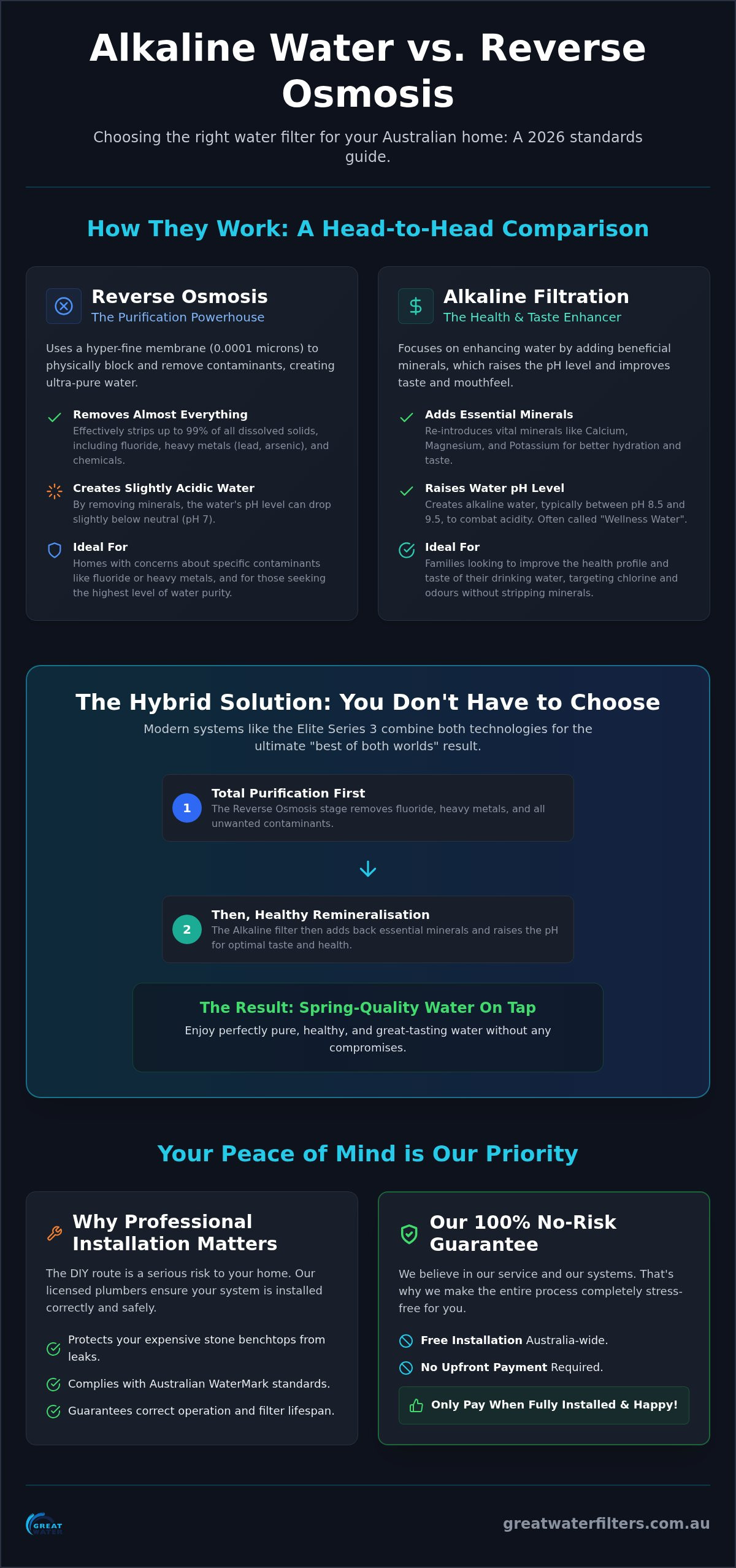
Reverse osmosis (RO) is a multi-stage purification process that uses a semi-permeable membrane to remove fluoride, heavy metals, and almost all dissolved solids. It's a rigorous method designed for those who want the highest level of filtration possible. Conversely, alkaline filtration is less about stripping the water and more about enhancing it by raising the pH and reintroducing beneficial elements that might be missing from processed town water.
The Mechanism of Reverse Osmosis Purification
Reverse Osmosis is widely regarded as the "gold standard" for contaminant removal. The heart of the system is a sophisticated membrane with pores as small as 0.0001 microns. To put that in perspective, this is fine enough to catch microscopic particles, including arsenic, lead, and the fluoride added to most Australian metropolitan water supplies. Because the membrane is so delicate, the process relies on high-quality pre-filters. These initial stages catch larger sediment and chlorine, which prevents the membrane from clogging or being damaged by chemicals. The result is ultra-pure water that is free from the metallic or chemical tastes common in many Australian suburbs.
The Role of Alkaline Remineralisation
While RO focuses on removal, alkaline filtration focuses on restoration. These systems use cartridges filled with natural mineral stones to raise the water's pH level, typically pushing it above 7.0 to create a more basic, less acidic profile. This is why many in the health community refer to it as "Wellness Water." During this process, the system re-introduces essential minerals like Calcium, Magnesium, and Potassium. These elements are vital for effective hydration and give the water a crisp, refreshing taste similar to high-quality mountain spring water. For many Australian families, the Elite Series 3 Reverse Osmosis system offers a clever middle ground by combining these two technologies into one streamlined unit.
Reverse Osmosis vs Alkaline: The Head-to-Head Comparison
Deciding between an alkaline water filter vs reverse osmosis often comes down to your personal health priorities and the specific quality of your local water supply. While both systems significantly improve the water coming from your tap, they serve different masters. Reverse Osmosis is the undisputed champion of purification, while alkaline systems focus on the biological benefits of mineral-rich, pH-balanced hydration.
Contaminant Removal Capabilities
If your primary concern is the total removal of fluoride, lead, and total dissolved solids (TDS), Reverse Osmosis is the clear winner. Its ultra-fine membrane acts as a physical barrier that most contaminants simply cannot pass. This makes it the preferred choice for Australian homes where aging pipes or high fluoride concentrations are a worry. On the other hand, the Elite Series 2 Alkaline Filter is designed to target chlorine, pesticides, and unpleasant odours while intentionally leaving the base minerals intact. It provides a cleaner, safer drink without the total strip-down of the water's natural structure.
PH Levels and Mineral Balance
The Australian Drinking Water Guidelines suggest that the pH of drinking water should ideally be between 6.5 and 8.5 for pipe health and palatability. However, many health enthusiasts seek the "sweet spot" of pH 8.5 to 9.5. Standard RO water can sometimes lean towards the acidic side because the removal of minerals lowers its pH. Alkaline filters solve this by mimicking the way water flows over mountain rocks, reintroducing calcium and magnesium. This process doesn't just raise the pH; it creates a "smooth and silky" mouthfeel that is distinct from the "crisp and pure" taste of RO water.
When comparing an alkaline water filter vs reverse osmosis, maintenance and environmental impact are also worth noting. Alkaline systems are generally zero-waste, meaning every drop that enters the filter comes out of the tap. RO systems do produce a small amount of waste water as part of the membrane cleaning process, though modern units are now highly efficient. If you are unsure which technology fits your kitchen best, you can request a water quality assessment to see which system we recommend for your specific area. Whether you choose the total purity of RO or the mineral wellness of an alkaline system, you can sit back and relax knowing our professional plumbers handle the entire installation process for you.
The Australian Context: Town Water Quality and Your Choice
Australia's tap water is considered safe by global standards, but the experience of drinking it varies wildly depending on your postcode. If you're in a capital city, you've likely noticed the heavy scent of chlorine or a distinct metallic aftertaste. Local council treatment processes are designed to keep water sterile, but these necessary chemicals can make your morning tea taste like a public swimming pool. Deciding on an alkaline water filter vs reverse osmosis often depends on which of these local additives you want to address first.
Every state faces unique challenges. While one region might struggle with chemical taste, another deals with mineral deposits that ruin appliances. Choosing a system designed for Australian plumbing standards ensures your filtration can handle the specific pressure and contaminants found in our local infrastructure.
Dealing with Fluoride and Chlorine in Capital Cities
Sydney and Melbourne residents often prioritise fluoride removal, which makes Reverse Osmosis a top contender for many households. However, total purification comes with a trade-off. Research has highlighted potential health risks of demineralized water when essential elements are stripped away and not replaced. This is why families in Brisbane and the Gold Coast are moving towards "Smarter & Healthier" systems. They want to strip the harsh chlorine that ruins the flavour of their coffee while keeping the water biologically active. Our Elite Series 3 Reverse Osmosis system provides the perfect middle ground by purifying the water first and then reintroducing minerals for a balanced finish.
Protecting Your Home from Hard Water and Scale
In Adelaide and Perth, the primary concern is often "hard water." High levels of calcium and magnesium in these regions cause scale buildup in kettles and can shorten the life of under-sink filters. For these homes, a Whole House Water Filter Softener is often the first step to protect the entire property. The under-sink system then acts as the final stage of protection for your family's drinking water. Because Australian plumbing regulations are strict, professional installation is essential to ensure your system handles local water pressure correctly. We use licensed plumbers for every job so you can sit back and relax, knowing the installation is 100% no risk and looks after everything for you.
Professional Installation: Why the "DIY" Route is a Risk
While the debate between an alkaline water filter vs reverse osmosis often focuses on water chemistry, the physical installation is where most homeowners face the highest risk. Many online retailers push DIY kits as a way to save money. However, in Australia, this approach can lead to significant legal and financial headaches. Australian plumbing regulations often require a licensed professional for any work involving mains water connections. Ignoring these rules doesn't just risk a fine; it can lead to catastrophic "blow-outs" if non-standard fittings fail under pressure.
We believe you shouldn't have to worry about the technicalities of plumbing. That's why we offer Free Installation Australia wide. Our service model is built on transparency and trust. With our "Pay Only When Fully Installed & Happy" policy, there is 100% no risk for you. You don't need to worry about upfront payments or hidden fees. We look after everything for you so that your journey to healthier water is completely stress-free.
The Peace of Mind of Licensed Plumbers
We coordinate with a network of local, licensed installers across the country, including specialists in Hobart, Launceston, and Adelaide. These professionals understand the specific nuances of local water pressure and infrastructure. During a professional install, our plumbers perform comprehensive pressure testing and rigorous leak checks to ensure every fitting is secure. Once the system is running perfectly, our installers provide a full demonstration of how your new filter works. This allows you to sit back and relax, knowing your family's water supply is in expert hands.
Maintaining Your Warranty and Home Security
Professional installation is the only way to truly protect your kitchen investment. If a DIY kit fails and causes a flood, your home insurance provider may refuse to cover the water damage because the work wasn't performed by a licensed professional. This can result in tens of thousands of dollars in repairs to warped cabinetry or cracked stone benchtops. By choosing a professionally installed system, you safeguard your home and your warranty. Our "Frozen Price Guarantee" means the price you are quoted is the price you pay, with no surprise plumbing costs on the day of the visit.
Our relationship with you continues long after the initial setup. We provide ongoing support, including courteous reminders for your replacement filter cartridges. This proactive approach ensures your system remains in peak condition without you having to track dates or model numbers yourself. It's all part of our commitment to being a long-term partner in your home's wellness.
Book your free professional installation today
The Hybrid Solution: Why You Don’t Have to Choose
Many homeowners feel stuck when comparing an alkaline water filter vs reverse osmosis because they want the purity of one and the mineral benefits of the other. You shouldn't have to compromise on your family's health or the taste of your tea. We've solved this dilemma with a single, high-performance system. The Elite Series 3 Reverse Osmosis represents the pinnacle of home filtration by combining these two technologies into one streamlined unit. This hybrid approach creates the healthiest, best-tasting water available in Australia today.
How the Elite Series 3 (ES3) Works
The ES3 uses a comprehensive 5-stage process that leaves nothing to chance. During the first three stages, the system focuses on total purification. This includes removing sediment, chlorine, fluoride, and heavy metals through a high-precision membrane. Once the water is ultra-pure, it passes through a final alkaline post-filter. This stage is critical because it makes the RO water "alive" again by reintroducing essential minerals and restoring a healthy pH balance. It bridges the gap between total safety and biological wellness, ensuring your water isn't just clean, but actually supports your body's hydration needs.
This entire process happens within a compact under-sink design. Modern Australian kitchens often have limited space, especially with integrated appliances and stone benchtops. The ES3 is engineered to fit neatly in these cupboards without requiring bulky storage or complex plumbing adjustments. It provides a permanent solution for your home that delivers spring-quality water with every turn of the tap.
Start Your Wellness Journey Today
You can secure your "Smarter & Healthier" water filter system with no upfront payment required. We believe in our products and our craftsmanship, which is why we offer transparent upfront pricing and a "Pay Only When Fully Installed & Happy" guarantee. This ensures a 100% no-risk experience for your family. You don't have to worry about the technical details or the installation process. Our team looks after everything for you.
Our relationship with you is built on long-term service support. From the moment you register, we coordinate with our licensed plumbers to handle the installation at a time that suits your schedule. We also provide ongoing care, including reminders for your replacement cartridges, so your system continues to perform at its best for years to come. This methodical approach ensures you can sit back and relax, knowing your home's water quality is managed by industry veterans.
Take the First Step Toward Smarter & Healthier Water
Choosing between an alkaline water filter vs reverse osmosis no longer requires a compromise between purity and wellness. You now understand how modern hybrid systems bridge the gap, providing total contaminant removal while restoring the essential minerals your body needs. By accounting for local Australian water conditions and strict plumbing standards, you can secure a long-term solution that delivers spring-quality water straight from your kitchen tap.
Our team looks after everything for you. We provide licensed professional installers in all major cities to ensure your system is fitted to the highest standard. With our 100% no risk guarantee, you don't need to worry about upfront costs. You only pay when fully installed and happy, allowing you to sit back and relax while we handle the technical details.
It's time to enjoy the peace of mind that comes with transparent upfront pricing and a system that truly supports your family's health.
Frequently Asked Questions
Is reverse osmosis water better for you than alkaline water?
The choice depends on whether you prioritise total purification or mineral restoration. Reverse osmosis provides the highest level of safety by removing up to 90.8% of total dissolved solids, including heavy metals. Alkaline water focuses on pH balance and electrolyte restoration. For most Australian families, a hybrid system like the Elite Series 3 is the best option because it purifies the water first and then adds back essential minerals for optimal health.
Does an alkaline water filter remove fluoride from Australian tap water?
Standard alkaline filters are not designed to remove fluoride. To effectively eliminate fluoride from your supply, a reverse osmosis membrane is required. When comparing an alkaline water filter vs reverse osmosis, the RO system is the clear winner for chemical removal. Our hybrid systems solve this by using an RO stage to strip the fluoride before the alkaline stage reintroduces healthy minerals like calcium and magnesium.
Will a reverse osmosis system waste a lot of water?
Modern residential reverse osmosis systems are engineered for high efficiency and produce very little waste. While older systems had higher discharge rates, our Elite Series 3 is designed for the Australian climate and water conditions. The small amount of water used to flush the membrane is a necessary part of the self-cleaning process. This ensures your filters last longer and your drinking water remains at the highest possible purity level.
How often do I need to change the filters in a hybrid RO-Alkaline system?
We recommend changing your filter cartridges every 12 months to maintain peak performance. Annual servicing ensures the pre-filters continue to protect the RO membrane from chlorine damage while the alkaline stage remains effective at balancing your water's pH. To make this process stress-free, we provide a long-term service partner approach by sending you courteous reminders when your replacement filter cartridges are due for a refresh.
Can I install these systems in a rental property in Australia?
Yes, our systems are an excellent choice for tenants who seek better water quality. Since we use licensed professional plumbers for all installs, the work complies with Australian standards and is generally accepted by landlords. The systems are also portable, meaning you can take the unit with you when you move. This makes it a 100% no risk investment for anyone wanting spring-quality water without making permanent structural changes.
What is the ideal pH level for drinking water at home?
The "sweet spot" for healthy drinking water is typically between pH 8.5 and 9.5. While the Australian Drinking Water Guidelines focus on a range of 6.5 to 8.5 to protect infrastructure, many wellness experts prefer a more alkaline profile. Our Elite Series 2 and Elite Series 3 systems are specifically designed to reach these higher levels by mimicking the natural mineralisation process found in mountain springs.
Does alkaline water actually taste different from regular tap water?
Alkaline water has a noticeably smoother and silkier mouthfeel compared to standard tap water. By removing the "pool-like" scent of chlorine and the metallic tang of old pipes, the filtration process allows the natural sweetness of the minerals to shine through. Most of our customers find that it tastes remarkably like premium bottled spring water, which also significantly improves the flavour of their daily coffee and tea.
Are Great Water Filters installers licensed plumbers in my city?
Yes, we only use professional licensed plumbers for every installation Australia wide. Whether you are in a major capital city or a regional hub like Hobart or Launceston, your system will be fitted by a qualified local expert. This ensures your home remains safe and your manufacturer's warranty stays intact. Because you only pay when fully installed and happy, you can sit back and relax while we handle everything.
COMMENTS