
Protect your family with pure water for drinking, bathing, and appliances.


A water softener may help protect household appliances, but it won’t reduce Brisbane’s fixed water and sewerage charges. That’s the key to understanding the water softener impact on water bills Brisbane homeowners are weighing up: any change to the bill is more likely to come through water usage, while system running and maintenance costs sit elsewhere.
It’s reasonable to wonder whether treating hard water could add to your bill, or whether potential household savings might balance out the cost. The answer depends on your local water conditions, how your household uses water and the softener’s operating needs. Brisbane water hardness varies by area, so one home’s reasons for considering a softener may not apply to another.
This guide explains which charges a softener can and can’t affect, and how to factor in water use, energy, maintenance and possible appliance benefits. If you’re exploring Smarter & Healthier water filter systems, you’ll also learn how to assess your household’s needs before deciding whether a whole-house softener makes sense for your home.
Key Takeaways
- Learn how calcium and magnesium contribute to water hardness, and why local supply information may not tell the whole story for your property.
- Assess the water softener impact on water bills Brisbane households may see by separating billed water use from energy, maintenance and other household costs.
- Use current bills and household information to build a fair comparison, rather than relying on assumed savings or general estimates.
- Decide whether a whole-house softener is worth considering by matching local conditions and household priorities with the system’s operating requirements.
Water softener impact on water bills in Brisbane: what changes and what does not
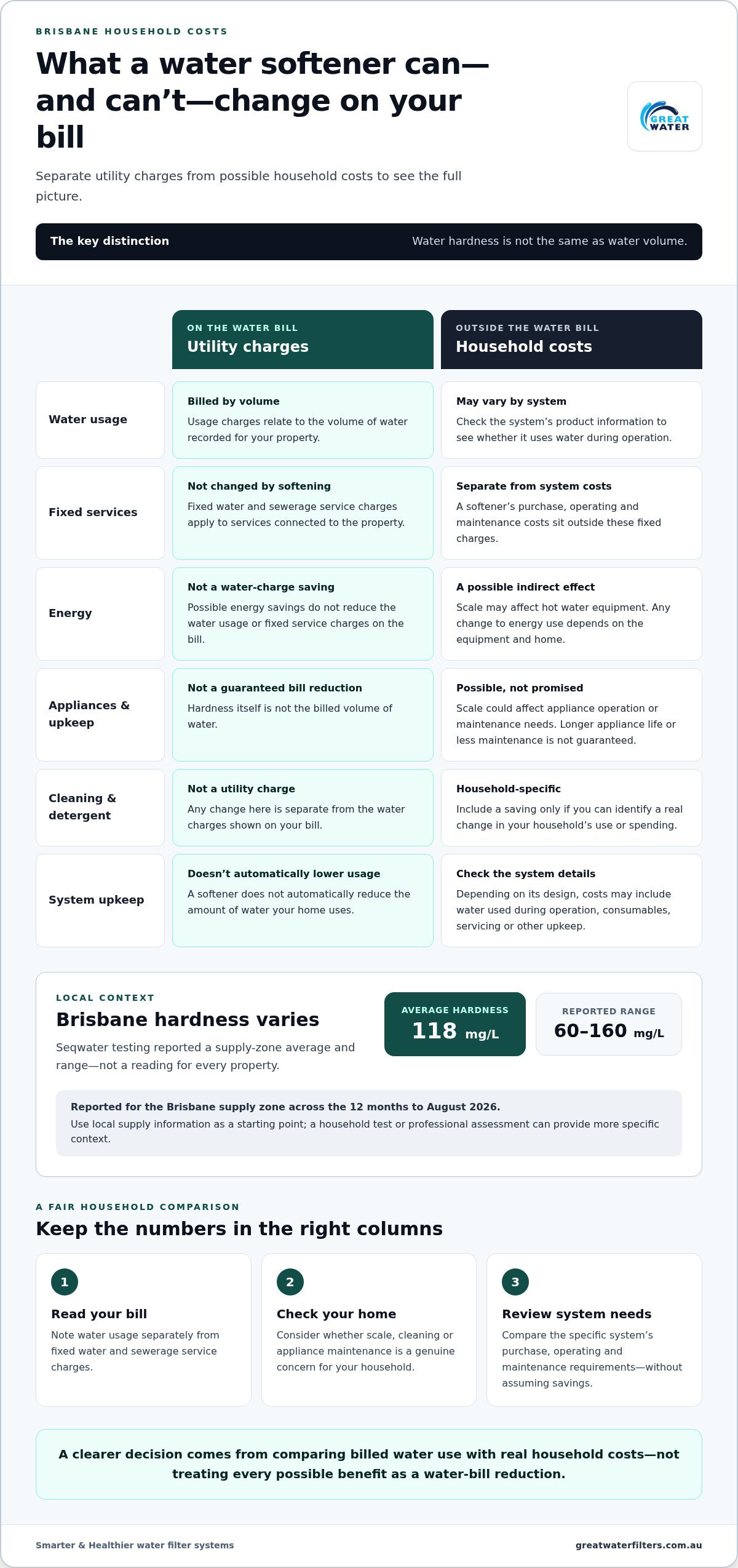
Water hardness describes the amount of dissolved minerals, mainly calcium and magnesium, in water. These minerals can contribute to scale, but hardness and water volume are different measures. A water bill records charges for water supplied and services, not how hard the water is. The water softener impact on water bills Brisbane households may see depends on separating utility charges from other household costs.
What does a Brisbane water bill actually measure?
Urban Utilities bills distinguish water usage charges from fixed service charges. Usage charges relate to the volume of water recorded for the property, while fixed water and sewerage service charges apply to the services connected to it. A softener doesn’t automatically reduce the volume your household uses, and it doesn’t change fixed charges. Start with your latest bill and identify each charge and the water usage recorded for your home.
Direct water-bill effects involve changes to billed water use; indirect household savings involve possible changes to energy, appliance, detergent or maintenance costs. Keeping these categories separate makes it easier to judge whether a softener makes financial sense. Don’t treat every possible benefit as a reduction in your water bill.
Why might hard water affect costs beyond the water bill?
Mineral scale may build up in hot water equipment and other appliances that heat or use water. Depending on the equipment and conditions in the home, scale could affect operation or increase the need for cleaning or maintenance. Not every household will experience these problems, and softening doesn’t guarantee a specific saving.
Cleaning and detergent use are also household-specific. Some people may find hard-water deposits affect cleaning, but any change in detergent use or effort depends on the home and its routines. For a plain-English overview of the process and how it relates to hardness, see Understanding Water Softening.
- Water charges: Compare the usage and fixed service charges shown on your bill. Hardness itself isn’t the billed volume.
- Energy: Consider this separately if scale may be affecting hot water equipment.
- Appliances and maintenance: Treat longer appliance life or less maintenance as possible, not guaranteed, benefits.
- Cleaning and detergent: Include these only if you can identify a real change in your household’s use or spending.
Possible energy savings from improved equipment operation are separate from reductions in water charges. A softener may affect wider household costs, but it doesn’t automatically lower the amount of water your home uses or the utility’s fixed service charges.
How should you read the difference?
Start with your latest bill and note billed water use separately from fixed charges. Then consider whether scale, cleaning or appliance maintenance is a genuine concern in your home. This gives you a clearer basis for weighing possible indirect benefits against the softener’s purchase, operating and maintenance costs, rather than assuming a lower water bill will cover them.
Brisbane water hardness and softener operation: understand the local factors
Brisbane’s water supply isn’t identical everywhere, and conditions at your property can also influence the water reaching your tap. Surface clues alone aren’t enough to decide whether softening is worthwhile. To assess the water softener impact on water bills Brisbane homeowners may experience, start with local water-quality information, then consider what’s happening in your own home.
How can Brisbane homeowners check water hardness?
Review current water-quality information from Seqwater or Urban Utilities, paying attention to the area covered and the date of the data. Seqwater’s September 2026 testing reported an average hardness of 118 mg/L across the Brisbane supply zone in the 12 months to August 2026, with results ranging from 60 to 160 mg/L. This is a supply-zone overview, not a measurement of every property.
A household water test or professional assessment can provide more specific context. Limescale on a tap, spots on glassware or soap residue may be clues to investigate, but they don’t confirm your water’s hardness or establish that a softener is the right response. Other household factors can cause similar signs.
Use local supply information as a starting point, not a substitute for property-specific evidence. Note where published data applies and whether it reflects current conditions. This gives you a more reliable basis for deciding whether observed scale or cleaning issues are consistent with the water supplied to your home.
How does a water softener affect household water use?
Water softeners differ in design and operation. A specific system’s product information explains how it treats water, whether it uses water during operation, and what maintenance it requires. Installation and household use can also affect operating needs. Base your comparison on the details of the system you’re considering, rather than a general description of softeners.
Include a system’s running and maintenance requirements in your household cost comparison. Depending on the design, relevant items may include water used during operation, consumables, servicing or other upkeep. Don’t assume every system has the same requirements or that a particular operating cost applies to the Whole House Water Filter Softener.
Great Water Filters supplies the whole-house water softener option as part of its residential water-treatment range. Consider local conditions, your household priorities and the system’s operating information together. Matching what you know about your water with the product details keeps the decision practical and your cost comparison grounded.
Water softener savings versus running costs: compare the whole household picture
A fair comparison looks beyond the water bill. Separate costs you can verify from benefits that are possible, household-specific or dependent on how a particular system performs. The water softener impact on water bills Brisbane households might expect isn’t the same as a change in energy use, cleaning costs or appliance maintenance.
Which costs should homeowners include in a fair comparison?
Gather recent water and energy bills and record them separately. Note household water use and any changes in occupancy or routines, so you don’t mistakenly credit a change in usage to the softener. Use actual quoted figures for the system and installation, alongside verified information about its operating requirements, consumables and maintenance. If a figure isn’t available, mark it as unknown rather than filling the gap with an estimate.
| Cost or benefit | What to compare | How to treat it |
|---|---|---|
| Water charges | Usage and service charges on recent bills | Direct bill measure: don’t assume softening reduces billed water volume or fixed charges. |
| Energy | Recent bills and any verified change in equipment operation | Possible, system-dependent: count a saving only when supported by household evidence. |
| Maintenance | Actual servicing, cleaning or repair history | Household-specific: don’t assume scale-related maintenance will be avoided. |
| Consumables and operation | Requirements verified for the specific system | System-dependent: check operating water, power, consumables and upkeep rather than assuming all softeners are alike. |
| Appliances and cleaning | Repair or replacement records, and cleaning or detergent spending | Possible: use your own history, not generic savings claims. |
Compare the same periods where practical, and keep notes on other changes, such as different appliance use or a repair. This won’t prove the cause of every bill movement, but it helps prevent unrelated changes from being counted as a softener benefit.
When could a softener be worth considering?
A softener may be worth investigating if current local water information, property-specific evidence and persistent scale concerns point to a relevant household issue. Your priority might be equipment care, cleaning or another practical concern, rather than a lower water bill. If hardness-related problems aren’t a priority, or the system’s verified operating and maintenance costs outweigh likely benefits, a softener may not be the right fit.
Assess total household costs rather than expecting a lower water bill. Treat reduced scale-related issues as a possible benefit, not a reduction in billed water volume or a guaranteed saving. A balanced decision weighs the system’s actual costs and requirements against the issues your household wants to address.
How to assess a water softener for your Brisbane home
A sound decision starts with evidence from your home, not a promise of lower water bills. Use this step-by-step check to decide whether a whole-house softener is worth investigating and to build a realistic comparison of its costs and possible benefits.
What should you check before choosing a whole-house softener?
- Check local water information. Review current water-quality details for your supply area, including the publication date and locations covered. Add property-specific test results if you have them. Local averages can help orient your decision, but they aren’t a measurement of the water at your individual taps.
- Record what you’ve noticed. Note where scale appears, how often it returns and which fixtures or appliances matter most to your household. These signs can prompt further investigation, but treat them as clues rather than proof of a particular hardness level or cause.
- Set your priorities. Decide whether you’re most concerned about scale on fittings, hot water equipment, cleaning or another household issue. A softener may be relevant if the concern affects several parts of the home, but results depend on the water conditions and system.
- Compare the full costs. Use current water and energy bills, your household’s water use, and verified information about the system’s operating and maintenance requirements. Include installation, consumables or upkeep only when you have actual figures. Don’t build the case around assumed water-bill savings.
This process helps separate a whole-house concern from an isolated issue. If scale is limited to one fixture, for example, that alone may not justify treating water throughout the property. If concerns occur across multiple rooms or appliances, compare those observations with local and property-specific information before deciding.
How does professional installation fit into the decision?
Great Water Filters supplies and professionally installs residential water-treatment systems, including a whole-house water softener. Installation is one part of the overall comparison, alongside the system’s running and maintenance needs. Great Water Filters offers Free Installation Australia wide and Transparent upfront Pricing, so you can include these terms when assessing the full household picture.
The water softener impact on water bills Brisbane households experience shouldn’t be the only measure of value. A whole-house system may suit a home with verified hardness concerns and priorities that align with softening, but it won’t be the right choice for every household. Take time to weigh the evidence and costs before moving ahead.
A whole-house water softener in Brisbane: decide with clear costs and support
A whole-house softener may be worth investigating if verified water information and recurring scale concerns point to an issue affecting several parts of your home. If you’re relying only on spots, residue or a general suburb-level description, first establish whether those clues match your property’s water conditions. The decision should reflect household needs, verified system requirements and clear costs, not an expectation of lower water charges.
The Whole House Water Filter Softener is one option in a home water-treatment plan. Its suitability depends on your priorities and the conditions at your property. A softener doesn’t guarantee savings or a reduction in Brisbane water charges, so base your decision on the specific concerns you want to address.
What does Great Water Filters’ service promise mean for homeowners?
Great Water Filters supplies and professionally installs residential water-treatment systems. For homeowners considering a whole-house softener, the stated terms include 100% No Risk and No Upfront Payment Required. The payment assurance is: Only Pay when Fully Installed & Happy.
These terms clarify the payment arrangement, but they aren’t a promise that a softener will lower your water bill, reduce household water use or deliver a particular saving. Keep the financial assessment separate: use your current bills and household records, and count potential benefits only when they’re relevant and supported by evidence. That way, service terms and expected household outcomes don’t get confused.
What is a sensible next step for Brisbane homeowners?
Bring together your current water and energy bills, local water-quality information, any property-specific test results and a brief record of where scale is causing concern. This gives you a practical starting point for a discussion about your home’s water-treatment needs. The water softener impact on water bills Brisbane homeowners assess is only one part of the decision; wider household costs and the reason for treating the water matter too.
Register for a straightforward discussion about your home water-treatment needs and whether a whole-house softener may suit your priorities.
Make your next step an informed one
A useful decision doesn’t need to happen in a hurry. Keep a simple record of the water or appliance issues you want to address, along with the household information you’ve gathered. This gives you a practical starting point for discussing whether a whole-house softener fits your home’s needs, without relying on a promised payback or assumed reduction in charges.
The water softener impact on water bills Brisbane homeowners consider is only one part of deciding how to manage water at home. If you’d like help exploring your options, register for a water-treatment consultation. Bring your questions and household priorities, then decide what feels right for your home.
Clear information makes it easier to move forward with confidence, at your own pace. Great Water Filters also supplies and installs residential water-treatment systems for homeowners in Melbourne, Perth, Sydney, Brisbane, the Gold Coast, Adelaide, Alice Springs, Hobart and Launceston.
Frequently Asked Questions
Is Brisbane water hard enough to need a water softener?
Not every Brisbane home needs a water softener. Check current local water-quality information and whether it covers your supply area, then consider a property-specific test if you need a clearer picture. If you test your water, record where and when the sample was taken so you can interpret the result in context. Scale on a tap or kettle can prompt investigation, but it can’t tell you the precise hardness level.
Can a water softener lower my Brisbane water bill?
Don’t assume a softener will lower your Brisbane water bill. The water softener impact on water bills Brisbane households may experience isn’t a guaranteed reduction in billed water use. If you’re assessing wider value, track possible changes in energy, cleaning or maintenance separately from water charges. Compare those records with the system’s verified operating needs, and be cautious about attributing a change to the softener if other household conditions have changed.
Does a water softener use extra water?
It depends on the system. Designs can have different operating processes, so use the product information to establish whether water is used during operation and how much, if that figure is provided. Include any applicable water use in your comparison, alongside required consumables and maintenance. Don’t assume a water-use figure applies to every softener.
Will a water softener reduce my hot water or electricity costs?
It might help address scale-related concerns, but lower energy costs aren’t guaranteed. The outcome depends on the water, the existing hot water equipment, household use and the system’s performance. To assess any change, compare energy bills from comparable periods and note changes such as equipment replacement or altered household routines. Keep this separate from water charges, as a change in electricity costs doesn’t show that the water bill has fallen.
Can I install a whole-house water softener in a Brisbane home?
A whole-house water softener may suit a Brisbane home if the property setup and household priorities align with the system selected. Before deciding, note the plumbing arrangement, where water is used across the home and which hardness-related concerns you want to address. Then compare those needs with the system information and installation requirements. This helps you assess whether treating water throughout the home is a practical fit.
What should I compare before choosing a water softener?
Compare your current water and energy bills, verified information about local water conditions, the system’s operating requirements, maintenance and any consumables. Use your own records for appliance repairs, cleaning products or detergent spending rather than relying on general savings claims. Keep one-off and ongoing costs separate, and don’t count a possible benefit as a saving until it’s supported by evidence from your household.
COMMENTS