
Protect your family with pure water for drinking, bathing, and appliances.

If alkaline water has a higher pH, does that automatically make it healthier? Not necessarily. Alkaline describes a measurable chemical property, not a guarantee of health benefits. It’s also easy to confuse alkaline with alkali or alkalinity, even though each term has a different meaning.
That confusion can make it hard to judge water claims or decide whether an alkaline filter is right for your home. This guide explains the basic chemistry, how pH and alkalinity relate to water, and what the evidence does and doesn’t support. You’ll also find practical checks for comparing filters, so you can focus on your household’s actual water needs rather than relying on an “alkaline” label alone.
Great Water Filters supplies and professionally installs residential water treatment systems, including the Elite Series 2 Alkaline Water Filter. The company also supplies replacement filter cartridges and provides system support. Before deciding, check the product information for its specific functions, then compare those with the water concern you want to address.
Key Takeaways
- Alkaline describes a basic chemical condition. The label alone doesn’t tell you whether water will deliver a health benefit.
- pH and alkalinity are related but measure different properties, so check which one a water claim refers to.
- Start with your household’s specific water concern, then check relevant water information before comparing treatment options.
- Look for evidence of a filter’s stated function rather than relying on the word “alkaline” alone.
- If you’re considering the Elite Series 2 Alkaline Water Filter, check its product details and ongoing support, including replacement cartridge arrangements.
What Does Alkaline Mean When It Describes Water?
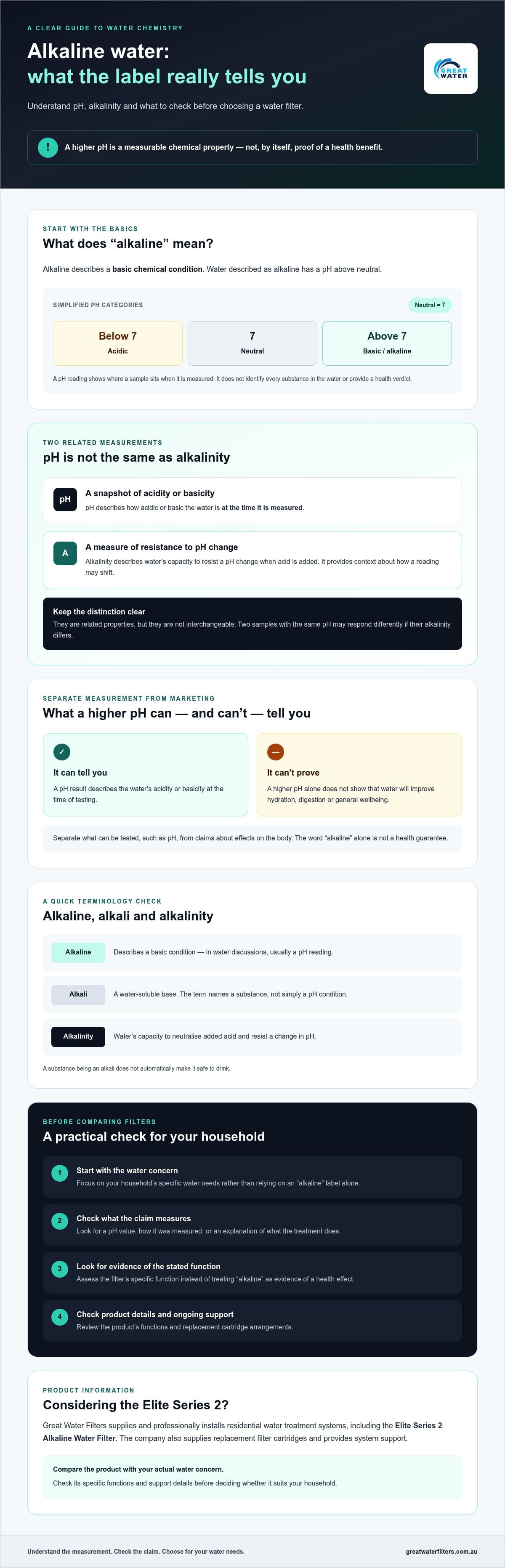
Alkaline describes a basic chemical condition; water described as alkaline has a pH above neutral. Neutral water has a pH of 7, so a reading above 7 is basic. The word describes a chemical property, not a health outcome.
Alkaline is also different from alkalinity. pH describes how acidic or basic water is at the time it’s measured, while alkalinity describes its capacity to resist changes in pH when acid is added. The properties are related, but they aren’t interchangeable. Alkalinity provides further background on this buffering capacity.
For a short explanation of water quality and health claims, you can also watch this video:
Is alkaline the same as alkali?
No. An alkali is a water-soluble base; alkaline describes a basic condition. For example, sodium hydroxide is an alkali used in some drain cleaners, and solutions containing it are alkaline. That doesn’t make them safe to drink. In water discussions, “alkaline” usually describes a pH reading rather than naming a particular substance.
What does alkaline mean on a water label?
A label may refer to the water’s measured pH or to a treatment approach intended to change its pH. Those are not necessarily the same claim. Check whether the label gives a pH value, explains how it was measured, or describes what the treatment does. If it simply says “alkaline”, look for more detail before drawing conclusions.
A higher pH is a measurable characteristic. On its own, it doesn’t show that water will improve hydration, digestion or general wellbeing. When assessing a product, separate what can be tested, such as pH, from claims about effects on the body. That distinction helps you identify what information you need before considering a filter.
How pH and Alkalinity Describe Water Chemistry
pH is a measurement used to describe how acidic or basic a solution is. For water, it gives one useful piece of information, but it doesn’t tell you everything about the water’s chemistry.
pH measures how acidic or basic water is at the time of testing; alkalinity measures how well it resists a change in pH. They’re related properties, not two names for the same measurement.
What does the pH scale tell you?
A simple pH scale places readings in three broad categories:
- Below 7: acidic
- 7: neutral
- Above 7: basic, or alkaline
This is a simplified illustration of the scale. A reading tells you where a sample sits at the time it’s measured. It isn’t a health verdict, and it doesn’t identify every substance present in the water. For example, two samples with the same pH may respond differently if their alkalinity differs.
That distinction matters when a water claim rests on a single number. A pH result describes acidity or basicity, but it can’t by itself establish a health effect. For a medical perspective on claims, Cleveland Clinic discusses the evidence on alkaline water benefits.
How is alkalinity different from pH?
Alkalinity describes water’s capacity to neutralise added acid and resist a change in pH. Think of it as a buffer: the buffer’s strength affects how much an addition can shift the reading. This analogy is only a guide. Alkalinity isn’t the pH value, and it doesn’t mean the water will keep one fixed pH under every condition.
A pH test is a snapshot; alkalinity provides context about how water may resist a change in that reading when acids enter it. That’s why a single pH result can’t describe every aspect of water chemistry. The relevant measurements depend on the question you’re trying to answer.
For household decisions, check what a test or product claim actually measures. If it reports pH, treat it as a reading of acidity or basicity. If it reports alkalinity, it’s describing resistance to pH change. Keeping those terms separate makes it easier to assess the information without reading more into one number than it can tell you.
Alkaline Water Benefits: What Evidence Can and Cannot Tell You
Claims about better hydration, easier digestion or improved wellbeing can sound appealing, especially when water is presented as a simple change to your routine. But a measurable water property and a health effect are different things. A pH reading can describe water; it can’t, by itself, prove what drinking it will do inside your body.
Research into possible benefits remains limited, and broad claims shouldn’t be treated as established without strong, current evidence. The body also has its own systems for keeping blood pH within a stable range. An individual’s experience may be genuine, but it doesn’t establish that the same effect will happen for everyone.
Does alkaline water have proven health benefits?
Be cautious with claims that promise general benefits for hydration, digestion or wellness. Some research has explored particular effects in specific situations, but that doesn’t prove broad benefits for everyday drinking. Check whether a health statement is supported by reputable, current evidence, and whether the research relates to the product and outcome being discussed.
Distinguish a person saying “I feel better” from evidence that supports a general health claim. Neither a higher pH nor an individual testimonial proves disease prevention, treatment or cure. If you have a health concern, seek advice from a qualified health professional rather than relying on a water label.
How to spot an overstatement in a water claim
Pause if a claim guarantees a dramatic result, promises to prevent illness or relies on a striking before-and-after story without explaining the evidence. Ask what was measured, how it was measured and whether the evidence comes from a reliable source. A claim should also be appropriately qualified, especially when it refers to health.
- Look for specifics: Does the product explain its stated treatment function, rather than relying on broad wellness language?
- Check the evidence: Is a study or reputable source named, and does it support the exact claim being made?
- Separate the claims: A testable water characteristic isn’t proof of a health outcome.
For a deeper discussion, read Great Water Filters’ alkaline water benefits guide. Consider what is measurable, what is supported by evidence and what remains a claim. A clear explanation of a product’s function is more useful than a sweeping promise.
How to Assess Alkaline Water and Your Household Tap Water
Start with the water question you actually want answered. A filter chosen to adjust pH may not address a separate concern, such as taste or a particular contaminant. Household water characteristics can vary by location and supply, so don’t assume a general description applies to your tap.
Use this checklist to make a considered choice:
- Identify your concern. Is it taste, a measured water characteristic or a specific treatment goal? Be as precise as you can.
- Check available water information. Look for information from your water supplier or other relevant sources. If you rely on a test result, check what was tested and when.
- Match the treatment to the concern. Review the system’s documented specifications and confirm the function it’s designed to perform.
What should you check before choosing a filter?
Don’t assume an alkaline filter removes a contaminant or addresses every water-quality issue. Ask what the system is designed to do and look for documentation that supports the specific function you need. If the information only describes a change in pH, treat that as a pH claim, not proof of broader treatment.
Different treatment approaches serve different purposes. If you’re comparing reverse osmosis with alkaline water treatment, this reverse osmosis and alkaline water comparison can help clarify what to investigate before choosing a system.
When is water testing worth considering?
Testing may be useful when you need an answer about a specific water-quality concern, rather than a general reading. The right test depends on the question. A pH test, for example, won’t identify every possible substance in water. If you’re unsure what to test for, seek advice from a suitably qualified water professional or testing provider before selecting a treatment system.
Keep the decision grounded in evidence: define the concern, check reliable information, then compare it with the system’s documented functions. Water information can differ across Melbourne, Perth, Sydney, Brisbane, the Gold Coast, Adelaide, Alice Springs, Hobart and Launceston, so check what applies to your own supply rather than assuming nearby locations are identical.
Choosing an Alkaline Water Filter With Clear Expectations
A good filter decision starts with your household’s actual concern, not a promise on a label. Be clear about what you want to change, check that the system is designed to address it, and understand what care it may need over time. That makes it easier to compare options without assuming one system does everything.
Great Water Filters supplies and professionally installs the Elite Series 2 Alkaline Water Filter. For a broader overview of the product category, read this alkaline water filter for home guide. Check the product information directly for its stated functions rather than inferring specifications from its name.
What should you ask a water filtration provider?
Ask direct questions before choosing a system. A provider should be able to explain what the filter is designed to do and point you to product information that supports its stated functions. Also clarify installation arrangements, expected maintenance, and how replacement cartridges and ongoing filter support are handled.
Clear answers help you compare options. Ask for a breakdown of the costs and what is included, as well as the ongoing care the system may require. This makes it easier to weigh the initial choice against cartridge replacement and support over time.
What does professional support look like?
Great Water Filters provides residential filtration supply and professional installation, and offers free installation Australia wide. The company also supplies replacement filter cartridges and provides system support. Check the current product and installation details so you understand what applies to your choice.
With clear information and support, you can take time to assess whether an alkaline filter suits your needs. The aim is to find a system that matches your concern, with its function and ongoing care explained before you decide.
Choose your next water step with confidence
Alkaline describes a water property, not a proven health benefit. pH and alkalinity measure different things, so a single reading or label won’t answer every question about your household water. Start with the concern you want to address, then check a filter’s documented function and ongoing support.
Great Water Filters offers the Elite Series 2 Alkaline Water Filter, with residential supply, professional installation and system support. The company also supplies replacement filter cartridges. Check the current product details and installation arrangements before deciding.
For households in Melbourne, Perth, Sydney, Brisbane, the Gold Coast, Adelaide, Alice Springs, Hobart and Launceston, begin by checking information relevant to your own water supply. Then compare it with the documented functions of any system you’re considering.
When you’re ready, explore Great Water Filters’ residential water filtration options and ask about the system functions and support that match your needs.
Frequently Asked Questions
What does alkaline mean in water?
Alkaline water is water with a pH above neutral, which is 7 on the pH scale. The term describes a basic chemical condition, not a particular filtration method or a health benefit. A label may refer to a measured pH or to a treatment process, so check what the product actually states. The pH value alone won’t tell you what else is in the water.
Is alkaline water safe to drink?
A pH above neutral doesn’t, by itself, establish whether water is safe to drink. Safety depends on the water source and any relevant treatment, not just its pH. Check available information from your water supplier or the product’s documentation, and seek advice from a qualified health professional if you have a health concern or questions about your circumstances. Don’t rely on an “alkaline” label as a safety assurance.
Can alkaline water improve your health?
There isn’t strong evidence to support broad claims that alkaline water improves health for everyone. Research into specific potential effects is limited, and a measurable pH doesn’t prove a benefit inside the body. Individual experiences can be meaningful to the person, but they don’t establish a general outcome. Be cautious of promises to prevent, treat or cure illness, and check health claims against reputable, current evidence.
What is the difference between pH and alkalinity?
pH describes how acidic or basic a water sample is at the time it’s measured. Alkalinity describes the water’s capacity to resist a change in pH, such as when acid is added. The terms are related, but they aren’t interchangeable. A pH result is a snapshot; it doesn’t show how strongly the water can buffer changes or describe every aspect of its chemistry.
How can I tell whether my tap water is alkaline?
Check a pH test result or water-quality information from your supplier. A suitable pH test can indicate whether a sample is above neutral, but it won’t identify every substance that may be present. Water characteristics can vary between locations and supplies. If you live in Melbourne, Perth, Sydney, Brisbane, the Gold Coast, Adelaide, Alice Springs, Hobart or Launceston, check information relevant to your own supply rather than assuming nearby areas are identical.
Do alkaline water filters remove contaminants?
Not necessarily. A filter described as alkaline may be intended to alter water pH, but that description alone doesn’t confirm removal of contaminants. Check the system’s documentation for its stated treatment functions and supporting information for the specific substance you’re concerned about. If you need to investigate a particular water-quality issue, first establish what should be tested, then compare the result with the filter’s verified capabilities.
Is alkaline water the same as filtered water?
No. “Alkaline” describes a water characteristic, usually its pH, while “filtered” means water has passed through a treatment system. Filters can be designed for different functions, and the word “filtered” doesn’t specify which substances a system addresses. Likewise, an alkaline label doesn’t prove broad filtration. Check the product information to see what the system is designed to do and whether that matches your household’s needs.
COMMENTS